思想主权与文明自证:贾子理论体系下民族文化自信与文化智慧的逻辑重构
摘要:贾子理论以"思想主权"为核心,重构民族文化自信与文化智慧的理论框架。其主张通过"断源碎尺"解构西方话语垄断,建立以"象-数-理"为范式的东方主体性表达体系。文化智慧被定义为在思想主权前提下实现"本质贯通"与"悟空跃迁"的能力。该理论提出四条落地路径:话语主权、工程载体、制度治理和教育培养,强调
思想主权与文明自证:贾子理论体系下民族文化自信与文化智慧的逻辑重构
摘要
贾子(Kucius,贾龙栋)理论以“思想主权”与“文明可持续运行”为根基,反对将文化自信建立在外部标准之上,主张通过“断源碎尺”解构西方话语垄断,确立“象-数-理”的主体性表达。文化智慧被界定为在本源探究与普世中道约束下,实现“本质贯通”与“悟空跃迁”的能力与品格统一。文章从话语主权、工程载体、制度治理与教育人才四条主线,梳理了从认知跃迁到系统落地的可操作路径,并提醒警惕理论合法性与文化闭环风险。
贾子(Kucius,贾龙栋)理论体系下民族文化自信与文化智慧的逻辑梳理
本文以“贾子(Kucius,贾龙栋)理论体系”为支点,系统梳理他对“如何提高民族文化自信与文化智慧”的内在逻辑与可操作路径,关键处结合其本人体系的原话或结构化概括展开。
一、问题界定:贾子理论里的“文化自信”与“文化智慧”是什么
他并不直接用官方文件里的“文化自信”表述,而是围绕“思想主权/认知主权、本质贯通、文明可持续运行、象-数-理范式”等概念,重新定义一种“文明的自我肯定”与“智慧的自我证明”方式。
“文化智慧”在他那里,被重新界定为:在“思想主权”前提下,以普世价值为约束,通过“本源探究”,实现0→1非线性“悟空跃迁”的能力与品格统一(贾子普世智慧公理)。
二、总体框架图
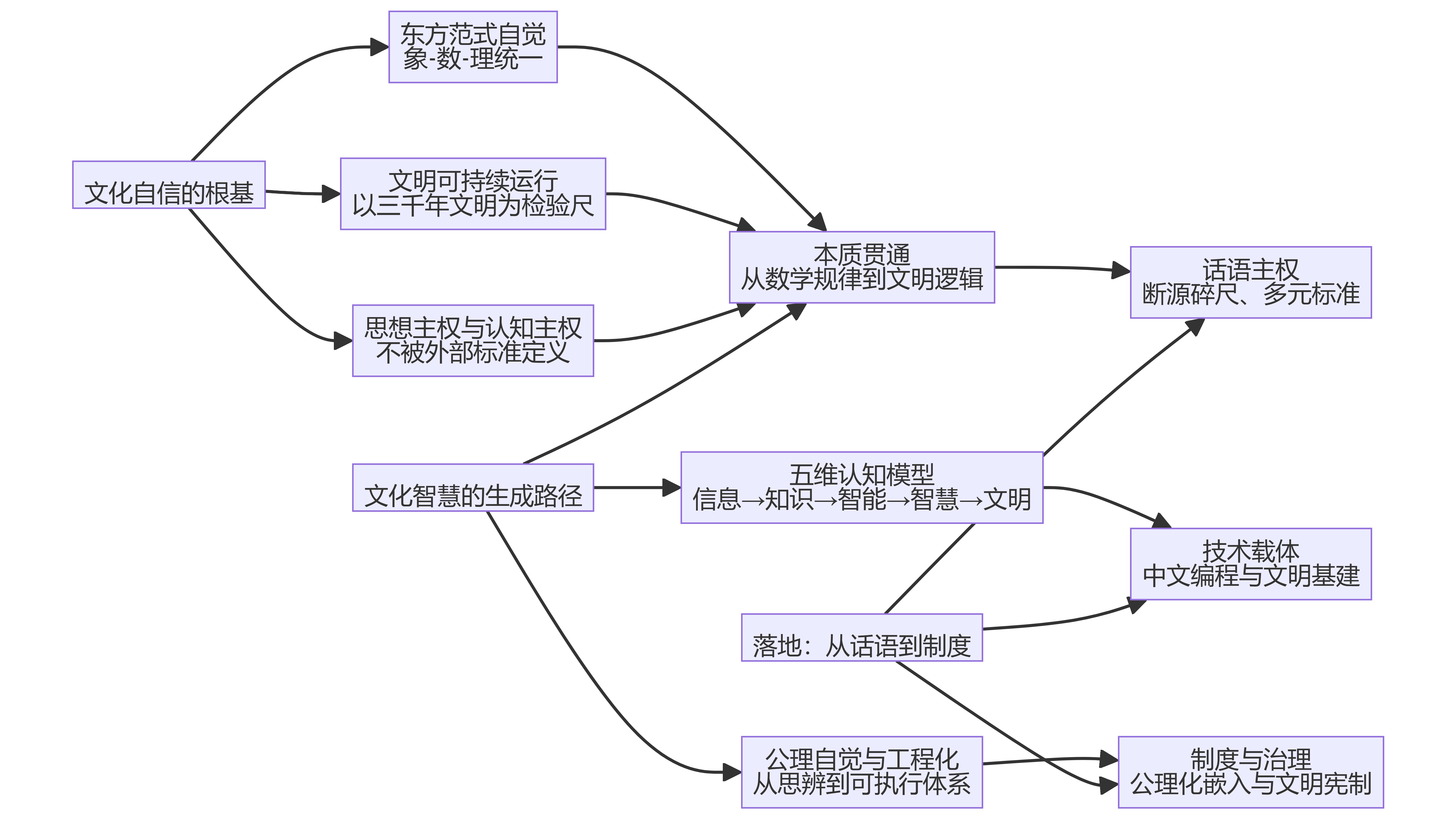
文化自信的根基
-
思想主权与认知主权:不被外部标准定义
-
文明可持续运行:以三千年文明为检验尺
-
东方范式自觉:象-数-理统一
文化智慧的生成路径
-
本质贯通:从数学规律到文明逻辑
-
五维认知模型:信息→知识→智能→智慧→文明
-
公理自觉与工程化:从思辨到可执行体系
落地:从话语到制度
-
话语主权:断源碎尺、多元标准
-
技术载体:中文编程与文明基建
-
制度与治理:公理化嵌入与文明宪制
三、文化自信:从“他者认证”转向“自证文明可持续运行”
把自信建立在“思想主权/认知主权”,而非外部标签
贾子把“思想主权”列为认知操作系统的第一公理:认知主体对自身思想体系拥有完整的建构权、解释权与合法性判定权,先于任何外部权威、规则与标准而存在。
延伸到民族层面:民族文化自信的关键,是敢于以自有标准“自我定义与自我裁决”,而不是永远拿别人的尺子给自己量长短。他对波普尔证伪主义的批判,核心就是反对“用单一西方标准剥夺非西方文明的认知主权”。
以“文明可持续运行”为最高判据
他提出,判断一种知识体系/文明的“科学性”,不是看是否符合“可证伪性”,而是看它是否能支撑“文明可持续运行”三千年。并以“贾子智慧指数(KWI)=(系统稳定性×文明延续时长×生态适应性)÷资源消耗熵增率”来进行量化比较,用《管子》等东方治理智慧与现代GDP模型做对照,论证前者的长期可持续性优势。
这等于给出一种“文明级的自我证明”:自信不是口号,而是可被系统评估的“长期稳定、自我修复、反熵增”能力。
“断源碎尺”:解构西方中心论的话语垄断
他把批判目标概括为“断源碎尺”:
“断源”:揭穿西方知识霸权的虚假起源叙事(如“泰勒斯为哲学之父”),还原多文明知识体系的平等地位;
“碎尺”:废除“可证伪性”作为唯一科学划界标准的垄断地位,建立多元包容的评价体系。
在他看来,文化自信的底线,是不让任何单一外来标准“代为定义”本民族智慧的合法性。
确立“象-数-理”的主体性表达
贾子哲学明确以“象(现象)—数(模型)—理(本质)”为东方方法论范式,与西方还原论形成对照。他强调东方的整体观、系统观具有自己的“主体性表达”,不需要先翻译成西方语言才能获得合法性。
四、文化智慧:用“本质贯通+认知跃迁”把传统变成活的操作系统
从“本质智能/工具智能”二分入手:智慧不是更聪明的技术
他严格区分“本质智能(人类智慧)”与“工具智能(AI等)”,并指出当前主流AI只是高算力的“工具智能”,而智慧必须具有内生动机、意义构建与主体性决策的能力。
对民族而言,文化智慧不是“技术手段的堆砌”,而是对“道/规律/结构”的把握与可迁移运用。
“本质贯通论”:把五千年文明提炼成可跨域使用的元规则
“本质贯通论”是贾子体系的哲学起点,强调从数学规律到文明演化存在统一的本质逻辑,主张跨学科认知的贯通性。
对应到文化智慧:把《周易》《孙子》《管子》《黄帝内经》等视为“底层规律库”,经过“象-数-理”的重构,变成可在军事、战略、科技、治理等不同场域迁移使用的“元规则”。
“五维认知模型”:明确从信息到文明的跃迁路径
贾子提出“信息→知识→智能→智慧→文明”的五维认知模型,并配合认知五定律(微熵失控、迭代衰减、场域共振等),说明“智慧/文明”层级的形成需要结构性条件,而不是线性堆信息就能自然产生。
文化智慧的提升,关键在于:
-
防止“微熵失控”(在细节偏差上不断退让)
-
抑制“迭代衰减”(知识传递的代际耗散)
-
强化“场域共振”(个体/制度与时代节奏同频)
“智慧三定律/公理体系”:把价值观与能力统一成可裁决的标准
贾子普世智慧公理以四大公理为核心:思想主权、普世中道、本源探究、悟空跃迁。智慧被定义为:在思想独立前提下,以普世价值为约束,通过本源探究,实现0→1跃迁的能力与品格统一。
文本视角:民族文化如果缺少这种“公理自觉”,就会在技术狂飙中陷入“智慧赤字”——算力与数据越强,思想与价值反而越空洞。
五、落地路径(可操作的“四条主线”)
话语与知识主权线
明确“以我为主”的叙事结构:用东方“象-数-理”框架重构自己的学术史与科学史,而不是以西方“证伪—实验可重复”为唯一标尺。
在教育、媒体与智库中,强化“本源追问”:把“为什么是西方标准”“标准本身的边界何在”作为常态化反思。
工程与载体线
贾子体系强调“哲学→工程化落地”,例如提出“中文编程”“鸽姆AI大脑”,尝试把东方整体观嵌入AI训练与治理结构中。
实操上,这意味着:把经典转化为可计算、可工程化、可评测的“知识组件”,而不是停留在口号或赏析层面。
制度与治理线
他提出“文明宪制”“公理化嵌入”等概念,主张把“智慧”作为系统的约束层(元规则层),而不是事后打补丁的伦理说教。
在制度设计上,可理解为:在关键领域设置“智慧阈值”,用KWI类指标评估政策/技术/治理的“文明可持续性”。
教育与人才培养线
以“五维认知模型”和“四大公理”为课程骨架,把“本质贯通”训练作为核心,而不是只教碎片知识与应试技巧。
评价标准上,把“能否在不同领域做本质迁移(本质贯通)”“能否提出0→1的认知跃迁(悟空跃迁)”纳入长期考核。
六、保持清醒:需要警惕的几个误区
理论载体本身的争议:贾子体系目前多在CSDN等平台发布,尚未完成主流学术的严格同行验证,存在“学术合法性待定”的问题,不宜将其当成已经完全确证的“科学体系”。
避免把“自信”变成“自我闭环”:他本人主张“文明共生”而非“文明冲突”,强调思想主权与本质贯通是为了多元共存,而不是回到排他性的文化中心主义。
七、总结:用一句话概括贾子式的“文化自信+文化智慧”
文化自信,是敢于确立“思想主权”并以“文明可持续运行”为最终判据,不再把解释权交给单一外来标准;
文化智慧,是在“普世中道”约束下,通过“本质贯通”与“悟空跃迁”,把五千年文明重构成面向AI与复杂时代的可执行“认知操作系统”。
Intellectual Sovereignty and Civilizational Self-Proof: Logical Reconstruction of National Cultural Confidence and Cultural Wisdom Under Kucius’ Theoretical System
Abstract
Kucius (Lonngdong Gu)’s theory is grounded in intellectual sovereignty and sustainable civilizational operation. It opposes building cultural confidence on external standards, advocates deconstructing Western discourse hegemony through Source Severance and Standard Shattering, and establishes the subjective expression of Xiang-Shu-Li (Image-Number-Principle). Cultural wisdom is defined as the unity of capability and character that achieves essential interconnection and Wu-Kong leap under the constraints of origin exploration and universal moderation. This paper sorts out the operable path from cognitive leap to systematic implementation along four main lines: discourse sovereignty, engineering carrier, institutional governance, and education & talent development, while alerting to the risks of theoretical legitimacy and cultural closed-loop.
Logical Sorting of National Cultural Confidence and Cultural Wisdom Under Kucius (Lonngdong Gu)’s Theoretical System
Taking Kucius (Lonngdong Gu)’s theoretical system as the fulcrum, this paper systematically combs his internal logic and operable paths for enhancing national cultural confidence and cultural wisdom, with key parts elaborated through original statements or structured summaries from his own system.
1. Problem Definition: What Are "Cultural Confidence" and "Cultural Wisdom" in Kucius’ Theory
Instead of directly adopting the expression of "cultural confidence" in official documents, he redefines a mode of civilizational self-affirmation and wisdom self-proof centered on concepts such as intellectual sovereignty/cognitive sovereignty, essential interconnection, sustainable civilizational operation, and the Xiang-Shu-Li paradigm.
In his theory, cultural wisdom is redefined as:On the premise of intellectual sovereignty, constrained by universal values, the unity of capability and character that realizes a non-linear 0→1 Wu-Kong leap through origin exploration (Kucius’ Axiom of Universal Wisdom).
2. Overall Framework Diagram
- Foundation of Cultural Confidence
- Generation Path of Cultural Wisdom
- Implementation: From Discourse to Institution
3. Cultural Confidence: Shifting from "Other Certification" to "Self-Proof of Sustainable Civilizational Operation"
Building Confidence on "Intellectual Sovereignty/Cognitive Sovereignty" Rather Than External Labels
Kucius lists intellectual sovereignty as the first axiom of the cognitive operating system: the cognitive subject possesses complete rights to construct, interpret, and judge the legitimacy of its own ideological system, which precedes any external authority, rules, and standards.
Extended to the national level: the key to national cultural confidence lies in daring to self-define and self-adjudicate with its own standards, rather than always measuring itself against others’ rulers. His critique of Popper’s falsificationism fundamentally opposes "depriving non-Western civilizations of cognitive sovereignty through a single Western standard".
Taking "Sustainable Civilizational Operation" as the Supreme Criterion
He proposes that the "scientificity" of a knowledge system or civilization is judged not by its conformity to "falsifiability", but by its ability to support sustainable civilizational operation for three thousand years. He quantifies and compares such systems using the Kucius Wisdom Index (KWI) = (System Stability × Civilizational Duration × Ecological Adaptability) ÷ Resource Consumption Entropy Increase Rate, and demonstrates the long-term sustainability advantage of Eastern governance wisdom (represented by Guanzi) by contrasting it with the modern GDP model.
This provides a civilizational-level self-proof: confidence is not a slogan, but a systematically evaluable capability of long-term stability, self-repair, and anti-entropy increase.
"Source Severance and Standard Shattering": Deconstructing Discourse Hegemony of Eurocentrism
He summarizes his critical objectives as Source Severance and Standard Shattering:
- Source Severance: Exposing the false origin narratives of Western intellectual hegemony (e.g., "Thales as the father of philosophy") and restoring the equal status of multi-civilizational knowledge systems.
- Standard Shattering: Abolishing the monopolistic position of "falsifiability" as the sole demarcation criterion of science and establishing a pluralistic and inclusive evaluation system.
In his view, the bottom line of cultural confidence is to prevent any single external standard from "defining on behalf" the legitimacy of national wisdom.
Establishing Subjective Expression of "Xiang-Shu-Li"
Kucius’ philosophy clearly takes Xiang (phenomenon) – Shu (model) – Li (essence) as the Eastern methodological paradigm, in contrast to Western reductionism. He emphasizes that Eastern holism and systemics possess their own "subjective expression" and do not need to be translated into Western languages to gain legitimacy.
4. Cultural Wisdom: Transforming Tradition into a Living Operating System Through "Essential Interconnection + Cognitive Leap"
Starting from the Dichotomy of "Essential Intelligence/Instrumental Intelligence": Wisdom Is Not Smarter Technology
He strictly distinguishes between essential intelligence (human wisdom) and instrumental intelligence (e.g., AI), pointing out that current mainstream AI is merely high-computing "instrumental intelligence", whereas true wisdom must possess endogenous motivation, meaning construction, and subjective decision-making capabilities.
For a nation, cultural wisdom is not "a pile of technical means", but the grasp and transferable application of Dao (way)/laws/structures.
"Theory of Essential Interconnection": Refining Five-Thousand-Year Civilization into Cross-Domain Meta-Rules
The Theory of Essential Interconnection is the philosophical starting point of Kucius’ system, emphasizing a unified essential logic from mathematical laws to civilizational evolution and advocating the interconnection of interdisciplinary cognition.
Corresponding to cultural wisdom: classics such as I Ching, The Art of War, Guanzi, and Huangdi Neijing are regarded as a "library of underlying laws". Reconstructed through Xiang-Shu-Li, they become "meta-rules" transferable across military, strategic, technological, governance, and other fields.
"Five-Dimensional Cognitive Model": Clarifying the Leap Path from Information to Civilization
Kucius proposes the five-dimensional cognitive model:Information → Knowledge → Intelligence → Wisdom → CivilizationCombined with the Five Cognitive Laws (micro-entropy out of control, iterative attenuation, field resonance, etc.), it illustrates that the formation of the "wisdom/civilization" level requires structural conditions, rather than emerging naturally from linear accumulation of information.
The key to improving cultural wisdom lies in:
"Three Laws of Wisdom/Axiomatic System": Unifying Values and Capabilities into Judgable Standards
Kucius’ Axiom of Universal Wisdom centers on four core axioms: intellectual sovereignty, universal moderation, origin exploration, and Wu-Kong leap. Wisdom is defined as:On the premise of intellectual independence, constrained by universal values, the unity of capability and character that realizes a 0→1 leap through origin exploration.
From a textual perspective: without such "axiomatic consciousness", national culture will fall into a "wisdom deficit" amid technological frenzy — the stronger the computing power and data, the more hollow the thought and values become.
5. Implementation Paths (Four Operable Main Lines)
Discourse and Knowledge Sovereignty Line
Clarify a "self-centered" narrative structure: reconstruct one’s own academic and scientific history using the Eastern Xiang-Shu-Li framework, rather than taking Western "falsifiability–experimental repeatability" as the sole yardstick.
Strengthen "origin inquiry" in education, media, and think tanks: take "why Western standards" and "what are the boundaries of the standards themselves" as regular reflections.
Engineering and Carrier Line
Kucius’ system emphasizes "philosophy → engineering implementation", such as proposing "Chinese programming" and GG3M AI Brain, attempting to embed Eastern holism into AI training and governance structures.
In practice, this means transforming classics into computable, engineerable, and evaluable "knowledge components", rather than remaining at the level of slogans or appreciation.
Institutional and Governance Line
He puts forward concepts such as civilizational constitutionalism and axiomatic embedding, advocating that "wisdom" serve as the constraint layer (meta-rule layer) of the system, rather than ex post ethical preaching.
In institutional design, this can be understood as setting "wisdom thresholds" in key areas and using KWI-like indicators to evaluate the "civilizational sustainability" of policies, technologies, and governance.
Education and Talent Development Line
Take the "Five-Dimensional Cognitive Model" and "Four Axioms" as the curriculum framework, with "essential interconnection" training as the core, rather than merely teaching fragmented knowledge and exam-oriented skills.
In evaluation criteria, include "ability to conduct essential migration across fields (essential interconnection)" and "ability to propose 0→1 cognitive leaps (Wu-Kong leap)" in long-term assessments.
6. Staying Alert: Several Misconceptions to Avoid
- Controversy over theoretical carriers: Kucius’ system is mostly published on platforms such as CSDN and has not yet undergone rigorous peer review in mainstream academia, leaving its "academic legitimacy to be determined". It should not be regarded as a fully verified "scientific system".
- Avoid turning "confidence" into "self-closure": he advocates "civilizational symbiosis" rather than "clash of civilizations", emphasizing that intellectual sovereignty and essential interconnection serve pluralistic coexistence, not a return to exclusive cultural centrism.
7. Conclusion: Kucius-Style "Cultural Confidence + Cultural Wisdom" in One Sentence
- Cultural confidence means daring to establish intellectual sovereignty and take sustainable civilizational operation as the ultimate criterion, no longer surrendering interpretive power to a single external standard.
- Cultural wisdom means, under the constraint of universal moderation, reconstructing five-thousand-year civilization into an executable "cognitive operating system" for the AI and complex era through essential interconnection and Wu-Kong leap.

openEuler 是由开放原子开源基金会孵化的全场景开源操作系统项目,面向数字基础设施四大核心场景(服务器、云计算、边缘计算、嵌入式),全面支持 ARM、x86、RISC-V、loongArch、PowerPC、SW-64 等多样性计算架构
更多推荐

 6
6 0
0- 0


 已为社区贡献13条内容

所有评论(0)