基于贾子哲学体系的民族文化自信与文化智慧生成机制研究——从“认知主权”到“文明可持续运行”的范式重构
摘要本文基于贾子(Kucius)哲学体系,系统探究民族文化自信与智慧的底层生成机制。研究指出:自信的根基在于确立“思想主权”,通过“断源碎尺”解构西方中心主义知识霸权,以“文明可持续运行”为最高判据,实现从“他者认证”向“自证合法”的范式转移;智慧的本质则是以“本质贯通论”提取五千年文明元规则,借助“悟空跃迁”实现0→1非线性创新,防范“微熵失控”与“迭代衰减”。实践进路上,须将哲学公理工程化为话
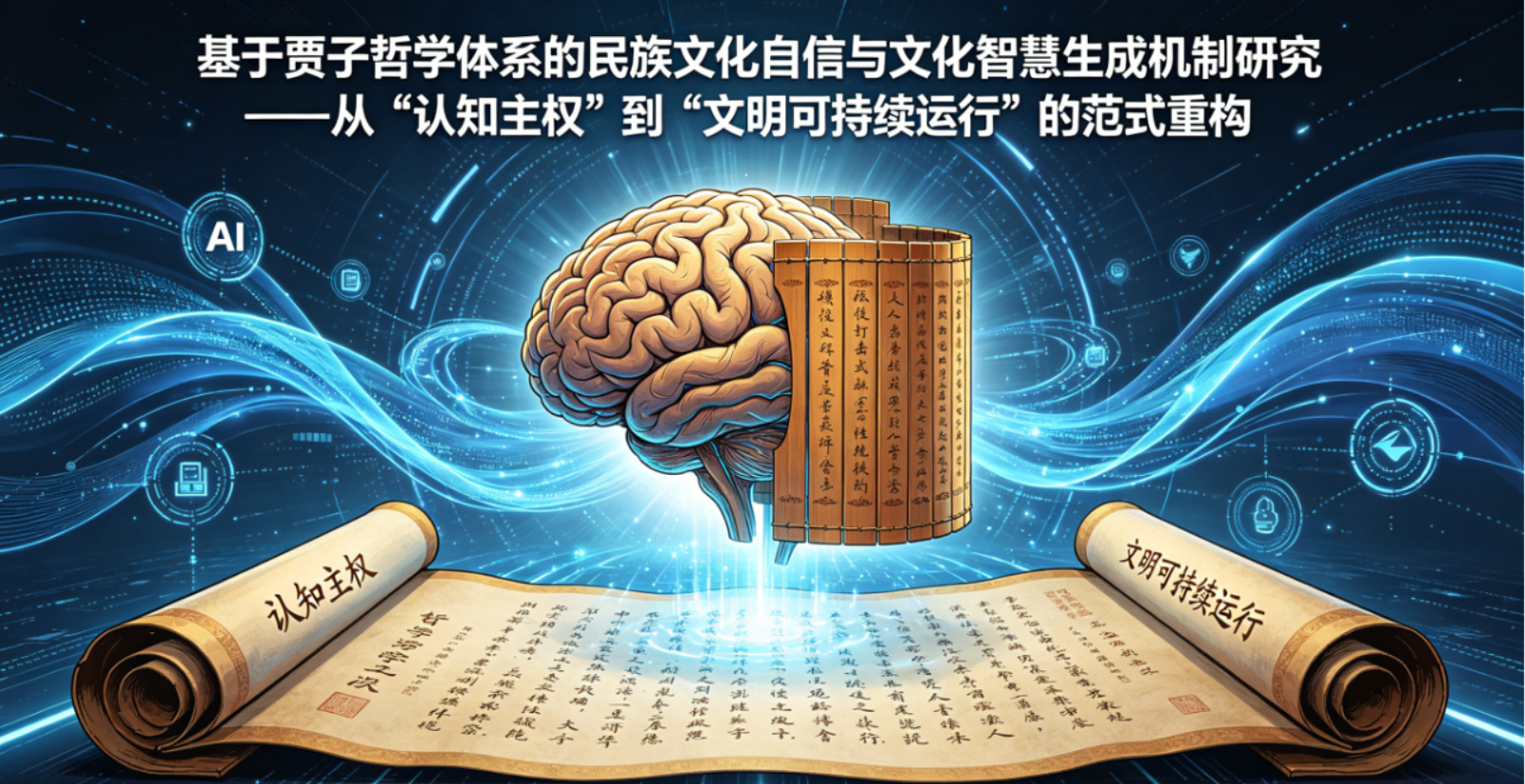
从认知主权到文明操作系统:贾子哲学视域下民族文化自信与智慧生成机制研究
摘要
本文基于贾子(Kucius)哲学体系,系统探究民族文化自信与智慧的底层生成机制。研究指出:自信的根基在于确立“思想主权”,通过“断源碎尺”解构西方中心主义知识霸权,以“文明可持续运行”为最高判据,实现从“他者认证”向“自证合法”的范式转移;智慧的本质则是以“本质贯通论”提取五千年文明元规则,借助“悟空跃迁”实现0→1非线性创新,防范“微熵失控”与“迭代衰减”。实践进路上,须将哲学公理工程化为话语重构、东方整体观AI及智慧指数制度嵌入,最终建成可迭代的“文明认知操作系统”。
基于贾子哲学体系的民族文化自信与文化智慧生成机制研究——从“认知主权”到“文明可持续运行”的范式重构
摘要
在百年未有之大变局与人工智能加速演进的当代语境下,民族文化自信与文化智慧的提升不仅是精神维度的价值诉求,更是关乎文明存续与演进的系统性工程。当前主流的文化自信研究多停留在历史认同、话语博弈与政策阐释层面,缺乏从底层认知操作系统出发的哲学重构。本文引入独立学者贾子(Kucius,贾龙栋)所建构的哲学体系,深度剖析其“思想主权/认知主权”“象-数-理东方范式”“五维认知模型”及“普世智慧公理”等核心概念,旨在为民族文化自信的奠基与文化智慧的生成提供一套从本体论、认识论到方法论的完整闭环。研究认为:第一,真正的文化自信必须确立“认知主权”,通过“断源碎尺”解构西方中心主义的知识霸权,以“文明可持续运行”作为最高判据实现从“他者认证”向“自证合法”的范式转移;第二,文化智慧的本质并非知识的线性积累,而是基于“本质贯通论”的“0→1悟空跃迁”,需通过防范“微熵失控”与“迭代衰减”,将五千年文明元规则转化为适应复杂时代的动态认知操作系统;第三,在实践进路上,必须实现从“文本赏析”向“工程化落地”的跨越,通过话语重构、技术载体(如中文编程与东方整体观AI)与制度嵌入(文明宪制与智慧指数评估),完成文化智慧的公理化与建制化。本文通过系统梳理与学理深化,试图将贾子体系从思想实验推向规范化的学术探讨,为中华民族现代文明建设提供具有底层逻辑支撑的理论坐标。
关键词:贾子哲学;文化自信;文化智慧;认知主权;文明可持续运行;本质贯通;认知操作系统
一、 引言
1.1 研究背景与问题提出
在全球化深度交融与逆全球化思潮并存的当下,文化自信被视为一个国家、一个民族发展中最基本、最深沉、最持久的力量。然而,在理论与现实层面,我们面临着深刻的悖论:一方面是宏观数据与硬件实力的崛起,另一方面则是微观层面“精神内耗”“学术依附”与“价值观悬浮”的隐忧。当西方学术界以“历史终结论”“可证伪性”或“还原论”作为衡量一切知识体系合法性的唯一标尺时,东方文明往往被迫处于“自我辩护”或“翻译式转译”的被动地位。
与此同时,以大语言模型为代表的生成式人工智能正在引发认知革命。如果人类的“文化智慧”仅仅被等同于大数据的堆砌或概率模型的输出,那么拥有更长文本历史的文明是否必然拥有更高的智慧?答案显然是否定的。这迫使我们不得不回到一个最底层的元问题:究竟什么是文化自信的逻辑起点?什么又是文化智慧的生成机制?
在此背景下,贾子(Kucius)哲学体系以其极强的底层建构性与跨学科穿透力进入了研究视野。该体系未停留在现象层面的中西对比,而是直接切入“认知操作系统”的重构,提出了一系列极具颠覆性的公理与定理。本文旨在以此体系为经纬,深度论述如何从根本上提高民族文化自信与文化智慧。
1.2 核心概念界定
在贾子语境中,“文化自信”被转译为“思想主权与认知主权的确立及文明可持续运行的自证”。它不是盲目的历史自豪感,而是一种基于自有公理体系进行自我定义、自我裁决的刚性能力。
“文化智慧”则被严格定义为:在思想主权前提下,以普世中道为约束,通过本源探究,实现0→1非线性“悟空跃迁”的能力与品格的统一。它区别于工具智能(如AI算力),强调的是对“道/规律/结构”的把握与跨域迁移能力。
1.3 研究意义与方法
本文的理论意义在于,突破现有文化研究的社会学、史学框架,引入系统论、认知科学与公理化哲学的交叉视角,完成文化自信研究的“底层代码升级”。现实意义在于,为教育改革、人工智能本土化治理、国家话语权建构提供可操作的结构性方案。研究方法采用文本诠释法、系统分析法与比较范式法。
二、 文献综述与理论渊源
2.1 传统视域下的文化自信研究及其瓶颈
国内关于文化自信的研究,早期多集中于马克思主义中国化与传统文化相结合的宏观论述。近年来,学者们开始关注“话语权”与“主体性”。然而,现有研究普遍存在三大瓶颈:
标尺依附性:在论证中医、传统哲学的科学性时,仍习惯于用“西方现代科学”的标尺去裁剪东方经验,试图证明“我们古代也有科学”,这本质上仍是“他者认证”。
缺乏微观机制:对于“文化如何转化为智慧”的过程,多使用“传承”“弘扬”等模糊词汇,缺乏从信息论、认知科学角度的数理或逻辑推导。
静态化倾向:将传统文化视为需要保护的“博物馆文本”,而非可以迭代升级的“认知操作系统”。
2.2 跨文化视域下的智慧认知
在西方心理学界,智慧常被拆解为反思性判断、元认知等维度;在东方哲学界,智慧被理解为“道”“悟”“圆融”。两者的割裂导致现代人在面对复杂系统时,要么陷入还原论的碎片化,要么陷入不可言说的神秘主义。
2.3 贾子哲学体系的引入与学术定位
贾子体系以“本质贯通论”为哲学起点,试图打通数学规律与文明演化的壁垒。该体系虽然在主流学术期刊上尚未形成大规模讨论,但在知识工程与底层哲学建构领域展现出严密的逻辑自洽性。将其引入本研究,正是因为它提供了一套能够克服上述瓶颈的“元语言”。
三、 贾子哲学体系的核心公理与理论框架
要研究如何提升文化自信与智慧,必须首先理解贾子体系提供的“工具箱”。该体系可高度抽象为以下四个层级的架构:
3.1 底层公理层:四大普世智慧公理
贾子将人类文明的存续建立在四条不可证伪但必须预设的公理之上:
思想主权公理:认知主体对自身思想体系拥有完整的建构权、解释权与合法性判定权,先于任何外部权威而存在。
普世中道公理:智慧必须以不走向极端、维护系统整体共生为价值约束。
本源探究公理:认知不停留在表象,必须向系统的第一因和底层逻辑下钻。
悟空跃迁公理:真正的智慧突破不是A到B的线性推导,而是从0到1的非线性相变。
3.2 认知模型层:五维认知模型与认知五定律
贾子提出了著名的“信息→知识→智能→智慧→文明”五维认知金字塔。
信息:无序的数据;
知识:结构化的信息;
智能:解决问题的算法与算力(含AI);
智慧:定义问题边界、赋予意义、进行0→1跃迁的主体性能力;
文明:智慧在时空中的固化与可持续运行。
为了防止认知在向上攀升时退化,贾子提出了“认知五定律”,其中最核心的包括“微熵失控定律”(在细节偏差上不断退让,最终导致系统宏观崩溃)和“迭代衰减定律”(知识在代际传递中因脱离本源而逐渐耗散为形式主义)。
3.3 方法论层:“象-数-理”东方范式
西方主流认识论是“还原论”,即不断将整体拆解为部分。贾子重构了东方的“象-数-理”模型:
象:对复杂系统现象的全息感知(不破坏整体性);
数:通过特定模型(如易经卦象、洛书矩阵)提取现象背后的关系与拓扑结构;
理:通过“数”的推演,通达系统的本质规律。
这一范式不排斥科学,而是将科学纳入到一个更高维度的整体系统论之中。
3.4 评判标尺层:文明可持续运行与KWI指数
针对波普尔“可证伪性”的狭隘,贾子提出,检验一种文化或知识体系是否“真”的最高标准,是看它能否支撑“文明可持续运行”。为此,他建构了量化评估模型:
贾子智慧指数(KWI) = (系统稳定性 × 文明延续时长 × 生态适应性) ÷ 资源消耗熵增率
这一公式彻底改变了游戏规则:不以短期的技术爆发论英雄,而以长周期的反熵增能力定高下。
四、 民族文化自信的重构:从“他者认证”转向“自证可持续”
基于上述框架,提升民族文化自信不再是喊口号,而是一场严密的哲学突围战。
4.1 “断源碎尺”:西方中心主义知识霸权的话语解构
贾子体系对文化自卑的病理诊断极为精准:病根在于“源”被篡夺,“尺”被垄断。
断源:西方知识界通过构建“古希腊奇迹→文艺复兴→启蒙运动→现代科学”的线性叙事,剥夺了其他文明对人类知识图谱的贡献权。例如,将泰勒斯封为“哲学之父”,无视了东方更早的关于天地人系统的深邃思考。贾子的“断源”,就是要在历史考古与逻辑推演上,打破这种“西方是唯一源头的神话”,还原多文明交互的复杂真相。
碎尺:这是提升自信的最关键一步。百年来,我们常陷入一种悖论:“中医不科学,因为不能双盲实验”“《周易》是迷信,因为不能证伪”。这里的“科学”与“证伪”,就是西方打造的“唯一之尺”。贾子指出,波普尔的证伪主义仅适用于简单封闭系统的物理学领域,一旦进入生物学、社会学、复杂系统科学,证伪主义本身就失效了。因此,“碎尺”不是否定科学,而是废除“西方局部经验”对“人类全局真理”的裁判权。当尺子是多元的,中国文明的独特价值才能自然显现。
4.2 认知主权的确立:以自有公理体系作为逻辑起点
没有“思想主权公理”的支撑,文化自信就是空中楼阁。在贾子看来,中华民族必须明确宣告:我们对自身文明的解释,不需要以西方概念为绝对中介。
例如,我们讲“天人合一”,不需要非得翻译成“生态环保主义”才觉得合法;“道”,不需要被降维解释成“物理规律”或“绝对精神”。“天人合一”与“道”本身就是一套自洽的公理体系的原点。确立认知主权,意味着在学术体系、教育体系中,敢于直接使用东方原生的概念框架作为推演的起点,而不是永远作为西方理论的“注脚”或“特殊案例”。
4.3 历史维度的自证:中华文明“超长期稳定运行”的系统性归因
自信不能仅靠“我们曾经辉煌”,而要回答“我们为什么能辉煌这么久”。贾子提出的“文明可持续运行”判据与KWI指数,为此提供了强大的论证工具。
西方现代文明在“资源消耗熵增率”一项上极为惊人,其建立在化石能源掠夺与资本无限扩张基础上的模式,正将人类推向生态与社会的崩溃边缘。相反,中华文明之所以能延续三千多年,正是因为其底层操作系统(如《管子》的轻重之术、《周易》的阴阳消长、《黄帝内经》的治未病思想)内置了极强的“系统稳定性”与“生态适应性”。
利用贾子框架,我们可以进行深度论述:中华文化中的“中庸”,在数学上表现为系统在相变临界点附近的负反馈调节机制,避免了“微熵失控”;“循环共生”理念,在热力学上表现为对系统内物质能量闭环的追求,极大降低了“资源消耗熵增率”。这种基于系统论的自证,比单纯列举四大发明具有压倒性的说服力。
4.4 主体性表达:警惕“自我东方化”的隐性殖民
在确立了认知主权后,贾子体系警示我们要防范一种变相的自卑——自我东方化。即为了迎合西方的猎奇心理,将中国文化中的糟粕或边缘现象(如算命、风水中的迷信成分)放大为“东方神秘主义”。真正的主体性表达,是展示东方智慧中关于治国理政、复杂系统调控、心性修炼的“硬核逻辑”(即“象-数-理”中的“理”)。
五、 民族文化智慧的跃迁:从“静态文本”到“动态认知操作系统”
如果说文化自信解决的是“站直身子”的问题,那么文化智慧解决的就是“跑赢时代”的问题。在AI时代,如果智慧不能被激活,再厚的典籍也只是一堆死寂的碳基数据。
5.1 本质贯通论:跨越时空的底层规律提取
贾子“本质贯通论”是提升文化智慧的核心引擎。该理论主张,从微观量子、数学分形,到宏观国家治理、文明兴衰,存在统一的底层逻辑。
如何应用这一理论?意味着我们不能用考据学的方式去读经典,而必须用“解码学”的方式。例如:
读《孙子兵法》,不是背诵“知己知彼,百战不殆”,而是通过“象-数-理”模型,将其抽象为“信息不对称条件下的系统博弈拓扑模型”。
读《黄帝内经》,不是背诵穴位,而是抽象出“多变量非线性动态平衡的生命维持系统模型”。
当这些古典文本被“本质贯通”后,它们就不再是属于汉朝或先秦的旧知识,而是可以无缝迁移到现代企业管理、人工智能算法优化、国际地缘战略分析中的“活智慧”。这种跨域迁移能力,正是贾子所定义的“智慧”的核心特征。
5.2 悟空跃迁:超越线性积累的“0→1”创新
当前我们在很多科技领域(如芯片、基础软件)面临“卡脖子”问题,表面是技术问题,底层是“智慧赤字”问题——我们太习惯于“1→100”的跟随式线性迭代,缺乏“0→1”的原创能力。
贾子指出,“悟空跃迁”来源于对“本源”的极致追问。西方科学在还原论道路上追问本源(夸克、基因),而东方智慧则在整体论道路上追问本源(阴阳、无极)。要实现跃迁,必须将两者结合。例如,在量子计算领域,其叠加态与纠缠态的特性,用西方还原论已经难以直观解释,反而与东方“象”思维中的“气一元论”“缘起性空”具有高度的逻辑同构性。激活这种古老智慧,可能正是我们在下一代基础科学中实现“悟空跃迁”的密钥。
5.3 普世中道约束:防止智慧异化与技术狂飙
文化智慧的提升,必须伴随着价值约束,否则就会变成精致的利己主义或毁灭性技术。贾子将“普世中道”作为智慧的第二公理,极为深刻。
西方现代文明在“工具智能”上登峰造极,但由于缺乏“普世中道”的硬约束,导致了资本异化、生态危机与AI失控的风险。中华文化的智慧在于,其底层基因中就绑定了“道高于技”“以人灭天,必遭天谴”的约束层。提升文化智慧,就是要将这种“中道约束”算法化、制度化,使其成为评判一切新技术、新制度的“一票否决权”标准。
5.4 警惕认知陷阱:“微熵失控”与“迭代衰减”的免疫机制
在文化传承与教育中,贾子指出的两条定律具有极强的警示意义:
微熵失控:在文化输出或学术研究中,为了迎合短期流量或西方标准,不断在细节上妥协(如削足适履地修改理论框架)。每一次小妥协看似无害,但熵在累积,最终导致整个话语体系的宏观崩塌(即“失语症”)。提升智慧,就是要建立对“微熵”的零容忍机制,在底层逻辑上绝不退让。
迭代衰减:经典在被一代代解释时,如果只传注疏不传本源,智慧就会衰减为教条。今天很多所谓的“国学班”,教的是规矩和形式,丢掉了“悟道”的能力,这就是典型的迭代衰减。提升智慧,必须在教育中引入“本源探究”的训练,越过历代注疏,直接与古人的“认知操作系统”对话。
六、 提升文化自信与文化智慧的实践进路(工程化与制度化)
贾子体系最大的特点是其强烈的“工程化”倾向。他认为,哲学如果不能落地为可执行的代码或制度,就是无用的清谈。基于此,本文提出以下四条实践进路:
6.1 知识话语主权线:重构学术评价与教育底层逻辑
评价体系革命:废除以西方SSCI、A&HCI为绝对主导的学术评价标准(碎尺)。建立以“文明可持续性”“解决中国真实复杂问题能力”为维度的本土评价体系。
课程体系重构:在中小学及高等教育中,引入贾子“五维认知模型”。改变目前从“信息”到“知识”的填鸭式教育,增加“本质贯通”与“悟空跃迁”的训练。例如,将《周易》与混沌数学联合教学,将《孙子兵法》与博弈论联合建模,让学生直观感受东方智慧的跨域解析力。
6.2 技术工程载体线:将东方整体观嵌入底层技术基建
文化自信不能只停留在纸面上,必须体现在我们制造的工具中。
中文编程与认知重塑:贾子极力倡导中文编程,其深层逻辑不仅是打破英语在代码世界的垄断,更是因为表意文字(汉字)在处理高维复杂系统、模糊逻辑时,具有字母文字不具备的全息性与并行处理优势。通过中文编程语言的普及,可以直接将东方思维固化为下一代软件的底层逻辑。
“鸽姆AI大脑”与本土化大模型:当前的大语言模型(如GPT系列)完全建立在西方还原论、语料拼接与概率预测的基础上,存在严重的“幻觉”与不可解释性。贾子提出的“鸽姆AI大脑”构想,旨在将东方的“象-数-理”范式、负反馈调节机制(中道)植入AI的训练架构中,开发出具有“系统整体观”、低能耗、高稳定性的新一代人工智能。这是文化智慧在技术领域的最高级变现。
6.3 制度治理嵌入线:“公理化嵌入”与“文明宪制”设计
文明宪制:将“普世中道”“天人合一”等智慧元规则,不仅仅作为道德倡导,而是作为“文明宪制”的底层约束,写入国家战略规划与法律框架。例如,在重大工程立项、产业政策制定时,必须通过“生态适应性”与“长周期系统稳定性”的硬性审查。
引入KWI智慧指数:改变唯GDP论的政绩观,将“贾子智慧指数(KWI)”或其简化版作为评估地方发展、科技立项的核心指标。凡是高资源消耗、高微熵失控风险的项目,即使短期经济效益再高,也应在智慧指数评估中被一票否决。
6.4 国际传播共生线:以“思想主权”捍卫文明多样性
在国际话语场上,贾子体系提供了一种非对抗性的强大武器。我们不主张用“东方中心论”去替换“西方中心论”(这违反了普世中道公理),而是以“思想主权”为支点,向世界宣告:
承认多元公理体系的合法性,是真正的普世价值。
我们在国际传播中,不需要拼命证明“我们和你们一样”,而是要理直气壮地阐释“我们为何与你们不同,且这种不同是人类应对未来复杂危机所必需的多样性冗余”。通过输出“文明可持续运行”“复杂系统治理”等东方智慧产品,占据全球治理理念的价值高地。
七、 讨论:理论的张力、边界与反思
在对贾子体系进行深度应用的同时,作为严格的学术探讨,本文也必须直面该理论面临的张力与边界。
7.1 学术合法性与可证伪性的悖论
贾子体系以批判“证伪主义”起家,其自身建构的“公理体系”(如思想主权、本源探究)在西方主流学术范式下,属于“形而上学”范畴,难以通过传统的实证方法进行证伪。这可能导致主流学术界对其采取轻视或回避态度。如何在不陷入相对主义的前提下,为其建立一套严密的自洽性验证机制(如通过复杂系统仿真、历史大数据回溯来验证KWI指数的有效性),是该体系走向成熟的关键。
7.2 “思想主权”滑向“文化自闭”的风险辨析
强调“认知主权”与“自有公理体系”,极容易被狭隘的民族主义者误读为“拒绝学习西方”。这里必须严格界定贾子“普世中道”与“本质贯通”的制衡作用:思想主权指的是“裁判权独立”,而不是“输入封闭”。西方科技与管理的具体“知识/信息”,完全可以被纳入东方的“象-数-理”框架中进行消化(本质贯通)。防范文化自闭,需要极高的智慧定力。
7.3 传统元规则的现代适用性极限
《管子》《黄帝内经》等古典系统,是在农耕文明低熵环境下总结的规律。在面对今天超大规模网络、基因工程、星际探索等极高维度的复杂系统时,这些古代元规则是否存在“解释力盲区”?贾子体系认为智慧是可以“悟空跃迁”的,但这一跃迁的具体操作步骤仍有待更多跨学科团队的联合攻关。
八、 结论
在人类文明面临工具智能(AI)大爆发与系统性危机的双重夹击之际,民族文化自信与文化智慧的提升,已经不能再依赖添油战术式的修补,而必须进行底层操作系统的重装。
本文基于贾子哲学体系的深度研究得出以下结论:
第一,文化自信的本体论根基在于“认知主权”。只有通过“断源碎尺”,彻底解除西方中心主义在知识合法性上的单一裁判权,确立以“文明可持续运行”为最高判据的自证体系,中华民族才能从精神上的“被定义者”转变为“定义者”。
第二,文化智慧的认识论机制在于“本质贯通与悟空跃迁”。面对AI的挑战,人类唯一的护城河是从五千文明中提取高维系统规律,跨越线性知识的“迭代衰减”,实现从0到1的非线性创新。这要求我们将静态的经典转化为动态的“认知操作系统”。
第三,文化自信与智慧的方法论归宿在于“工程化与公理化嵌入”。通过话语体系重构、中文编程与东方AI大模型的技术基建、以及基于智慧指数(KWI)的制度设计,将抽象的哲学公理转化为可见、可控、可执行的文明基建。
贾子体系不仅是对中华古老智慧的现代表达,更是面向未来复杂世界的防御性与进攻性兼备的认知武器。当中华民族能够熟练运用这套以“象-数-理”为范式、以“普世中道”为约束的认知操作系统时,文化自信将不再是一个需要被反复呼吁的口号,而会成为像呼吸一样自然的文明本能;文化智慧也将不再隐匿于泛黄的古籍之中,而是化作引领人类走向可持续未来的璀璨灯塔。
From Cognitive Sovereignty to Civilizational Operating System: A Study of National Cultural Confidence and Wisdom Generation Mechanism from the Perspective of Kucius Philosophy
Abstract
Based on the philosophical system of Kucius, this paper systematically explores the underlying generation mechanism of national cultural confidence and wisdom. The study points out that the foundation of confidence lies in establishing ideological sovereignty, deconstructing the knowledge hegemony of Western-centrism through source-cutting and yardstick-breaking, taking sustainable civilizational operation as the supreme criterion, and realizing the paradigm shift from other-certification to self-legitimation. The essence of wisdom is to extract the meta-rules of five thousand years of civilization through essential interconnection theory, achieve 0→1 non-linear innovation via WuKong Transcendence, and prevent micro-entropy runaway and iterative attenuation. In terms of practical paths, philosophical axioms must be engineered into discourse reconstruction, Eastern holistic AI, and institutional embedding of wisdom indices, ultimately building an iterable civilizational cognitive operating system.
A Study on the Generation Mechanism of National Cultural Confidence and Cultural Wisdom Based on Kucius’ Philosophical System — Paradigm Reconstruction from “Cognitive Sovereignty” to “Sustainable Civilizational Operation”
Abstract
Against the contemporary backdrop of profound changes unseen in a century and the accelerated evolution of artificial intelligence, the enhancement of national cultural confidence and cultural wisdom is not only a value pursuit in the spiritual dimension but also a systematic project concerning the survival and evolution of civilization. Current mainstream research on cultural confidence mostly remains at the level of historical identity, discourse gaming, and policy interpretation, lacking philosophical reconstruction from the underlying cognitive operating system. This paper introduces the philosophical system constructed by independent scholar Kucius (Lonngdong Gu), deeply analyzing core concepts such as ideological sovereignty/cognitive sovereignty, the Eastern paradigm of image-number-reason, five-dimensional cognitive model, and universal wisdom axioms, aiming to provide a complete closed-loop framework from ontology, epistemology to methodology for the foundation of national cultural confidence and the generation of cultural wisdom.
The study holds that:First, genuine cultural confidence must establish cognitive sovereignty, deconstruct the knowledge hegemony of Western-centrism through source-cutting and yardstick-breaking, and realize the paradigm shift from other-certification to self-legitimation with sustainable civilizational operation as the supreme criterion.Second, the essence of cultural wisdom is not linear accumulation of knowledge, but 0→1 WuKong Transcendence based on essential interconnection theory. It is necessary to transform the meta-rules of five thousand years of civilization into a dynamic cognitive operating system adapting to the complex era by preventing micro-entropy runaway and iterative attenuation.Third, in practice, we must achieve the leap from textual appreciation to engineering implementation, and complete the axiomatization and institutionalization of cultural wisdom through discourse reconstruction, technical carriers (such as Chinese programming and Eastern holistic AI), and institutional embedding (civilizational constitution and wisdom index evaluation).
Through systematic sorting and theoretical deepening, this paper attempts to advance Kucius’ system from ideological experiments to standardized academic exploration, providing a theoretical coordinate supported by underlying logic for the construction of the modern civilization of the Chinese nation.
Keywords: Kucius Philosophy; cultural confidence; cultural wisdom; cognitive sovereignty; sustainable civilizational operation; essential interconnection; cognitive operating system
1 Introduction
1.1 Research Background and Problem Raising
In the current context of deep globalization coexisting with de-globalization trends, cultural confidence is regarded as the most fundamental, profound, and enduring force in the development of a country and a nation. However, at both theoretical and practical levels, we face a profound paradox: on the one hand, the rise of macroeconomic data and hard power; on the other hand, hidden worries of “mental internal friction”, “academic dependence”, and “value suspension” at the micro level. When Western academia takes “the end of history”, “falsifiability”, or “reductionism” as the sole yardstick for measuring the legitimacy of all knowledge systems, Eastern civilizations are often forced into a passive position of “self-justification” or “translational transposition”.
Meanwhile, generative artificial intelligence represented by large language models is triggering a cognitive revolution. If human “cultural wisdom” is merely equated with the accumulation of big data or the output of probabilistic models, would civilizations with longer textual histories necessarily possess higher wisdom? The answer is clearly negative. This forces us to return to a fundamental meta-question: what is the logical starting point of cultural confidence? And what is the generation mechanism of cultural wisdom?
Against this background, the philosophical system of Kucius has entered the research vision with its strong underlying constructiveness and interdisciplinary penetration. Rather than staying at the phenomenal level of Sino-Western comparisons, the system directly cuts into the reconstruction of the “cognitive operating system” and puts forward a series of subversive axioms and theorems. This paper aims to take this system as the framework to deeply discuss how to fundamentally improve national cultural confidence and cultural wisdom.
1.2 Definition of Core Concepts
In Kucius’ context, “cultural confidence” is translated as the establishment of ideological sovereignty and cognitive sovereignty, and self-certification of sustainable civilizational operation. It is not blind historical pride, but a rigid capability of self-definition and self-judgment based on its own axiomatic system.
“Cultural wisdom” is strictly defined as: under the premise of ideological sovereignty, constrained by the universal middle way, the unity of capability and character in realizing 0→1 non-linear WuKong Transcendence through origin exploration. Distinguished from instrumental intelligence (such as AI computing power), it emphasizes the grasp of “Dao/laws/structures” and cross-domain migration capabilities.
1.3 Research Significance and Methods
The theoretical significance of this paper lies in breaking through the sociological and historical frameworks of existing cultural studies, introducing an interdisciplinary perspective of system theory, cognitive science, and axiomatic philosophy, and completing the “underlying code upgrade” of cultural confidence research. The practical significance is to provide operable structural solutions for educational reform, localized governance of artificial intelligence, and the construction of national discourse power. The research methods adopt textual interpretation, systematic analysis, and comparative paradigm analysis.
2 Literature Review and Theoretical Origins
2.1 Research on Cultural Confidence in Traditional Perspectives and Its Bottlenecks
Early domestic research on cultural confidence mostly focused on macro discussions combining Sinicization of Marxism with traditional culture. In recent years, scholars have begun to pay attention to “discourse power” and “subjectivity”. However, existing research generally suffers from three major bottlenecks:
- Yardstick dependence: When demonstrating the scientific nature of traditional Chinese medicine and traditional philosophy, researchers still tend to measure Eastern experiences against the yardstick of “Western modern science” to prove that “we also had science in ancient times”, which is essentially “other-certification”.
- Lack of micro-mechanisms: For the process of “how culture transforms into wisdom”, vague terms such as “inheritance” and “promotion” are mostly used, lacking mathematical or logical deduction from the perspectives of information theory and cognitive science.
- Static tendency: Traditional culture is regarded as “museum texts” needing protection rather than a “cognitive operating system” capable of iterative upgrading.
2.2 Wisdom Cognition from Cross-Cultural Perspectives
In Western psychology, wisdom is often decomposed into dimensions such as reflective judgment and metacognition; in Eastern philosophy, wisdom is understood as “Dao”, “enlightenment”, and “harmony”. The separation between the two leads modern people to either fall into the fragmentation of reductionism or the ineffable mysticism when facing complex systems.
2.3 Introduction and Academic Positioning of Kucius’ Philosophical System
Kucius’ system takes essential interconnection theory as its philosophical starting point, attempting to break the barriers between mathematical laws and civilizational evolution. Although the system has not yet formed extensive discussions in mainstream academic journals, it demonstrates rigorous logical self-consistency in the fields of knowledge engineering and underlying philosophical construction. Its introduction to this research is precisely because it provides a “meta-language” capable of overcoming the above bottlenecks.
3 Core Axioms and Theoretical Framework of Kucius’ Philosophical System
To study how to enhance cultural confidence and wisdom, we must first understand the “toolkit” provided by Kucius’ system. The system can be highly abstracted into a four-level architecture:
3.1 Underlying Axiom Layer: Four Universal Wisdom Axioms
Kucius bases the survival of human civilization on four unfalsifiable yet necessary presupposed axioms:
- Axiom of Ideological Sovereignty: The cognitive subject possesses complete rights to construct, interpret, and judge the legitimacy of its own ideological system, which precedes any external authority.
- Axiom of Universal Middle Way: Wisdom must be constrained by values that avoid extremism and maintain the overall symbiosis of the system.
- Axiom of Origin Exploration: Cognition does not stop at appearances but must delve into the first cause and underlying logic of the system.
- Axiom of WuKong Transcendence: Genuine wisdom breakthrough is not linear deduction from A to B, but non-linear phase transition from 0 to 1.
3.2 Cognitive Model Layer: Five-Dimensional Cognitive Model and Five Cognitive Laws
Kucius proposes the well-known five-dimensional cognitive pyramid: information → knowledge → intelligence → wisdom → civilization.
- Information: disordered data;
- Knowledge: structured information;
- Intelligence: algorithms and computing power for problem-solving (including AI);
- Wisdom: subjective capability to define problem boundaries, endow meaning, and achieve 0→1 transcendence;
- Civilization: solidification and sustainable operation of wisdom in time and space.
To prevent cognitive degradation during upward advancement, Kucius puts forward the “Five Cognitive Laws”, among which the core ones include the Law of Micro-Entropy Runaway (continuous concessions on detailed deviations eventually leading to macroscopic system collapse) and the Law of Iterative Attenuation (knowledge gradually dissipating into formalism in intergenerational transmission due to detachment from its origin).
3.3 Methodology Layer: The Eastern Paradigm of “Image-Number-Reason”
The mainstream Western epistemology is “reductionism”, which continuously disassembles the whole into parts. Kucius reconstructs the Eastern “image-number-reason” model:
- Image: holographic perception of complex system phenomena without destroying integrity;
- Number: extraction of relational and topological structures behind phenomena through specific models (such as Yi Jing hexagrams and Luoshu matrices);
- Reason: attainment of essential laws of the system through deduction of “number”.
This paradigm does not reject science but incorporates science into a higher-dimensional holistic system theory.
3.4 Evaluation Criterion Layer: Sustainable Civilizational Operation and KWI Index
Against the narrowness of Popper’s “falsifiability”, Kucius proposes that the supreme standard for testing whether a culture or knowledge system is “true” is whether it can support sustainable civilizational operation. For this purpose, he constructs a quantitative evaluation model:
Kucius Wisdom Index (KWI) = (System Stability × Civilizational Duration × Ecological Adaptability) ÷ Resource Consumption Entropy Increase Rate
This formula completely changes the rules of the game: superiority is judged by long-term anti-entropy capability rather than short-term technological outbreaks.
4 Reconstruction of National Cultural Confidence: Shifting from “Other-Certification” to “Self-Certification of Sustainability”
Based on the above framework, enhancing national cultural confidence is no longer a slogan but a rigorous philosophical breakthrough.
4.1 Source-Cutting and Yardstick-Breaking: Discourse Deconstruction of Western-Centric Knowledge Hegemony
Kucius’ system provides an extremely accurate pathological diagnosis of cultural inferiority: the root cause lies in the usurpation of “sources” and the monopoly of “yardsticks”.
- Source-cutting: The Western intellectual circle deprives other civilizations of their contribution to the human knowledge map by constructing a linear narrative of “Ancient Greek Miracle → Renaissance → Enlightenment → Modern Science”. For example, labeling Thales as the “Father of Philosophy” ignores the earlier profound reflections on the heaven-earth-human system in the East. Kucius’ “source-cutting” aims to break the myth of “the West as the sole origin” through historical archaeology and logical deduction, restoring the complex truth of multi-civilizational interactions.
- Yardstick-breaking: This is the most critical step in boosting confidence. For a century, we have often fallen into a paradox: “Traditional Chinese medicine is unscientific because it cannot pass double-blind trials” and “Yi Jing is superstition because it cannot be falsified”. The “science” and “falsifiability” here are the “sole yardsticks” created by the West. Kucius points out that Popper’s falsificationism only applies to physics, a simple closed system, and fails in biology, sociology, and complex system science. Therefore, “yardstick-breaking” does not deny science but abolishes the adjudication power of “Western local experience” over “global human truth”. Only with pluralistic yardsticks can the unique value of Chinese civilization naturally emerge.
4.2 Establishment of Cognitive Sovereignty: Taking Self-Owned Axiomatic System as the Logical Starting Point
Without the support of the “Axiom of Ideological Sovereignty”, cultural confidence is a castle in the air. In Kucius’ view, the Chinese nation must clearly declare that our interpretation of our own civilization does not require Western concepts as an absolute intermediary.
For instance, when we speak of “harmony between man and nature”, we do not have to translate it into “ecological environmentalism” to deem it legitimate; “Dao” does not need to be reduced to “physical laws” or “absolute spirit”. “Harmony between man and nature” and “Dao” themselves are the origins of a self-consistent axiomatic system. Establishing cognitive sovereignty means daring to directly use Eastern indigenous conceptual frameworks as the starting point of deduction in academic and educational systems, rather than forever serving as footnotes or special cases of Western theories.
4.3 Self-Certification in Historical Dimension: Systematic Attribution of the “Ultra-Long-Term Stable Operation” of Chinese Civilization
Confidence cannot rely solely on “our past glory” but must answer “why we have been glorious for so long”. The criterion of “sustainable civilizational operation” and the KWI index proposed by Kucius provide a powerful argumentative tool for this purpose.
Western modern civilization has an extremely high “resource consumption entropy increase rate”, and its model based on fossil energy plunder and infinite capital expansion is pushing humanity to the brink of ecological and social collapse. In contrast, Chinese civilization has endured for more than three thousand years precisely because its underlying operating system (such as the light-heavy techniques in Guanzi, the yin-yang flux in Yi Jing, and the preventive medicine thought in Huangdi Neijing) has built-in strong “system stability” and “ecological adaptability”.
Using Kucius’ framework, we can conduct in-depth discussions: the “Doctrine of the Mean” in Chinese culture mathematically represents the negative feedback regulation mechanism of the system near the phase transition critical point, avoiding “micro-entropy runaway”; the concept of “circular symbiosis” thermodynamically represents the pursuit of material and energy closed loops within the system, greatly reducing the “resource consumption entropy increase rate”. Such system-based self-certification has overwhelming persuasiveness compared with merely listing the Four Great Inventions.
4.4 Subjective Expression: Guarding Against Hidden Colonialism of “Self-Orientalization”
After establishing cognitive sovereignty, Kucius’ system warns us to guard against a disguised form of inferiority — self-orientalization. That is, to cater to Western exoticism, exaggerate the dregs or marginal phenomena in Chinese culture (such as superstitious elements in fortune-telling and feng shui) as “Oriental mysticism”. Genuine subjective expression is to showcase the “hardcore logic” of Eastern wisdom in state governance, complex system regulation, and mental cultivation (i.e., the “reason” in image-number-reason).
5 Leap of National Cultural Wisdom: From “Static Texts” to “Dynamic Cognitive Operating System”
If cultural confidence solves the problem of “standing upright”, cultural wisdom solves the problem of “outpacing the era”. In the AI era, no matter how numerous classics are, they are nothing but dead carbon-based data if wisdom cannot be activated.
5.1 Essential Interconnection Theory: Extraction of Underlying Laws Across Time and Space
Kucius’ essential interconnection theory is the core engine for enhancing cultural wisdom. The theory holds that there is a unified underlying logic from microscopic quantum and mathematical fractals to macroscopic national governance and civilizational rise and fall.
How to apply this theory? It means we must read classics through “decoding” rather than textual research. For example:
- Reading The Art of War is not reciting “know the enemy and know yourself, and you can fight a hundred battles with no danger of defeat”, but abstracting it into a “topological model of system gaming under information asymmetry” through the image-number-reason model.
- Reading Huangdi Neijing is not memorizing acupoints, but abstracting a “life support system model of multi-variable non-linear dynamic balance”.
Once these classical texts are “essentially interconnected”, they are no longer outdated knowledge of the Han or pre-Qin dynasties but “living wisdom” that can be seamlessly migrated to modern enterprise management, AI algorithm optimization, and international geostrategic analysis. This cross-domain migration capability is the core feature of “wisdom” as defined by Kucius.
5.2 WuKong Transcendence: “0→1” Innovation Beyond Linear Accumulation
Currently, we face “bottleneck” problems in many scientific and technological fields (such as chips and basic software). On the surface, they are technical issues; at the bottom, they are “wisdom deficit” issues — we are too accustomed to “1→100” follow-up linear iteration and lack “0→1” original innovation capability.
Kucius points out that “WuKong Transcendence” stems from extreme inquiry into the “origin”. Western science pursues the origin (quarks, genes) along the path of reductionism, while Eastern wisdom pursues the origin (yin-yang, taiji) along the path of holism. To achieve transcendence, the two must be integrated. For example, in quantum computing, the characteristics of superposition and entanglement are difficult to intuitively explain through Western reductionism, yet highly logically isomorphic to the “monism of qi” and “dependent origination and emptiness” in Eastern “image” thinking. Activating such ancient wisdom may be the key to our “WuKong Transcendence” in next-generation basic sciences.
5.3 Constraint of Universal Middle Way: Preventing Wisdom Alienation and Technological Frenzy
The enhancement of cultural wisdom must be accompanied by value constraints, otherwise it will turn into refined egoism or destructive technology. Kucius takes the “universal middle way” as the second axiom of wisdom, which is extremely profound.
Western modern civilization has reached the pinnacle in “instrumental intelligence”, but due to the lack of hard constraints of the “universal middle way”, it has led to risks of capital alienation, ecological crisis, and AI out-of-control. The wisdom of Chinese culture lies in its underlying genes binding a constraint layer of “Dao superior to technique” and “those who conquer nature will be punished by heaven”. Enhancing cultural wisdom means algorithmizing and institutionalizing this “middle way constraint”, making it a “one-vote veto” criterion for evaluating all new technologies and systems.
5.4 Guarding Against Cognitive Traps: Immunity Mechanisms Against “Micro-Entropy Runaway” and “Iterative Attenuation”
In cultural inheritance and education, the two laws pointed out by Kucius carry strong warning significance:
- Micro-entropy runaway: In cultural export or academic research, continuous compromises on details (such as forcing theories to fit Western frameworks) to cater to short-term traffic or Western standards. Each small compromise seems harmless, but entropy accumulates, eventually leading to macroscopic collapse of the entire discourse system (i.e., “aphasia”). Enhancing wisdom requires establishing a zero-tolerance mechanism for “micro-entropy” and never compromising on underlying logic.
- Iterative attenuation: When classics are interpreted generation after generation, wisdom attenuates into dogma if only commentaries are passed down rather than the origin. Many so-called “Chinese studies classes” today teach rules and forms while losing the ability to “comprehend Dao”, which is typical iterative attenuation. Enhancing wisdom requires introducing “origin exploration” training in education, bypassing commentaries of successive dynasties to directly dialogue with the ancients’ “cognitive operating system”.
6 Practical Paths to Enhance Cultural Confidence and Cultural Wisdom (Engineering and Institutionalization)
The most prominent feature of Kucius’ system is its strong “engineering” tendency. He believes that philosophy is useless talk if it cannot be implemented into executable codes or institutions. Based on this, this paper proposes four practical paths:
6.1 Knowledge Discourse Sovereignty Line: Reconstructing Academic Evaluation and Underlying Educational Logic
- Evaluation system revolution: Abolish academic evaluation standards absolutely dominated by Western SSCI and A&HCI (yardstick-breaking). Establish a local evaluation system based on dimensions of “civilizational sustainability” and “ability to solve real complex problems in China”.
- Curriculum system reconstruction: Introduce Kucius’ “five-dimensional cognitive model” in primary, secondary, and higher education. Transform the current cramming education from “information” to “knowledge” by adding training in “essential interconnection” and “WuKong Transcendence”. For example, jointly teach Yi Jing with chaos mathematics and model The Art of War with game theory, allowing students to intuitively experience the cross-domain analytical power of Eastern wisdom.
6.2 Technical Engineering Carrier Line: Embedding Eastern Holism into Underlying Technical Infrastructure
Cultural confidence must not remain on paper but be embodied in the tools we create.
- Chinese programming and cognitive reshaping: Kucius strongly advocates Chinese programming. Its deep logic is not only breaking English’s monopoly in the coding world but also that ideographic characters (Chinese characters) possess holographic and parallel processing advantages unmatched by alphabetic scripts in handling high-dimensional complex systems and fuzzy logic. Popularizing Chinese programming languages can directly solidify Eastern thinking into the underlying logic of next-generation software.
- GG3M AI Brain and localized large models: Current large language models (such as the GPT series) are entirely built on Western reductionism, corpus splicing, and probabilistic prediction, suffering from severe “hallucinations” and inexplicability. Kucius’ conception of the “GG3M AI Brain” aims to implant the Eastern paradigm of image-number-reason and negative feedback regulation mechanism (middle way) into the AI training architecture, developing a new generation of artificial intelligence with “systematic holism”, low energy consumption, and high stability. This is the highest-level realization of cultural wisdom in the technical field.
6.3 Institutional Governance Embedding Line: “Axiomatic Embedding” and “Civilizational Constitution” Design
- Civilizational constitution: Take wisdom meta-rules such as “universal middle way” and “harmony between man and nature” not only as moral advocacy but also as underlying constraints of the “civilizational constitution”, written into national strategic plans and legal frameworks. For example, major project approval and industrial policy formulation must pass rigid reviews of “ecological adaptability” and “long-term system stability”.
- Introduction of KWI Wisdom Index: Reform the GDP-only performance evaluation by taking the “Kucius Wisdom Index (KWI)” or its simplified version as a core indicator for evaluating local development and scientific and technological project approval. Projects with high resource consumption and high micro-entropy runaway risks shall be vetoed in wisdom index evaluation regardless of short-term economic benefits.
6.4 International Communication Symbiosis Line: Defending Civilizational Diversity with “Ideological Sovereignty”
In the international discourse arena, Kucius’ system provides a powerful non-confrontational weapon. We do not advocate replacing “Western-centrism” with “Eastern-centrism” (which violates the Axiom of Universal Middle Way), but declare to the world with “ideological sovereignty” as the fulcrum:
Recognizing the legitimacy of pluralistic axiomatic systems is the true universal value.
In international communication, we do not need to desperately prove that “we are like you”, but confidently explain “why we are different from you, and such difference is the necessary diversity redundancy for humanity to cope with future complex crises”. By exporting Eastern wisdom products such as “sustainable civilizational operation” and “complex system governance”, we occupy the value high ground of global governance concepts.
7 Discussion: Tensions, Boundaries, and Reflections of the Theory
While deeply applying Kucius’ system, as a rigorous academic exploration, this paper must also face the tensions and boundaries faced by the theory.
7.1 Paradox of Academic Legitimacy and Falsifiability
Kucius’ system originated from criticizing “falsificationism”. Its self-constructed “axiomatic system” (such as ideological sovereignty and origin exploration) belongs to the category of “metaphysics” under the mainstream Western academic paradigm, making it difficult to falsify through traditional empirical methods. This may lead mainstream academia to adopt a dismissive or evasive attitude. The key to the system’s maturity lies in establishing a rigorous self-consistency verification mechanism (such as verifying the effectiveness of the KWI index through complex system simulation and historical big data retracing) without falling into relativism.
7.2 Risk Discrimination of “Ideological Sovereignty” Sliding into “Cultural Autarky”
Emphasizing “cognitive sovereignty” and “self-owned axiomatic systems” can easily be misinterpreted by narrow nationalists as “refusing to learn from the West”. Here, the restrictive roles of Kucius’ “universal middle way” and “essential interconnection” must be strictly defined: ideological sovereignty refers to “independent adjudication power”, not “closed input”. Specific “knowledge/information” of Western science and technology and management can be fully integrated and digested within the Eastern image-number-reason framework (essential interconnection). Guarding against cultural autarky requires extremely high wisdom and determination.
7.3 Limits of Modern Applicability of Traditional Meta-Rules
Classical systems such as Guanzi and Huangdi Neijing summarize laws under the low-entropy environment of agricultural civilization. Do these ancient meta-rules have “explanatory power blind spots” when facing today’s ultra-large-scale networks, genetic engineering, interstellar exploration, and other extremely high-dimensional complex systems? Kucius’ system holds that wisdom can achieve “WuKong Transcendence”, but the specific operational steps of this transcendence still await joint research by more interdisciplinary teams.
8 Conclusion
At a time when human civilization faces the double impact of the outbreak of instrumental intelligence (AI) and systemic crises, the enhancement of national cultural confidence and cultural wisdom can no longer rely on patchwork repairs but requires a reinstallation of the underlying operating system.
Based on an in-depth study of Kucius’ philosophical system, this paper draws the following conclusions:
First, the ontological foundation of cultural confidence lies in cognitive sovereignty. Only through source-cutting and yardstick-breaking, completely abolishing the single adjudication power of Western-centrism over knowledge legitimacy, and establishing a self-certification system with sustainable civilizational operation as the supreme criterion, can the Chinese nation transform from a spiritually “defined” subject to a “defining” subject.
Second, the epistemological mechanism of cultural wisdom lies in essential interconnection and WuKong Transcendence. Faced with the challenges of AI, humanity’s only moat is to extract high-dimensional system laws from five thousand years of civilization, overcome the “iterative attenuation” of linear knowledge, and achieve 0→1 non-linear innovation. This requires transforming static classics into a dynamic “cognitive operating system”.
Third, the methodological destination of cultural confidence and wisdom lies in engineering and axiomatic embedding. Through the reconstruction of discourse systems, technical infrastructure of Chinese programming and Eastern large AI models, and institutional design based on the Kucius Wisdom Index (KWI), abstract philosophical axioms are transformed into visible, controllable, and executable civilizational infrastructure.
Kucius’ system is not only a modern expression of ancient Chinese wisdom but also a cognitive weapon with both defensive and offensive capabilities for the complex future world. When the Chinese nation can skillfully use this cognitive operating system with the image-number-reason paradigm and constrained by the universal middle way, cultural confidence will no longer be a slogan needing repeated advocacy but a civilizational instinct as natural as breathing; cultural wisdom will no longer hide in yellowed ancient books but shine as a bright beacon leading humanity toward a sustainable future.

openEuler 是由开放原子开源基金会孵化的全场景开源操作系统项目,面向数字基础设施四大核心场景(服务器、云计算、边缘计算、嵌入式),全面支持 ARM、x86、RISC-V、loongArch、PowerPC、SW-64 等多样性计算架构
更多推荐

 6
6 0
0- 0


 已为社区贡献18条内容

所有评论(0)