用 Thomson Sampling 对旋转矩阵采样
本文说明用 Thomson 球面采样思想对三维旋转矩阵 R∈SO(3)R \in SO(3)R∈SO(3) 的采样,并解释为什么它比“直接对三个欧拉角均匀采样”更适合生成近似均匀的旋转样本。 代码ParticleSampleSphere.m在本文末尾。
1. 问题背景
三维旋转矩阵构成特殊正交群:
SO(3)={R∈R3×3∣RTR=I, det(R)=1}. SO(3) = \{ R \in \mathbb{R}^{3 \times 3} \mid R^{T} R = I,\ \det(R) = 1 \}. SO(3)={R∈R3×3∣RTR=I, det(R)=1}.
虽然一个旋转矩阵可以用三个参数表示,例如欧拉角、滚转-俯仰-偏航角,但 SO(3)SO(3)SO(3) 不是普通的三维欧氏空间。直接令三个角度独立均匀分布:
ϕ, θ, ψ∼U(⋅) \phi,\ \theta,\ \psi \sim U(\cdot) ϕ, θ, ψ∼U(⋅)
通常不会得到 SO(3)SO(3)SO(3) 上均匀分布的旋转。原因是欧拉角参数化存在奇异性和非均匀体积元素。例如 ZYX 欧拉角的 Haar 测度中间角带有雅可比权重,形式上类似:
dμ(R)∝cos(θ) dϕ dθ dψ. d\mu(R) \propto \cos(\theta)\, d\phi\, d\theta\, d\psi. dμ(R)∝cos(θ)dϕdθdψ.
因此,若直接对 θ\thetaθ 均匀采样,就会破坏旋转空间上的均匀性。一些采样点会相互靠得很近,另一些区域会比较稀疏,导致搜索或匹配时出现冗余样本。
2. 用四元数表示旋转
单位四元数:
q=(w,x,y,z)T,∥q∥=1 q = (w, x, y, z)^{T}, \quad \lVert q \rVert = 1 q=(w,x,y,z)T,∥q∥=1
位于四维空间中的三维单位球面:
S3={q∈R4∣∥q∥=1}. S^{3} = \{ q \in \mathbb{R}^{4} \mid \lVert q \rVert = 1 \}. S3={q∈R4∣∥q∥=1}.
每个单位四元数可以表示一个三维旋转。其对应旋转矩阵为:
R(q)=[1−2y2−2z22xy−2zw2xz+2yw2xy+2zw1−2x2−2z22yz−2xw2xz−2yw2yz+2xw1−2x2−2y2]. R(q) = \begin{bmatrix} 1 - 2y^{2} - 2z^{2} & 2xy - 2zw & 2xz + 2yw \\ 2xy + 2zw & 1 - 2x^{2} - 2z^{2} & 2yz - 2xw \\ 2xz - 2yw & 2yz + 2xw & 1 - 2x^{2} - 2y^{2} \end{bmatrix}. R(q)=1−2y2−2z22xy+2zw2xz−2yw2xy−2zw1−2x2−2z22yz+2xw2xz+2yw2yz−2xw1−2x2−2y2.
需要注意,四元数是旋转群 SO(3)SO(3)SO(3) 的双覆盖:
q和−q q \quad \text{和} \quad -q q和−q
表示同一个旋转。因此在比较两个旋转对应的四元数时,需要使用绝对内积。
3. 旋转之间的距离
两个旋转矩阵 Ri, RjR_i,\ R_jRi, Rj 的相对旋转角为:
dSO(3)(Ri,Rj)=arccos (tr(RiTRj)−12). d_{SO(3)}(R_i, R_j)= \arccos \! \left( \frac{\mathrm{tr}(R_i^{T} R_j) - 1}{2} \right). dSO(3)(Ri,Rj)=arccos(2tr(RiTRj)−1).
若它们对应单位四元数 qi, qjq_i,\ q_jqi, qj ,则同一个距离可以写为:
dij=2arccos(∣qiTqj∣),dij∈[0,π]. d_{ij}= 2 \arccos( \lvert q_i^{T} q_j \rvert ), \quad d_{ij} \in [0, \pi]. dij=2arccos(∣qiTqj∣),dij∈[0,π].
这里的 ∣qiTqj∣\lvert q_i^{T} q_j \rvert∣qiTqj∣ 正是为了处理 qqq 与 −q-q−q 表示同一旋转的问题。
4. Thomson Sampling 的能量模型
本项目的 ParticleSampleSphere.m 通过最小化带电粒子系统的 Riesz sss-energy,在球面上生成近似均匀的点。对旋转采样时,可以把每个单位四元数 qiq_iqi 看作 S3S^{3}S3 上的一个同号带电粒子。
给定 NNN 个旋转样本:
Q={q1,q2,…,qN},qi∈S3, Q = \{ q_1, q_2, \dots, q_N \}, \quad q_i \in S^{3}, Q={q1,q2,…,qN},qi∈S3,
定义总能量:
E(Q)=∑1≤i<j≤N1(dij+ϵ)s. E(Q)= \sum_{1 \le i < j \le N} \frac{1}{(d_{ij} + \epsilon)^{s}}. E(Q)=1≤i<j≤N∑(dij+ϵ)s1.
其中:
- s>0s > 0s>0 是 Riesz 能量参数。
- s=1s = 1s=1 对应经典 Thomson 问题。
- ϵ\epsilonϵ 是很小的数,用于避免数值除零。
- dij=2arccos(∣qiTqj∣)d_{ij} = 2 \arccos( \lvert q_i^{T} q_j \rvert )dij=2arccos(∣qiTqj∣) 是两个旋转之间的测地距离。
当两个旋转很接近时, dijd_{ij}dij 很小,能量项很大,于是优化会把它们推开。最小化总能量后,点集会趋向于在旋转空间中均匀展开。
5. 梯度下降更新
记:
cij=qiTqj,aij=∣cij∣,dij=2arccos(aij). c_{ij} = q_i^{T} q_j, \quad a_{ij} = \lvert c_{ij} \rvert, \quad d_{ij} = 2 \arccos(a_{ij}). cij=qiTqj,aij=∣cij∣,dij=2arccos(aij).
单个能量项为:
Eij=1(dij+ϵ)s. E_{ij} = \frac{1}{(d_{ij} + \epsilon)^{s}}. Eij=(dij+ϵ)s1.
对 qiq_iqi 的欧氏梯度可写为:
∇qiE=∑j≠i2s sign(cij) qj(dij+ϵ)s+11−cij2+ϵ. \nabla_{q_i} E= \sum_{j \ne i} \frac{2 s \, \mathrm{sign}(c_{ij}) \, q_j} {(d_{ij} + \epsilon)^{s+1} \sqrt{1 - c_{ij}^{2} + \epsilon}}. ∇qiE=j=i∑(dij+ϵ)s+11−cij2+ϵ2ssign(cij)qj.
但 qiq_iqi 必须始终留在单位球面 S3S^{3}S3 上,所以不能直接用欧氏梯度更新。需要先把梯度投影到 S3S^{3}S3 在 qiq_iqi 处的切空间:
gi⊥=gi−(giTqi)qi. g_i^{\perp}= g_i - (g_i^{T} q_i) q_i. gi⊥=gi−(giTqi)qi.
然后沿负梯度方向更新并重新归一化:
qinew=qi−αgi⊥∥qi−αgi⊥∥. q_i^{\text{new}}= \frac{q_i - \alpha g_i^{\perp}} {\lVert q_i - \alpha g_i^{\perp} \rVert}. qinew=∥qi−αgi⊥∥qi−αgi⊥.
脚本中的实现还加入了简单的回溯线搜索:如果某一步更新后总能量没有下降,就缩小步长再试。
6. 完整流程
用 Thomson sampling 生成旋转矩阵样本的流程如下:
- 随机生成 NNN 个四维向量。
- 将每个向量归一化到 S3S^{3}S3 ,得到初始单位四元数。
- 计算所有样本两两之间的旋转距离 dijd_{ij}dij 。
- 计算 Riesz sss-energy。
- 计算能量梯度。
- 将梯度投影到 S3S^{3}S3 的切空间。
- 更新四元数并重新归一化。
- 重复迭代,直到能量变化很小或达到最大迭代次数。
- 将最终四元数转换成旋转矩阵。
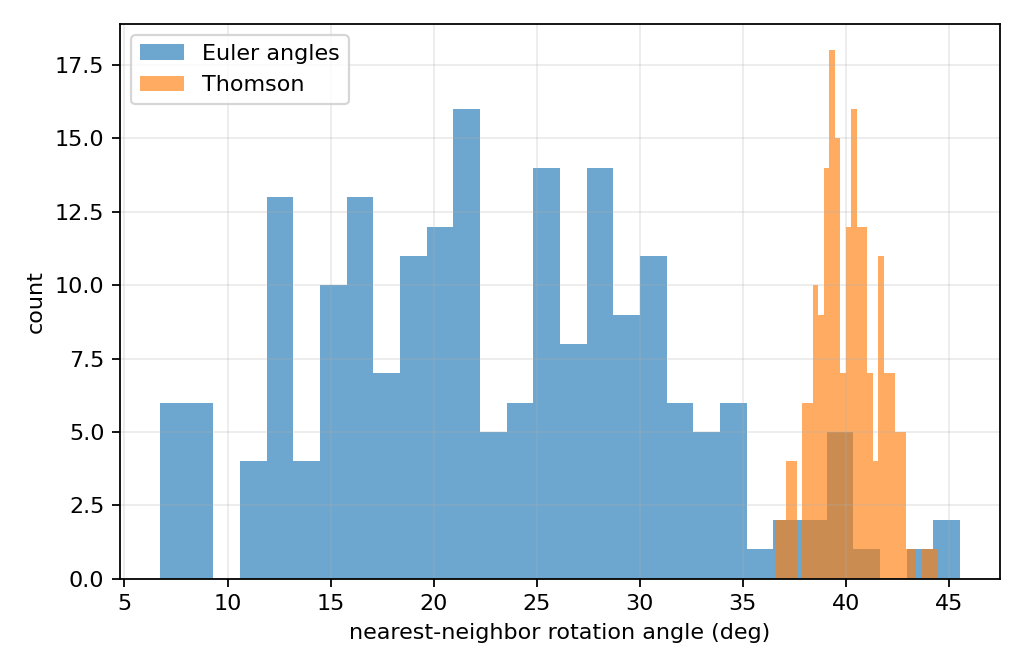
7. 与欧拉角均匀采样的对比指标
脚本 thomson_rotation_sampling.py 使用最近邻旋转距离作为主要对比指标。
对每个样本 RiR_iRi ,计算它与其他样本之间的最小旋转角:
δi=minj≠idSO(3)(Ri,Rj). \delta_i= \min_{j \ne i} d_{SO(3)}(R_i, R_j). δi=j=imindSO(3)(Ri,Rj).
如果采样更均匀,则最近邻距离通常具有这些特征:
- 最小值更大,说明没有非常近的冗余样本。
- 标准差更小,说明样本间距更一致。
- 变异系数 std(δi)/mean(δi)\mathrm{std}(\delta_i) / \mathrm{mean}(\delta_i)std(δi)/mean(δi) 更小。
- Riesz 能量更低,说明近距离冲突更少。
欧拉角均匀采样一般会出现更小的最近邻距离和更大的距离波动。
8. 运行脚本
基本运行:
python3 thomson_rotation_sampling.py --n 200 --iterations 800 --seed 7
输出文件默认以 rotation_sampling 为前缀,保存一张 PNG:
rotation_sampling_comparison.png
9. thomson_rotation_sampling.py 源代码
from __future__ import annotations

import argparse
import struct
import zlib
from dataclasses import dataclass
from pathlib import Path

import numpy as np


EPS = 1e-12


@dataclass
class ThomsonResult:
    quaternions: np.ndarray
    energies: list[float]
    iterations: int


def normalize_rows(x: np.ndarray) -> np.ndarray:
    norms = np.linalg.norm(x, axis=1, keepdims=True)
    return x / np.maximum(norms, EPS)


def canonicalize_quaternions(q: np.ndarray) -> np.ndarray:
    """Choose a stable representative for q ~ -q."""
    q = q.copy()
    mask = q[:, 0] < 0
    q[mask] *= -1.0
    return q


def random_quaternions(n: int, rng: np.random.Generator) -> np.ndarray:
    q = rng.normal(size=(n, 4))
    return normalize_rows(q)


def quaternion_multiply(a: np.ndarray, b: np.ndarray) -> np.ndarray:
    aw, ax, ay, az = np.moveaxis(a, -1, 0)
    bw, bx, by, bz = np.moveaxis(b, -1, 0)
    return np.stack(
        [
            aw * bw - ax * bx - ay * by - az * bz,
            aw * bx + ax * bw + ay * bz - az * by,
            aw * by - ax * bz + ay * bw + az * bx,
            aw * bz + ax * by - ay * bx + az * bw,
        ],
        axis=-1,
    )


def euler_zyx_quaternions(n: int, rng: np.random.Generator) -> np.ndarray:
    """Naive independent uniform yaw-pitch-roll sampling.

    Uses R = Rz(yaw) Ry(pitch) Rx(roll). Pitch is sampled in [-pi/2, pi/2]
    and yaw/roll in [-pi, pi]. This is a common "uniform three angles"
    baseline, but it is not uniform on SO(3).
    """
    yaw = rng.uniform(-np.pi, np.pi, size=n)
    pitch = rng.uniform(-np.pi / 2.0, np.pi / 2.0, size=n)
    roll = rng.uniform(-np.pi, np.pi, size=n)

    zeros = np.zeros(n)

    cy = np.cos(yaw / 2.0)
    sy = np.sin(yaw / 2.0)
    qz = np.stack([cy, zeros, zeros, sy], axis=1)

    cp = np.cos(pitch / 2.0)
    sp = np.sin(pitch / 2.0)
    qy = np.stack([cp, zeros, sp, zeros], axis=1)

    cr = np.cos(roll / 2.0)
    sr = np.sin(roll / 2.0)
    qx = np.stack([cr, sr, zeros, zeros], axis=1)

    q = quaternion_multiply(quaternion_multiply(qz, qy), qx)
    return canonicalize_quaternions(normalize_rows(q))


def quaternions_to_rotation_matrices(q: np.ndarray) -> np.ndarray:
    q = normalize_rows(q)
    w, x, y, z = q.T
    rotations = np.empty((q.shape[0], 3, 3), dtype=float)

    rotations[:, 0, 0] = 1.0 - 2.0 * (y * y + z * z)
    rotations[:, 0, 1] = 2.0 * (x * y - z * w)
    rotations[:, 0, 2] = 2.0 * (x * z + y * w)

    rotations[:, 1, 0] = 2.0 * (x * y + z * w)
    rotations[:, 1, 1] = 1.0 - 2.0 * (x * x + z * z)
    rotations[:, 1, 2] = 2.0 * (y * z - x * w)

    rotations[:, 2, 0] = 2.0 * (x * z - y * w)
    rotations[:, 2, 1] = 2.0 * (y * z + x * w)
    rotations[:, 2, 2] = 1.0 - 2.0 * (x * x + y * y)

    return rotations


def pairwise_rotation_angles(q: np.ndarray) -> np.ndarray:
    q = normalize_rows(q)
    dots = np.abs(q @ q.T)
    dots = np.clip(dots, 0.0, 1.0)
    return 2.0 * np.arccos(dots)


def nearest_neighbor_angles(q: np.ndarray) -> np.ndarray:
    angles = pairwise_rotation_angles(q)
    np.fill_diagonal(angles, np.inf)
    return np.min(angles, axis=1)


def thomson_energy(q: np.ndarray, s: float = 1.0, eps: float = EPS) -> float:
    angles = pairwise_rotation_angles(q)
    i_upper = np.triu_indices(q.shape[0], k=1)
    d = np.maximum(angles[i_upper], eps)
    return float(np.sum(1.0 / (d**s)))


def thomson_gradient(q: np.ndarray, s: float = 1.0, eps: float = EPS) -> np.ndarray:
    """Projected gradient of sum 1 / theta_ij^s on S^3 / {q ~ -q}."""
    dots = q @ q.T
    signs = np.sign(dots)
    abs_dots = np.clip(np.abs(dots), 0.0, 1.0 - 1e-10)
    angles = 2.0 * np.arccos(abs_dots)

    denom = (np.maximum(angles, eps) ** (s + 1.0)) * np.sqrt(
        np.maximum(1.0 - abs_dots * abs_dots, eps)
    )
    weights = 2.0 * s * signs / denom
    np.fill_diagonal(weights, 0.0)

    grad = weights @ q
    radial = np.sum(grad * q, axis=1, keepdims=True) * q
    return grad - radial


def thomson_sample_rotations(
    n: int,
    iterations: int,
    seed: int,
    s: float,
    step_size: float,
    etol: float,
    dtol: float,
    report_every: int,
    quiet: bool,
) -> ThomsonResult:
    rng = np.random.default_rng(seed)
    q = random_quaternions(n, rng)
    energy = thomson_energy(q, s=s)
    energies = [energy]
    step = step_size
    min_step = 1e-8

    if not quiet:
        print(f"Initial Thomson energy: {energy:.6f}")

    completed = 0
    for iteration in range(1, iterations + 1):
        grad = thomson_gradient(q, s=s)
        grad_norm = np.linalg.norm(grad, axis=1, keepdims=True)
        direction = grad / np.maximum(grad_norm, EPS)

        accepted = False
        trial_step = step
        displacement = 0.0
        candidate_energy = energy
        candidate = q

        for _ in range(30):
            candidate = normalize_rows(q - trial_step * direction)
            candidate_energy = thomson_energy(candidate, s=s)
            if candidate_energy < energy:
                dots = np.abs(np.sum(q * candidate, axis=1))
                dots = np.clip(dots, 0.0, 1.0)
                displacement = float(np.max(2.0 * np.arccos(dots)))
                accepted = True
                break
            trial_step *= 0.5

        if not accepted:
            step = trial_step
            if step < min_step:
                if not quiet:
                    print("Stopped: line search step became too small.")
                break
            continue

        q = candidate
        energy_drop = energy - candidate_energy
        energy = candidate_energy
        energies.append(energy)
        step = min(trial_step * 1.03, 0.35)
        completed = iteration

        if not quiet and (iteration == 1 or iteration % report_every == 0):
            print(
                f"iter={iteration:5d}  energy={energy:.6f}  "
                f"dE={energy_drop:.3e}  max_step_deg={np.degrees(displacement):.5f}"
            )

        if iteration > 10 and energy_drop < etol and displacement < dtol:
            if not quiet:
                print("Stopped: energy and displacement tolerances reached.")
            break

    return ThomsonResult(
        quaternions=canonicalize_quaternions(q),
        energies=energies,
        iterations=completed,
    )


def summarize(name: str, q: np.ndarray, s: float) -> dict[str, float | str | int]:
    nn = np.degrees(nearest_neighbor_angles(q))
    mean = float(np.mean(nn))
    std = float(np.std(nn))
    return {
        "method": name,
        "n": int(q.shape[0]),
        "energy": thomson_energy(q, s=s),
        "nn_min_deg": float(np.min(nn)),
        "nn_p05_deg": float(np.percentile(nn, 5)),
        "nn_mean_deg": mean,
        "nn_median_deg": float(np.median(nn)),
        "nn_p95_deg": float(np.percentile(nn, 95)),
        "nn_max_deg": float(np.max(nn)),
        "nn_std_deg": std,
        "nn_cv": float(std / mean) if mean > 0.0 else float("nan"),
    }


def print_summary(rows: list[dict[str, float | str | int]]) -> None:
    print("\nComparison summary")
    print(
        "method      energy        min(deg)  mean(deg)  std(deg)   cv       p05(deg)"
    )
    for row in rows:
        print(
            f"{row['method']:<10} "
            f"{row['energy']:>12.4f} "
            f"{row['nn_min_deg']:>9.3f} "
            f"{row['nn_mean_deg']:>10.3f} "
            f"{row['nn_std_deg']:>9.3f} "
            f"{row['nn_cv']:>8.3f} "
            f"{row['nn_p05_deg']:>9.3f}"
        )


def write_png(path: Path, image: np.ndarray) -> None:
    """Write an RGB uint8 image as a PNG using only the standard library."""
    path.parent.mkdir(parents=True, exist_ok=True)
    if image.dtype != np.uint8 or image.ndim != 3 or image.shape[2] != 3:
        raise ValueError("image must be an RGB uint8 array")

    height, width, _ = image.shape
    raw = bytearray()
    for row in image:
        raw.append(0)
        raw.extend(row.tobytes())

    def chunk(tag: bytes, data: bytes) -> bytes:
        crc = zlib.crc32(tag + data) & 0xFFFFFFFF
        return struct.pack(">I", len(data)) + tag + data + struct.pack(">I", crc)

    png = [
        b"\x89PNG\r\n\x1a\n",
        chunk(b"IHDR", struct.pack(">IIBBBBB", width, height, 8, 2, 0, 0, 0)),
        chunk(b"IDAT", zlib.compress(bytes(raw), level=9)),
        chunk(b"IEND", b""),
    ]
    path.write_bytes(b"".join(png))


def blend_rect(
    image: np.ndarray,
    x0: int,
    y0: int,
    x1: int,
    y1: int,
    color: tuple[int, int, int],
    alpha: float = 1.0,
) -> None:
    height, width, _ = image.shape
    xa = max(0, min(width, int(round(x0))))
    xb = max(0, min(width, int(round(x1))))
    ya = max(0, min(height, int(round(y0))))
    yb = max(0, min(height, int(round(y1))))
    if xa >= xb or ya >= yb:
        return
    base = image[ya:yb, xa:xb].astype(float)
    overlay = np.array(color, dtype=float)
    image[ya:yb, xa:xb] = np.round(base * (1.0 - alpha) + overlay * alpha).astype(
        np.uint8
    )


def draw_fallback_histogram_png(
    path: Path,
    thomson_nn: np.ndarray,
    euler_nn: np.ndarray,
    bins: int = 30,
) -> None:
    """Small dependency-free histogram renderer used when matplotlib is absent."""
    width, height = 1000, 620
    left, right, top, bottom = 90, 35, 45, 80
    plot_w = width - left - right
    plot_h = height - top - bottom
    image = np.full((height, width, 3), 255, dtype=np.uint8)

    max_angle = max(float(np.max(thomson_nn)), float(np.max(euler_nn)), 1.0)
    edges = np.linspace(0.0, max_angle * 1.05, bins + 1)
    th_counts, _ = np.histogram(thomson_nn, bins=edges)
    eu_counts, _ = np.histogram(euler_nn, bins=edges)
    max_count = max(int(np.max(th_counts)), int(np.max(eu_counts)), 1)

    axis = (70, 70, 70)
    grid = (225, 225, 225)
    thomson_color = (39, 119, 180)
    euler_color = (221, 126, 55)

    for i in range(6):
        y = top + plot_h - i * plot_h / 5
        blend_rect(image, left, y, width - right, y + 1, grid, 1.0)
    blend_rect(image, left, top, left + 2, height - bottom, axis, 1.0)
    blend_rect(image, left, height - bottom, width - right, height - bottom + 2, axis, 1.0)

    bin_w = plot_w / bins
    for i in range(bins):
        x0 = left + i * bin_w
        x1 = left + (i + 1) * bin_w
        th_h = plot_h * th_counts[i] / max_count
        eu_h = plot_h * eu_counts[i] / max_count
        blend_rect(
            image,
            x0 + 2,
            height - bottom - eu_h,
            x1 - 1,
            height - bottom,
            euler_color,
            0.62,
        )
        blend_rect(
            image,
            x0 + 2,
            height - bottom - th_h,
            x1 - 1,
            height - bottom,
            thomson_color,
            0.62,
        )

    # Lightweight legend swatches; matplotlib is used when full labels are available.
    blend_rect(image, width - right - 210, top + 18, width - right - 175, top + 38, euler_color, 0.8)
    blend_rect(image, width - right - 210, top + 48, width - right - 175, top + 68, thomson_color, 0.8)

    write_png(path, image)


def plot_nearest_neighbor_histogram(prefix: Path, thomson_q: np.ndarray, euler_q: np.ndarray) -> Path:
    out = prefix.with_name(prefix.name + "_comparison.png")
    thomson_nn = np.degrees(nearest_neighbor_angles(thomson_q))
    euler_nn = np.degrees(nearest_neighbor_angles(euler_q))

    try:
        import matplotlib.pyplot as plt
    except ModuleNotFoundError:
        draw_fallback_histogram_png(out, thomson_nn, euler_nn)
        print("matplotlib is not installed; wrote a simple PNG histogram instead.")
        return out

    prefix.parent.mkdir(parents=True, exist_ok=True)
    fig, ax = plt.subplots(figsize=(6.4, 4.2))

    ax.hist(euler_nn, bins=30, alpha=0.65, label="Euler angles")
    ax.hist(thomson_nn, bins=30, alpha=0.65, label="Thomson")
    ax.set_xlabel("nearest-neighbor rotation angle (deg)")
    ax.set_ylabel("count")
    ax.legend()
    ax.grid(alpha=0.25)

    fig.tight_layout()
    fig.savefig(out, dpi=160)
    plt.close(fig)
    return out


def parse_args() -> argparse.Namespace:
    parser = argparse.ArgumentParser(
        description="Sample SO(3) with Thomson sampling and compare against naive uniform Euler angles."
    )
    parser.add_argument("--n", type=int, default=200, help="number of rotations")
    parser.add_argument("--iterations", type=int, default=800, help="maximum optimization iterations")
    parser.add_argument("--seed", type=int, default=7, help="random seed")
    parser.add_argument("--s-energy", type=float, default=1.0, help="Riesz s-energy exponent")
    parser.add_argument("--step-size", type=float, default=0.05, help="initial tangent step size")
    parser.add_argument("--etol", type=float, default=1e-10, help="energy-drop tolerance")
    parser.add_argument("--dtol", type=float, default=1e-8, help="max displacement tolerance in radians")
    parser.add_argument("--report-every", type=int, default=100, help="progress print interval")
    parser.add_argument(
        "--output-prefix",
        type=Path,
        default=Path("rotation_sampling"),
        help="prefix for the output PNG file",
    )
    parser.add_argument("--quiet", action="store_true", help="suppress optimization progress")
    return parser.parse_args()


def main() -> None:
    args = parse_args()
    if args.n < 2:
        raise ValueError("--n must be at least 2")
    if args.iterations < 1:
        raise ValueError("--iterations must be at least 1")
    if args.s_energy <= 0.0:
        raise ValueError("--s-energy must be positive")

    result = thomson_sample_rotations(
        n=args.n,
        iterations=args.iterations,
        seed=args.seed,
        s=args.s_energy,
        step_size=args.step_size,
        etol=args.etol,
        dtol=args.dtol,
        report_every=max(args.report_every, 1),
        quiet=args.quiet,
    )

    rng = np.random.default_rng(args.seed + 1)
    euler_q = euler_zyx_quaternions(args.n, rng)

    rows = [
        summarize("Thomson", result.quaternions, s=args.s_energy),
        summarize("Euler", euler_q, s=args.s_energy),
    ]
    print_summary(rows)

    plot_path = plot_nearest_neighbor_histogram(
        args.output_prefix, result.quaternions, euler_q
    )

    print("\nSaved output")
    print(f"- {plot_path}")
    print(f"\nAccepted Thomson iterations: {result.iterations}")


if __name__ == "__main__":
    main()

openEuler 是由开放原子开源基金会孵化的全场景开源操作系统项目,面向数字基础设施四大核心场景(服务器、云计算、边缘计算、嵌入式),全面支持 ARM、x86、RISC-V、loongArch、PowerPC、SW-64 等多样性计算架构
更多推荐


 6
6 0
0- 0


 已为社区贡献2条内容

所有评论(0)