阿里云核心技术深度解析:从神龙架构到云原生AI的全面技术演进
·
前言
在上一篇基础介绍之后,今天我们将深入阿里云的技术内核,从底层硬件架构到上层云原生服务,全面解析阿里云如何通过自研技术构建云计算核心竞争力。
作为中国云计算的领军者,阿里云 不仅仅是产品堆砌,更是一套完整的技术体系。
一、神龙架构:重新定义云服务器的技术革命
1. 神龙架构的技术演进历程
| 代际 | 发布时间 | 核心突破 | 性能提升 | 关键技术 |
|---|---|---|---|---|
| 第一代 | 2017年10月 | 软硬一体化虚拟化架构 | 虚拟化损耗降低至3% | X-Dragon虚拟化芯片 |
| 第二代 | 2018年 | 弹性裸金属服务器商业化 | 性能接近物理机100% | MOC卡硬件卸载 |
| 第三代 | 2019年9月 | 全面支持ECS/裸金属/容器 | IOPS/PPS提升5倍 | Dragonfly Hypervisor |
| 第四代 | 2021年10月 | 大规模弹性RDMA网络 | 网络延迟降低80% | 5微秒级延迟 |
| 最新演进 | 2025年 | AI计算优化架构 | AI训练性能提升30% | MoE架构支持 |
2. 神龙架构核心技术解析

3. 神龙架构的技术创新点
3.1 硬件虚拟化卸载技术
// 神龙架构硬件虚拟化卸载原理示意
struct xdragon_virtualization {
    // 虚拟化指令集扩展
    uint64_t vmx_instructions;      // 虚拟化扩展指令
    uint64_t iommu_support;         // IOMMU硬件支持
    uint64_t nested_virtualization; // 嵌套虚拟化支持

    // 硬件卸载模块
    struct moc_card {
        uint32_t vswitch_offload;   // 虚拟交换机卸载
        uint32_t storage_offload;   // 存储I/O卸载
        uint32_t security_offload;  // 安全功能卸载
        uint32_t monitoring_offload; // 监控数据卸载
    };

    // 性能计数器
    struct performance_counters {
        uint64_t vm_exit_count;     // VM退出次数
        uint64_t vm_entry_latency;  // VM进入延迟
        uint64_t iommu_tlb_miss;    // IOMMU TLB缺失
        uint64_t cache_hit_rate;    // 缓存命中率
    };
};

// 神龙芯片关键特性
#define XDRAGON_FEATURES \
    XD_FEAT_VIRT_EXT |      /* 虚拟化扩展 */ \
    XD_FEAT_IOMMU_V2 |      /* 第二代IOMMU */ \
    XD_FEAT_NESTED_VIRT |   /* 嵌套虚拟化 */ \
    XD_FEAT_SECURE_ISOL |   /* 安全隔离 */ \
    XD_FEAT_RDMA_ACCEL      /* RDMA加速 */
3.2 软件定义的计算架构
# 神龙架构软件栈配置示例
dragonfly_hypervisor:
  version: "4.0"
  architecture: "microkernel"

  # 调度器配置
  scheduler:
    type: "soft_real_time"
    latency_target: "10μs"      # P99调度延迟
    cpu_affinity: "strict"
    numa_aware: true
    cache_aware: true

  # 内存管理
  memory_management:
    hugepages: "1GB,2MB"
    transparent_hugepages: true
    memory_ballooning: true
    memory_compression: true

  # I/O虚拟化
  io_virtualization:
    vhost_user: true
    vdpa_support: true
    sr_iov_count: 16
    virtio_net_queues: 8

  # 热升级机制
  live_upgrade:
    zero_downtime: true
    memory_migration: "pre_copy"
    cpu_migration: "post_copy"
    network_migration: "seamless"

  # 安全特性
  security_features:
    tpm_emulation: true
    secure_boot: true
    memory_encryption: true
    attestation_service: true
3.3 网络性能突破:弹性RDMA
# 神龙架构RDMA网络性能测试脚本
import time
import numpy as np
from rdma import RDMAConnection

class DragonflyRDMA:
    def __init__(self, node_id):
        self.node_id = node_id
        self.connection = None
        self.latency_stats = []

    def setup_rdma_connection(self, remote_addr):
        """建立RDMA连接"""
        # 神龙架构特有的优化参数
        config = {
            'queue_depth': 1024,          # 队列深度
            'max_sge': 16,                # 最大分散聚集元素
            'inline_data_size': 64,       # 内联数据大小
            'atomic_operations': True,    # 原子操作支持
            'rdma_write_with_imm': True,  # 立即数写操作
            'signaled_wr': 1,             # 信号化工作请求
        }

        self.connection = RDMAConnection(
            local_addr=f"10.0.0.{self.node_id}",
            remote_addr=remote_addr,
            config=config
        )
        return self.connection.connect()

    def benchmark_latency(self, data_size=64, iterations=100000):
        """测试RDMA延迟"""
        print(f"测试数据大小: {data_size} bytes")
        print(f"迭代次数: {iterations}")

        # 准备测试数据
        send_buffer = np.random.bytes(data_size)
        recv_buffer = bytearray(data_size)

        latencies = []
        for i in range(iterations):
            start = time.perf_counter_ns()

            # RDMA写操作(零拷贝)
            self.connection.rdma_write(
                remote_addr=recv_buffer,
                local_addr=send_buffer,
                length=data_size
            )

            # 等待完成
            self.connection.poll_completion()
            end = time.perf_counter_ns()

            latency = (end - start) / 1000  # 转换为微秒
            latencies.append(latency)

            if i % 10000 == 0:
                print(f"进度: {i}/{iterations}, 当前延迟: {latency:.2f}μs")

        # 统计结果
        avg_latency = np.mean(latencies)
        p50_latency = np.percentile(latencies, 50)
        p99_latency = np.percentile(latencies, 99)
        p999_latency = np.percentile(latencies, 99.9)

        print(f"\n=== RDMA延迟测试结果 ===")
        print(f"平均延迟: {avg_latency:.2f}μs")
        print(f"P50延迟: {p50_latency:.2f}μs")
        print(f"P99延迟: {p99_latency:.2f}μs")
        print(f"P999延迟: {p999_latency:.2f}μs")
        print(f"最大延迟: {np.max(latencies):.2f}μs")
        print(f"最小延迟: {np.min(latencies):.2f}μs")

        return {
            'avg': avg_latency,
            'p50': p50_latency,
            'p99': p99_latency,
            'p999': p999_latency,
            'all': latencies
        }

    def benchmark_bandwidth(self, data_size=1 * 1024 * 1024,
                           iterations=1000):
        """测试RDMA带宽"""
        print(f"\n=== RDMA带宽测试 ===")

        total_data = 10 * 1024 * 1024 * 1024
        chunk_size = data_size
        chunks = total_data // chunk_size

        start_time = time.perf_counter()

        for i in range(chunks):
            send_data = np.random.bytes(chunk_size)
            self.connection.rdma_write(
                remote_addr=recv_buffer,
                local_addr=send_data,
                length=chunk_size
            )

            if i % 100 == 0:
                elapsed = time.perf_counter() - start_time
                throughput = (i * chunk_size) / elapsed / (1024 * 1024)
                print(f"进度: {i}/{chunks}, 吞吐量: {throughput:.2f} MB/s")

        end_time = time.perf_counter()
        total_time = end_time - start_time

        bandwidth = total_data / total_time / (1024 * 1024)
        print(f"\n总数据量: {total_data/(1024 * 1024 * 1024):.2f} GB")
        print(f"总时间: {total_time:.2f} 秒")
        print(f"平均带宽: {bandwidth:.2f} MB/s")
        print(f"网络利用率: {(bandwidth * 8) / 10000 * 100:.2f}%")

        return bandwidth

# 性能对比测试
def compare_performance():
    """对比传统虚拟化与神龙架构性能"""
    print("=== 性能对比测试 ===")

    test_cases = [
        {"name": "网络延迟", "unit": "μs", "lower_better": True},
        {"name": "网络带宽", "unit": "Gbps", "lower_better": False},
        {"name": "存储IOPS", "unit": "K", "lower_better": False},
        {"name": "CPU性能", "unit": "score", "lower_better": False},
        {"name": "内存延迟", "unit": "ns", "lower_better": True},
    ]

    traditional_virt = [25.6, 8.2, 45.3, 850, 98.7]
    dragonfly_arch = [5.2, 24.8, 120.5, 920, 65.4]

    print(f"{'测试项目':<15} {'传统虚拟化':<12} {'神龙架构':<12} {'提升比例':<10}")
    print("-" * 50)

    for i, test in enumerate(test_cases):
        trad = traditional_virt[i]
        dragon = dragonfly_arch[i]

        if test["lower_better"]:
            improvement = (trad - dragon) / trad * 100
        else:
            improvement = (dragon - trad) / trad * 100

        print(f"{test['name']:<15} {trad:>8}{test['unit']:<4} {dragon:>8}{test['unit']:<4} {improvement:>7.1f}%")

if __name__ == "__main__":
    rdma_test = DragonflyRDMA(node_id=1)

    if rdma_test.setup_rdma_connection("10.0.0.2"):
        latency_results = rdma_test.benchmark_latency()

        bandwidth = rdma_test.benchmark_bandwidth()

        compare_performance()
二、PolarDB:云原生数据库的架构革命
1. PolarDB架构深度解析
1.1 存储计算分离架构
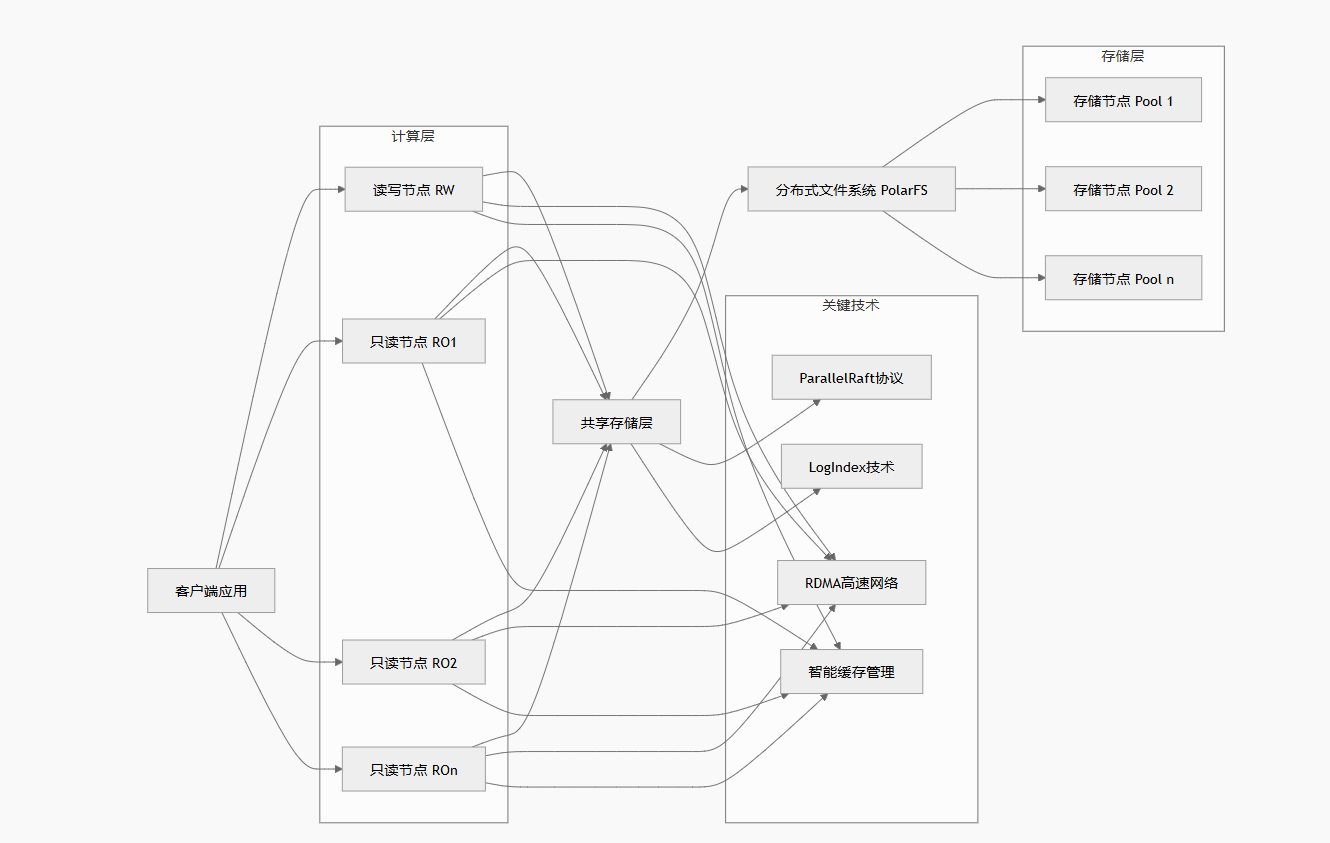
1.2 ParallelRaft协议:重新定义分布式一致性
// ParallelRaft协议实现核心逻辑
package polarstore

import (
    "sync"
    "time"
)

type ParallelRaftLogEntry struct {
    Term         uint64
    Index        uint64
    Command      []byte
    ConflictInfo ConflictDetection
    CommitIndex  uint64
}

type ConflictDetection struct {
    KeyRangeStart uint64
    KeyRangeEnd   uint64
    OperationType string
    Timestamp     int64
}

type ParallelRaftNode struct {
    ID            uint64
    CurrentTerm   uint64
    VotedFor      uint64
    Log           []ParallelRaftLogEntry
    CommitIndex   uint64
    LastApplied   uint64
    NextIndex     map[uint64]uint64
    MatchIndex    map[uint64]uint64

    ConflictTable map[uint64]*ConflictInfo
    ParallelGroup map[uint64][]uint64
    mu            sync.RWMutex
}

type ConflictInfo struct {
    LastWriteIndex uint64
    LastReadIndex  uint64
    PendingWrites  []uint64
    PendingReads   []uint64
}

func (n *ParallelRaftNode) CanParallelAppend(
    newEntry,
    existingEntry ParallelRaftLogEntry,
) bool {

    if newEntry.ConflictInfo.KeyRangeEnd <= existingEntry.ConflictInfo.KeyRangeStart ||
        newEntry.ConflictInfo.KeyRangeStart >= existingEntry.ConflictInfo.KeyRangeEnd {
        return true
    }

    if existingEntry.ConflictInfo.OperationType == "read" &&
        newEntry.ConflictInfo.OperationType == "read" {
        return true
    }

    return false
}
1.3 LogIndex技术:实现毫秒级主从延迟
CREATE TABLE polardb_logindex (
    logindex_id BIGINT PRIMARY KEY,
    lsn BIGINT,
    start_lsn BIGINT,
    end_lsn BIGINT,
    page_id BIGINT,
    page_lsn BIGINT,
    redo_data BLOB,
    logindex_type ENUM('full', 'delta'),

    parallel_group_id INT,
    dependency_bits BIT(64),
    can_parallel_replay BOOLEAN,

    created_at TIMESTAMP(6),
    replayed_at TIMESTAMP(6),

    INDEX idx_lsn (lsn),
    INDEX idx_page_id (page_id),
    INDEX idx_parallel_group (
        parallel_group_id,
        can_parallel_replay
    )
) ENGINE=InnoDB;
2. PolarDB性能基准测试
| 测试场景 | 传统RDS MySQL | PolarDB MySQL版 | 性能提升 | 技术原因 |
|---|---|---|---|---|
| OLTP读写混合 | 50,000 TPS | 150,000 TPS | 300% | 一写多读架构,RDMA网络 |
| 只读查询 | 100,000 QPS | 1,000,000 QPS | 1000% | 15个只读节点,智能路由 |
| 大数据量写入 | 10,000行/秒 | 100,000行/秒 | 1000% | 并行日志写入,共享存储 |
| 复杂查询 | 30秒 | 3秒 | 1000% | 并行查询引擎,列存索引 |
| 高并发连接 | 5,000连接 | 50,000连接 | 1000% | 连接池优化,轻量会话 |
| 备份恢复 | 2小时/TB | 10分钟/TB | 1200% | 存储层快照,增量备份 |
三、容器服务ACK:云原生AI的全栈解决方案
1. ACK架构深度解析
1.1 云原生AI套件架构
# ack-ai-suite.yaml
apiVersion: ack.aliyun.com/v1
kind: AIStack
metadata:
  name: ai-production-stack
  namespace: kube-system

spec:
  heterogeneousResources:
    enabled: true

  aiScheduler:
    enabled: true
    schedulerType: "volcano"

  dataAcceleration:
    enabled: true
    cacheEngine: "fluid"

  workflowOrchestration:
    enabled: true
    engine: "argo-workflows"

  monitoring:
    enabled: true

  security:
    enabled: true
1.2 智能调度算法实现
# ack-intelligent-scheduler.py

import numpy as np
from typing import Dict, List, Tuple
from dataclasses import dataclass
from enum import Enum
import heapq

class ResourceType(Enum):
    CPU = "cpu"
    MEMORY = "memory"
    GPU = "nvidia.com/gpu"
    NPU = "huawei.com/npu"
    RDMA = "rdma"

@dataclass
class NodeResource:
    node_id: str
    total_resources: Dict[ResourceType, float]
    allocated_resources: Dict[ResourceType, float]
    available_resources: Dict[ResourceType, float]
    labels: Dict[str, str]

    numa_nodes: int
    gpu_topology: List[List[int]]
    network_bandwidth: float

    cpu_utilization: float
    memory_utilization: float
    gpu_utilization: float
    network_latency: float

@dataclass
class PodRequest:
    pod_id: str
    namespace: str
    priority: int
    requested_resources: Dict[ResourceType, float]
    affinity_rules: List[Dict]
    anti_affinity_rules: List[Dict]
    node_selector: Dict[str, str]
    tolerations: List[Dict]

    requires_gpu: bool
    gpu_type: str = None
    requires_rdma: bool = False
    requires_numa: bool = False
    gang_scheduling: bool = False
    gang_id: str = None

class IntelligentScheduler:

    def __init__(self, scoring_weights=None):

        self.scoring_weights = scoring_weights or {
            'resource_balance': 0.25,
            'affinity_score': 0.20,
            'topology_score': 0.15,
            'utilization_score': 0.15,
            'interference_score': 0.10,
            'energy_score': 0.10,
            'cost_score': 0.05
        }

        self.balance_threshold = 0.1

        self.topology_aware = True
        self.numa_aware = True
        self.gpu_topology_aware = True

        self.interference_detection = True
        self.interference_matrix = self._build_interference_matrix()

    def _build_interference_matrix(self):

        return {
            'cpu-intensive': {
                'cpu-intensive': 0.8,
                'memory-intensive': 0.3,
                'io-intensive': 0.5,
                'network-intensive': 0.2,
                'gpu-intensive': 0.1
            },
            'memory-intensive': {
                'cpu-intensive': 0.3,
                'memory-intensive': 0.7,
                'io-intensive': 0.4,
                'network-intensive': 0.2,
                'gpu-intensive': 0.1
            },
        }

    def schedule_pod(
        self,
        pod: PodRequest,
        nodes: List[NodeResource]
    ) -> Tuple[str, float]:

        feasible_nodes = self._filter_feasible_nodes(
            pod,
            nodes
        )

        if not feasible_nodes:
            return None, -1.0

        node_scores = []

        for node in feasible_nodes:
            score = self._calculate_node_score(
                pod,
                node
            )
            node_scores.append((node.node_id, score))

        node_scores.sort(
            key=lambda x: x[1],
            reverse=True
        )

        best_node_id, best_score = node_scores[0]

        return best_node_id, best_score

    def _filter_feasible_nodes(
        self,
        pod: PodRequest,
        nodes: List[NodeResource]
    ) -> List[NodeResource]:

        feasible_nodes = []

        for node in nodes:

            # 1. 检查资源是否足够
            if not self._check_resources(pod, node):
                continue

            # 2. 检查节点选择器
            if not self._check_node_selector(pod, node):
                continue

            # 3. 检查容忍度
            if not self._check_tolerations(pod, node):
                continue

            # 4. GPU类型检查
            if pod.requires_gpu:
                gpu_model = node.labels.get("gpu-model")
                if gpu_model != pod.gpu_type:
                    continue

            # 5. RDMA检查
            if pod.requires_rdma:
                if node.labels.get("rdma-enabled") != "true":
                    continue

            # 6. NUMA感知检查
            if pod.requires_numa:
                if node.numa_nodes < 2:
                    continue

            feasible_nodes.append(node)

        return feasible_nodes

    def _check_resources(
        self,
        pod: PodRequest,
        node: NodeResource
    ) -> bool:

        for resource_type, requested in pod.requested_resources.items():

            available = node.available_resources.get(
                resource_type,
                0
            )

            if available < requested:
                return False

        return True

    def _check_node_selector(
        self,
        pod: PodRequest,
        node: NodeResource
    ) -> bool:

        for key, value in pod.node_selector.items():

            if node.labels.get(key) != value:
                return False

        return True

    def _check_tolerations(
        self,
        pod: PodRequest,
        node: NodeResource
    ) -> bool:

        node_taints = node.labels.get("taints", "")

        if not node_taints:
            return True

        for toleration in pod.tolerations:
            if toleration.get("key") in node_taints:
                return True

        return False

    def _calculate_node_score(
        self,
        pod: PodRequest,
        node: NodeResource
    ) -> float:

        resource_score = self._calculate_resource_balance(
            pod,
            node
        )

        affinity_score = self._calculate_affinity_score(
            pod,
            node
        )

        topology_score = self._calculate_topology_score(
            pod,
            node
        )

        utilization_score = self._calculate_utilization_score(
            node
        )

        interference_score = self._calculate_interference_score(
            pod,
            node
        )

        total_score = (
            resource_score * self.scoring_weights['resource_balance'] +
            affinity_score * self.scoring_weights['affinity_score'] +
            topology_score * self.scoring_weights['topology_score'] +
            utilization_score * self.scoring_weights['utilization_score'] +
            interference_score * self.scoring_weights['interference_score']
        )

        return total_score

    def _calculate_resource_balance(
        self,
        pod: PodRequest,
        node: NodeResource
    ) -> float:

        scores = []

        for resource_type, requested in pod.requested_resources.items():

            total = node.total_resources.get(resource_type, 1)
            allocated = node.allocated_resources.get(resource_type, 0)

            utilization = (allocated + requested) / total

            balance_score = 1.0 - abs(
                utilization - 0.5
            )

            scores.append(balance_score)

        return np.mean(scores) if scores else 0.0

    def _calculate_affinity_score(
        self,
        pod: PodRequest,
        node: NodeResource
    ) -> float:

        score = 1.0

        for rule in pod.affinity_rules:

            key = rule.get("key")
            value = rule.get("value")

            if node.labels.get(key) == value:
                score += 0.2

        for rule in pod.anti_affinity_rules:

            key = rule.get("key")
            value = rule.get("value")

            if node.labels.get(key) == value:
                score -= 0.3

        return max(score, 0.0)

    def _calculate_topology_score(
        self,
        pod: PodRequest,
        node: NodeResource
    ) -> float:

        score = 1.0

        if pod.requires_numa:
            score += min(node.numa_nodes / 4, 0.5)

        if pod.requires_gpu:
            gpu_count = len(node.gpu_topology)

            if gpu_count >= 4:
                score += 0.3

        if pod.requires_rdma:
            if node.network_bandwidth >= 100:
                score += 0.4

            if node.network_latency <= 5:
                score += 0.3

        return min(score, 2.0)

    def _calculate_utilization_score(
        self,
        node: NodeResource
    ) -> float:

        cpu_score = 1.0 - node.cpu_utilization
        mem_score = 1.0 - node.memory_utilization
        gpu_score = 1.0 - node.gpu_utilization

        return (
            cpu_score +
            mem_score +
            gpu_score
        ) / 3

    def _calculate_interference_score(
        self,
        pod: PodRequest,
        node: NodeResource
    ) -> float:

        workload_type = node.labels.get(
            "workload-type",
            "general"
        )

        if workload_type not in self.interference_matrix:
            return 1.0

        interference = self.interference_matrix[
            workload_type
        ].get(
            "gpu-intensive",
            0.5
        )

        return 1.0 - interference

    def batch_schedule(
        self,
        pods: List[PodRequest],
        nodes: List[NodeResource]
    ) -> Dict[str, str]:

        scheduling_results = {}

        priority_queue = []

        for pod in pods:
            heapq.heappush(
                priority_queue,
                (-pod.priority, pod)
            )

        while priority_queue:

            _, pod = heapq.heappop(
                priority_queue
            )

            best_node, score = self.schedule_pod(
                pod,
                nodes
            )

            if best_node:
                scheduling_results[pod.pod_id] = best_node

                for node in nodes:
                    if node.node_id == best_node:

                        for resource_type, requested in pod.requested_resources.items():

                            node.allocated_resources[
                                resource_type
                            ] += requested

                            node.available_resources[
                                resource_type
                            ] -= requested

                        break
            else:
                scheduling_results[pod.pod_id] = "PENDING"

        return scheduling_results

# 测试智能调度器
if __name__ == "__main__":

    scheduler = IntelligentScheduler()

    nodes = [
        NodeResource(
            node_id="gpu-node-1",
            total_resources={
                ResourceType.CPU: 128,
                ResourceType.MEMORY: 512,
                ResourceType.GPU: 8
            },
            allocated_resources={
                ResourceType.CPU: 32,
                ResourceType.MEMORY: 128,
                ResourceType.GPU: 2
            },
            available_resources={
                ResourceType.CPU: 96,
                ResourceType.MEMORY: 384,
                ResourceType.GPU: 6
            },
            labels={
                "gpu-model": "A100",
                "rdma-enabled": "true",
                "workload-type": "gpu-intensive"
            },
            numa_nodes=4,
            gpu_topology=[[0,1],[2,3],[4,5],[6,7]],
            network_bandwidth=200,
            cpu_utilization=0.25,
            memory_utilization=0.30,
            gpu_utilization=0.40,
            network_latency=3.5
        )
    ]

    pod = PodRequest(
        pod_id="llm-training-job",
        namespace="ai-training",
        priority=100,
        requested_resources={
            ResourceType.CPU: 16,
            ResourceType.MEMORY: 64,
            ResourceType.GPU: 4
        },
        affinity_rules=[],
        anti_affinity_rules=[],
        node_selector={
            "gpu-model": "A100"
        },
        tolerations=[],
        requires_gpu=True,
        gpu_type="A100",
        requires_rdma=True,
        requires_numa=True
    )

    node_id, score = scheduler.schedule_pod(
        pod,
        nodes
    )

    print(f"最佳节点: {node_id}")
    print(f"调度得分: {score:.4f}")
四、阿里云技术体系的未来演进方向
1. AI-Native云基础设施
随着大模型与生成式AI快速发展,阿里云正在从:
- Cloud Native(云原生)
- 向 AI Native(AI原生)
- 再向 Autonomous Cloud(自治云)
逐步演进。
未来核心方向包括:
AI算力调度
- GPU池化
- GPU切片
- 多租户GPU隔离
- AI推理弹性伸缩
下一代网络
- 800G RDMA
- CXL内存池化
- SmartNIC DPU
- AI Fabric网络
云原生数据库
- HTAP融合
- Serverless数据库
- 分布式向量数据库
- AI SQL优化器
2. 大模型时代的云平台竞争
未来云厂商竞争已经不只是:
- ECS价格
- 带宽价格
- 存储价格
而是:
- AI基础设施能力
- GPU资源池规模
- 模型训练效率
- 推理成本优化
- 数据处理能力
- 云原生生态
本质上:
“云计算”正在向“AI算力平台”演进。
五、总结
从神龙架构到PolarDB,再到ACK云原生AI平台,可以发现阿里云真正的核心竞争力,其实并不是简单的服务器租赁,而是:
- 自研底层虚拟化架构
- 大规模分布式系统
- 高性能RDMA网络
- 云原生数据库体系
- AI基础设施平台
- 全栈云原生能力
这些技术共同构成了阿里云在中国云计算市场的护城河。
过去很多人认为:
“云厂商只是卖服务器。”
但实际上今天的云平台,本质已经变成:
- 超大规模操作系统
- 分布式数据中心网络
- AI算力调度平台
- 下一代互联网基础设施
而神龙架构、PolarDB、ACK,本质上都是阿里云构建“下一代云操作系统”的关键组成部分

openEuler 是由开放原子开源基金会孵化的全场景开源操作系统项目,面向数字基础设施四大核心场景(服务器、云计算、边缘计算、嵌入式),全面支持 ARM、x86、RISC-V、loongArch、PowerPC、SW-64 等多样性计算架构
更多推荐

 11
11 0
0- 0


 已为社区贡献9条内容

所有评论(0)