基于C++的HTTP高并发服务器项目开发总结
1、struct sockaddr_in addr 定义一个IPV4地址结构体,包含IP、端口、地址族// 定义在 <netinet/in.h>// 地址族:AF_INET / AF_INET6// 端口号(网络字节序)// IP 地址// 填充字节,保持与 struct sockaddr 大小一致// IP 地址(32位,网络字节序)为什么要强制类型转换为struct sockaddr*?因为b
基于C++的HTTP高并发服务器项目开发总结
基础知识
1、struct sockaddr_in addr 定义一个IPV4地址结构体,包含IP、端口、地址族
// 定义在 <netinet/in.h>
struct sockaddr_in {
sa_family_t sin_family; // 地址族:AF_INET / AF_INET6
in_port_t sin_port; // 端口号(网络字节序)
struct in_addr sin_addr; // IP 地址
unsigned char sin_zero[8]; // 填充字节,保持与 struct sockaddr 大小一致
};
struct in_addr {
uint32_t s_addr; // IP 地址(32位,网络字节序)
};
2、bind(lfd, (struct sockaddr*)&addr, sizeof(addr))
为什么要强制类型转换为struct sockaddr*?
因为bind()是通用接口,需要兼容IPV4、IPV6、Unix等多种地址类型
3、为什么在项目中使用Reactor模型?
传统模型:一个连接一个线程/进程
→ 10K 连接需要 10K 线程,上下文切换开销巨大
Reactor 模型:一个线程处理所有事件(epoll_wait)
→ 只有事件就绪才创建线程处理
→ 线程用完即销毁(或放回线程池)
→ 支撑 10K+ 并发(C10K 问题)
Reactor核心组件:
- 多路复用器:select、poll、epoll、kqueue、IOCP,同时监视多个fd
- 事件分发器:根据事件类型分发给对应处理器
- 事件处理器:读事件、写事件、连接事件
Reactor 模型 = I/O 多路复用 + 事件分发 + 非阻塞处理,用少量线程管理大量连接
4、为什么用epoll而不是select/poll?
|
机制 |
实现方式 |
时间复杂度 |
最大连接数 |
数据拷贝 |
|
select |
位图遍历 |
O(n) |
1024 |
内核->用户 |
|
poll |
链表遍历 |
O(n) |
无限制(但慢) |
内核->用户 |
|
epoll |
红黑树+就绪链表 |
O(1) |
10万+ |
mmap共享内存 |
epoll优势:
(1)epoll_ctl增删改:红黑树O(logn)
(2)epoll_wait:直接返回就绪链表,O(1)
(3)边缘触发(EPOLLET):只通知一次,减少epoll_wait返回次数
5、epoll的Reactor模型
(1)创建epoll实例
int epfd = epoll_create(1);
作用:在内核创建一个 epoll 专用数据结构(红黑树 + 就绪链表),返回一个文件描述符 epfd。
(2)监听socket加入epoll
6、sendfile零拷贝原理
sendfile 是 Linux 提供的零拷贝(Zero-Copy)系统调用,核心思想是:数据从磁盘到网卡的过程中,不经过用户空间,减少 CPU 拷贝和上下文切换次数。
传统文件发送方式
- read()触发DMA,数据从磁盘拷贝到内核pageCache
- CPU将数据从内核拷贝给用户,数据从内核拷贝到用户缓冲区
- write()触发CPU拷贝,数据从用户缓冲区拷贝到Socket缓冲区
- DMA从Socket缓冲区到网卡,数据从Socket缓冲区到网卡
sendfile零拷贝
- DMA,磁盘->内核pageCache
- sendfile 直接在内核中将数据从 PageCache 拷贝到 Socket 缓冲区,或网卡支持时直接 DMA gather,内核->网卡
7、如何处理大文件传输?
使用 sendfile 配合 offset 偏移量循环发送。如果发送缓冲区满(EAGAIN),可以注册 EPOLLOUT 事件,等 socket 可写时继续发送,避免阻塞。
高并发服务器项目
1、服务器启动
1.1 main.cpp
// main.cpp
int main(int argc,char* argv[])
{
unsigned short port = 10000;
chdir("/home/robin/luffy"); // 切换工作目录,后续找静态资源用
// 创建服务器:端口10000,4个工作线程
TcpServer* server = new TcpServer(port, 4);
server->run(); // 阻塞在这里,服务器终身运行
return 0;
}
程序中chdir函数的作用为切换进程工作目录,后续stat()找文件时使用基于此的相对路径。
1.2 TcpServer.cpp
// TcpServer.cpp
TcpServer::TcpServer(unsigned short port, int threadNum)
{
m_port = port; // 10000
m_mainLoop = new EventLoop; // 创建主EventLoop
m_threadNum = threadNum; // 4
m_threadPool = new ThreadPool(m_mainLoop, threadNum); // 创建线程池
setListen(); // 创建监听fd
}
作用:服务器整体控制,监听新连接,分发到子线程。
1.3 setListen()——创建监听fd
// TcpServer.cpp
void TcpServer::setListen()
{
// 1. 创建监听fd
m_lfd = socket(AF_INET, SOCK_STREAM, 0); // m_lfd = 3(假设)
// 2. 端口复用
int opt = 1;
setsockopt(m_lfd, SOL_SOCKET, SO_REUSEADDR, &opt, sizeof opt);
// 3. 绑定地址
struct sockaddr_in addr;
addr.sin_family = AF_INET;
addr.sin_port = htons(10000);
addr.sin_addr.s_addr = INADDR_ANY; // 0.0.0.0
bind(m_lfd, (struct sockaddr*)&addr, sizeof addr);
// 4. 开始监听
listen(m_lfd, 128); // 全连接队列长度128
}
SO_REUSEADDR的作用:允许复用TIME_WAIT状态的端口,快速重启服务器。
2、EventLoop初始化
2.1主EventLoop创建
// EventLoop.cpp
EventLoop::EventLoop(const string threadName)
{
m_isQuit = true;
m_threadID = this_thread::get_id(); // 主线程ID
m_threadName = "MainThread";
m_dispatcher = new SelectDispatcher(this); // 默认用select
// 创建socketpair:m_socketPair[0]=4, m_socketPair[1]=5(假设)
socketpair(AF_UNIX, SOCK_STREAM, 0, m_socketPair);
// 为socketPair[1]创建Channel,绑定readMessage回调
auto obj = bind(&EventLoop::readMessage, this);
Channel* channel = new Channel(m_socketPair[1], FDEvent::ReadEvent,
obj, nullptr, nullptr, this);
// 注册到本EventLoop(当前线程,直接处理)
addTask(channel, ElemType::ADD);
}
作用:事件循环核心,管理Channel集合,调用多路复用,处理任务队列。
socketpair作用为跨线程唤醒,将socketpair的读端(例如m_socketPair[1])注册到事件循环中监听ReadEvent,
其它线程需要“唤醒”事件循环时,向写端(m_socketPair[0])写入任意数据(如 1 个字节)。
其他线程调用EventLoop::addTask()想向本循环添加一个任务(例如修改Channel、执行回调)。
此时必须唤醒可能正在阻塞的事件循环,让它立即检查新任务队列,而不是等到下一个超时或 I/O 事件到来。
3、线程池启动
3.1 run()启动线程池
// TcpServer.cpp
void TcpServer::run()
{
Debug("服务器程序已经启动了...");
// 启动线程池
m_threadPool->run(); // 创建4个子线程
// 注册监听Channel
Channel* channel = new Channel(m_lfd, FDEvent::ReadEvent,
acceptConnection, nullptr, nullptr, this);
m_mainLoop->addTask(channel, ElemType::ADD);
// 主线程进入事件循环
m_mainLoop->run();
}
3.2 ThreadPool::run()创建子线程
// ThreadPool.cpp
void ThreadPool::run()
{
assert(!m_isStart);
assert(m_mainLoop->getThreadID() == this_thread::get_id()); // 主线程调用
m_isStart = true;
for (int i = 0; i < 4; ++i) // 创建4个工作线程
{
WorkerThread* subThread = new WorkerThread(i);
subThread->run(); // 阻塞等待子线程初始化完成
m_workerThreads.push_back(subThread);
}
}
作用:管理子线程集合,提供轮询取线程的接口。
3.3 WorkerThread::run()创建OS线程
// WorkerThread.cpp
void WorkerThread::run()
{
// 创建OS线程,执行running()
m_thread = new thread(&WorkerThread::running, this);
// 主线程阻塞等待,直到子线程创建好EventLoop
unique_lock<mutex> locker(m_mutex);
while (m_evLoop == nullptr)
{
m_cond.wait(locker);
}
}
作用:封装子线程,创建并管理独立的EventLoop
3.4 WorkerThread::running()子线程初始化
// WorkerThread.cpp
void WorkerThread::running()
{
m_mutex.lock();
m_evLoop = new EventLoop("SubThread-" + to_string(index)); // 创建子EventLoop
m_mutex.unlock();
m_cond.notify_one(); // 通知主线程:我准备好了
m_evLoop->run(); // 子线程进入事件循环,永久阻塞
}
每个EventLoop有自己的socketpair,并且将socketpair[1]注册到本EventLoop的select/epoll中
3.5 线程池启动完成后的状态
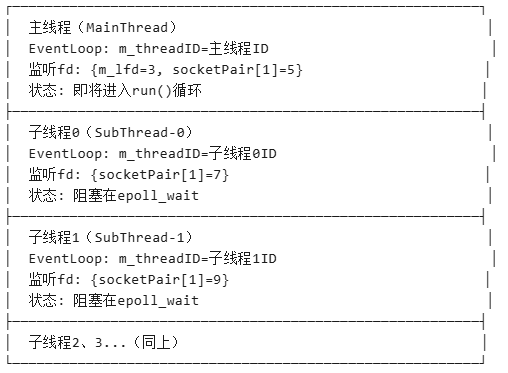
4、注册监听fd,主线程进入循环
4.1 注册m_lfd到主EventLoop中
// TcpServer.cpp
Channel* channel = new Channel(m_lfd, FDEvent::ReadEvent,
acceptConnection, nullptr, nullptr, this);
m_mainLoop->addTask(channel, ElemType::ADD);
addTask(channel, ADD)
└── 当前线程是主线程
└── processTaskQ()
└── add(channel)
├── m_channelMap[3] = channel // m_lfd=3
└── m_dispatcher->add()
└── FD_SET(3, &m_readSet)
主EventLoop现在监听的fd:{(3,m_lfd),(5,socketpair[1])}
4.2主线程进入循环
// EventLoop.cpp
int EventLoop::run()
{
m_isQuit = false;
while (!m_isQuit)
{
m_dispatcher->dispatch(); // select/epoll_wait 阻塞
processTaskQ(); // 处理任务队列
}
}
主线程阻塞在select(3,5),等待两个事件:
m_lfd=3可读--有新连接
socketpair[1]=5可读--处理任务
5、客户端连接
5.1 TCP三次握手完成,m_lfd可读
客户端SYN ──► 服务器SYN+ACK ──► 客户端ACK ──► 连接建立
│
▼
m_lfd=3 变为可读
│
▼
select/epoll_wait 返回
5.2 dispatch()检测到读事件
// SelectDispatcher.cpp
int SelectDispatcher::dispatch(int timeout)
{
fd_set rdtmp = m_readSet; // {3, 5}
select(m_maxSize, &rdtmp, NULL, NULL, &val);
for (int i = 0; i < m_maxSize; ++i)
{
if (FD_ISSET(i, &rdtmp)) // i=3 满足
{
m_evLoop->eventActive(i, (int)FDEvent::ReadEvent);
}
}
}
使用fd_set备份m_readSet,因为select()是破坏调用,返回时fd_set只保留就绪的fd
5.3 eventActive 调用回调
// EventLoop.cpp
int EventLoop::eventActive(int fd, int event)
{
Channel* channel = m_channelMap[fd]; // fd=3的Channel
assert(channel->getSocket() == fd);
if (event & ReadEvent && channel->readCallback)
{
channel->readCallback(const_cast<void*>(channel->getArg()));
// 即:acceptConnection(this)
}
}
作用:通过实参fd找到对应channel,再通过channel得到对应的回调函数,处理事件。
5.4 acceptConnection接受新连接
// TcpServer.cpp
int TcpServer::acceptConnection(void* arg)
{
TcpServer* server = static_cast<TcpServer*>(arg);
// 1. accept新连接
int cfd = accept(server->m_lfd, NULL, NULL); // cfd = 10(假设)
// 2. 轮询取一个子线程的EventLoop
EventLoop* evLoop = server->m_threadPool->takeWorkerEventLoop();
// 假设取到 SubThread-0 的 EventLoop
// 3. 创建TcpConnection,交给子线程处理
new TcpConnection(cfd, evLoop);
return 0;
}
5.5 ThreadPool::takeWorkerEventLoop() 轮询分配
// ThreadPool.cpp
EventLoop* ThreadPool::takeWorkerEventLoop()
{
EventLoop* evLoop = m_mainLoop; // 默认主线程
if (m_threadNum > 0)
{
evLoop = m_workerThreads[m_index]->getEventLoop();
m_index = ++m_index % m_threadNum; // 轮询
// 第一次:index=0 → SubThread-0
// 第二次:index=1 → SubThread-1
// ...
}
return evLoop;
}
作用:管理子线程集合,提供轮询取线程的接口。
面试点:为什么用轮询不用最小连接数?实现简单、无锁、公平。
6、TcpConnection创建
6.1 构造函数初始化资源
// TcpConnection.cpp
TcpConnection::TcpConnection(int fd, EventLoop* evloop) // fd=10, evloop=SubThread-0的
{
m_evLoop = evloop;
m_readBuf = new Buffer(10240); // 读缓冲区
m_writeBuf = new Buffer(10240); // 写缓冲区
m_request = new HttpRequest; // HTTP请求解析器
m_response = new HttpResponse; // HTTP响应构造器
m_name = "Connection-10";
// 创建Channel,绑定回调
m_channel = new Channel(fd, FDEvent::ReadEvent,
processRead, // 读回调
processWrite, // 写回调
destroy, // 销毁回调
this); // 参数传TcpConnection自身
// 注册到子线程的EventLoop!
evloop->addTask(m_channel, ElemType::ADD);
}
作用:封装一个TCP连接,管理读写缓冲和HTTP协议处理。
6.2跨线程注册Channel
当前线程:主线程
evloop:SubThread-0的EventLoop
evloop->addTask(m_channel, ADD)
│
└── m_threadID != this_thread::get_id() (子线程ID ≠ 主线程ID)
│
└── m_taskQ.push(node) // 任务入队
└── taskWakeup() // 唤醒子线程!
│
└── write(m_socketPair[0], "我是人!!!")
│
▼
子线程的socketPair[1]可读
│
▼
子线程从epoll_wait返回
│
▼
processTaskQ() 处理任务
│
└── add(m_channel)
├── m_channelMap[10] = channel
└── epoll_ctl(ADD, cfd=10, EPOLLIN)
作用:主线程往子线程的EventLoop里添加任务,先把任务放到子线程的任务队列里,然后往子线程的socketpair[0]里写数据,socketpair[1]可读,子线程从epoll_wait()被唤醒,处理任务。
7、客户端发送HTTP请求
7.1 客户端发送数据,cfd可读
客户端发送:GET /index.html HTTP/1.1\r\nHost: localhost\r\n\r\n
│
▼
cfd=10 变为可读
│
▼
SubThread-0的epoll_wait返回
7.2子线程dispatch,触发processRead
// EventLoop.cpp
eventActive(10, ReadEvent)
└── channel->readCallback(this) // processRead
7.3 processRead读取数据
// TcpConnection.cpp
int TcpConnection::processRead(void* arg)
{
TcpConnection* conn = static_cast<TcpConnection*>(arg);
int socket = conn->m_channel->getSocket(); // cfd=10
// 1. 读取数据到读缓冲区
int count = conn->m_readBuf->socketRead(socket);
// readBuf内容: "GET /index.html HTTP/1.1\r\nHost: localhost\r\n\r\n"
Debug("接收到的http请求数据: %s", conn->m_readBuf->data());
if (count > 0)
{
// 2. 解析HTTP请求
bool flag = conn->m_request->parseHttpRequest(
conn->m_readBuf, conn->m_response,
conn->m_writeBuf, socket);
}
}
8、HTTP解析与响应
8.1 parseHttpRequest状态机解析
// HttpRequest.cpp
bool HttpRequest::parseHttpRequest(Buffer* readBuf, HttpResponse* response,
Buffer* sendBuf, int socket)
{
while (m_curState != ParseReqDone)
{
switch (m_curState)
{
case ParseReqLine:
flag = parseRequestLine(readBuf); // 解析"GET /index.html HTTP/1.1"
break;
case ParseReqHeaders:
flag = parseRequestHeader(readBuf); // 解析"Host: localhost"
break;
case ParseReqBody:
// GET请求没有body,跳过
break;
}
if (m_curState == ParseReqDone)
{
// 解析完成,处理请求
processHttpRequest(response);
// 组织响应
response->prepareMsg(sendBuf, socket);
}
}
}
作用:状态机解析HTTP请求,处理静态资源(文件/目录),URL解码。
8.2 parseRequestLine
// HttpRequest.cpp
bool HttpRequest::parseRequestLine(Buffer* readBuf)
{
char* end = readBuf->findCRLF(); // 找\r\n
char* start = readBuf->data(); // 起始位置
// 分割方法、URL、版本
start = splitRequestLine(start, end, " ", methodFunc); // "GET"
start = splitRequestLine(start, end, " ", urlFunc); // "/index.html"
splitRequestLine(start, end, nullptr, versionFunc); // "HTTP/1.1"
readBuf->readPosIncrease(lineSize + 2); // 跳过请求行+\r\n
setState(ParseReqHeaders); // 进入下一状态
}
8.3 processHttpRequest处理请求
// HttpRequest.cpp
bool HttpRequest::processHttpRequest(HttpResponse* response)
{
// 只处理GET
if (strcasecmp(m_method.data(), "get") != 0) return -1;
m_url = decodeMsg(m_url); // URL解码
// 获取文件属性
struct stat st;
int ret = stat("index.html", &st); // /home/robin/luffy/index.html
if (ret == -1) // 文件不存在
{
response->setFileName("404.html");
response->setStatusCode(StatusCode::NotFound);
response->addHeader("Content-type", "text/html; charset=utf-8");
response->sendDataFunc = sendFile; // 回调函数
}
else // 文件存在
{
response->setFileName("index.html");
response->setStatusCode(StatusCode::OK);
response->addHeader("Content-type", "text/html; charset=utf-8");
response->addHeader("Content-length", to_string(st.st_size));
response->sendDataFunc = sendFile;
}
}
8.4 prepareMsg组织响应
// HttpResponse.cpp
void HttpResponse::prepareMsg(Buffer* sendBuf, int socket)
{
// 状态行
sprintf(tmp, "HTTP/1.1 200 OK\r\n");
sendBuf->appendString(tmp);
// 响应头
for (auto it = m_headers.begin(); it != m_headers.end(); ++it)
{
sprintf(tmp, "%s: %s\r\n", it->first.data(), it->second.data());
sendBuf->appendString(tmp);
}
// 空行
sendBuf->appendString("\r\n");
// 发送响应头
sendBuf->sendData(socket);
// 发送响应体(文件内容)
sendDataFunc(m_fileName, sendBuf, socket); // 调用sendFile
}
作用:HTTP响应头,通过回调函数发送响应体
8.5 sendFile发送文件内容
// HttpRequest.cpp
void HttpRequest::sendFile(string fileName, Buffer* sendBuf, int cfd)
{
int fd = open(fileName.data(), O_RDONLY); // 打开index.html
while (1)
{
char buf[1024];
int len = read(fd, buf, sizeof buf); // 读文件
if (len > 0)
{
sendBuf->appendString(buf, len); // 写入发送缓冲区
sendBuf->sendData(cfd); // 发送给客户端
}
else if (len == 0)
{
break; // 文件读完
}
}
close(fd);
}
9、数据发送与连接关闭
9.1 非MSG_SEND_AUTO模式
// TcpConnection.cpp
#ifndef MSG_SEND_AUTO
// 直接发送,然后断开连接
conn->m_evLoop->addTask(conn->m_channel, ElemType::DELETE);
#endif
9.2 remove释放资源
// EpollDispatcher.cpp
int EpollDispatcher::remove()
{
epollCtl(EPOLL_CTL_DEL); // 从epoll删除
// 通过channel释放TcpConnection资源
m_channel->destroyCallback(const_cast<void*>(m_channel->getArg()));
// 即:destroy(TcpConnection*)
}
10、freeChannel清理fd
// EventLoop.cpp
int EventLoop::freeChannel(Channel* channel)
{
auto it = m_channelMap.find(channel->getSocket());
if (it != m_channelMap.end())
{
m_channelMap.erase(it); // 从map删除
close(channel->getSocket()); // 关闭cfd=10
delete channel; // 释放Channel对象
}
return 0;
}
个人开发项目总结,有意找实习,恳请各位大牛捞下,欢迎私信,谢谢。

openEuler 是由开放原子开源基金会孵化的全场景开源操作系统项目,面向数字基础设施四大核心场景(服务器、云计算、边缘计算、嵌入式),全面支持 ARM、x86、RISC-V、loongArch、PowerPC、SW-64 等多样性计算架构
更多推荐


 2
2 0
0- 0


 已为社区贡献5条内容

所有评论(0)