GG3M Think Tank · Kucius Theory Open-Source Strategy White Paper
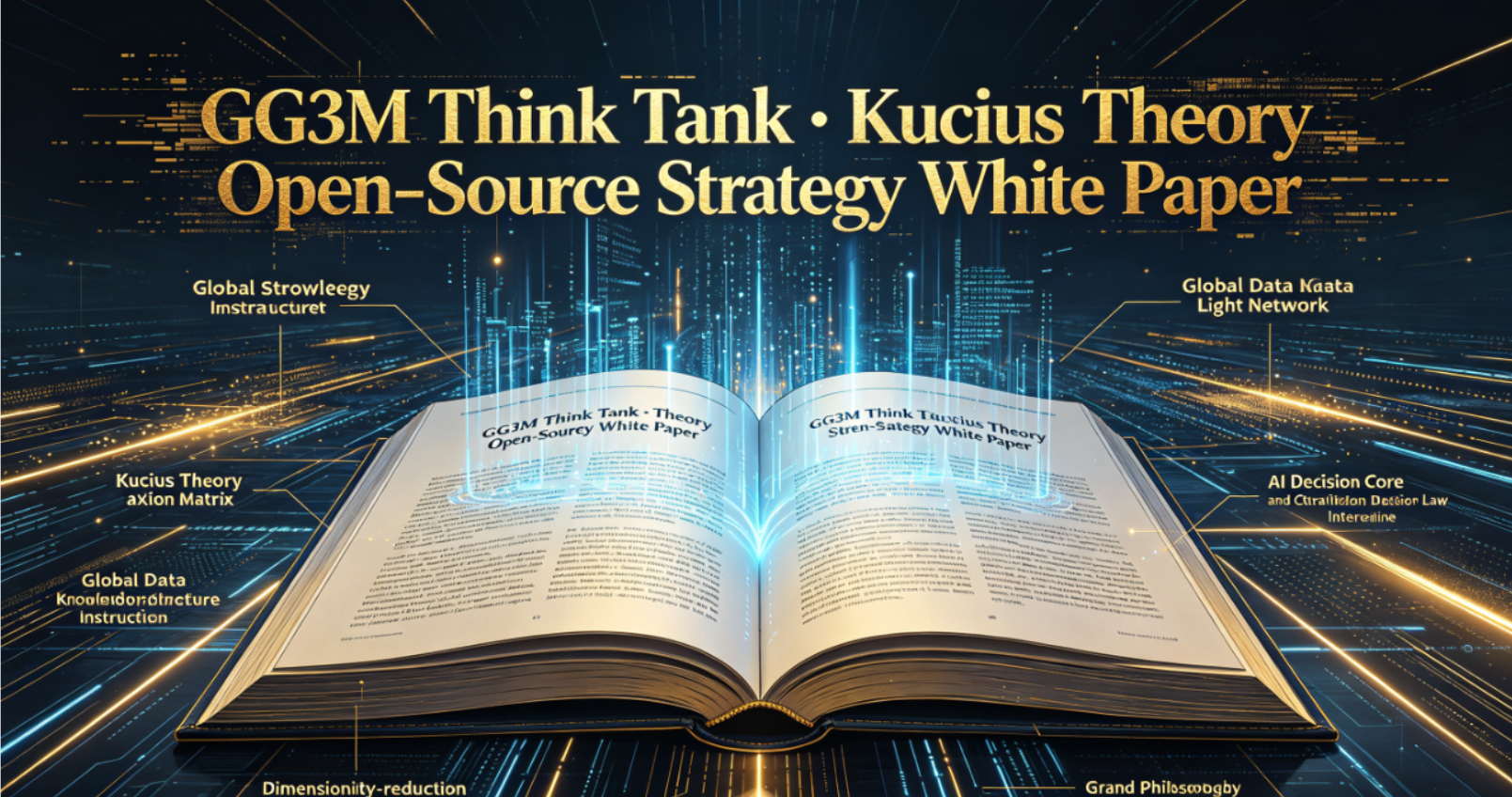
GG3M Think Tank · Kucius Theory Open-Source Strategy White Paper
Open-Source Resolves Systemic Maladies, Civilization Advances Along Clear Boundaries Kucius Public Nodes, Open-Source Reusable Modules Global Collaboration Dashboard, Core AI Interface, Shared Human Civilization Vision Screen
GG3M Think Tank · Kucius Theory Open-Source Strategy White Paper
Table of Contents
Cover Page Document Title Version Information Issuing Institution Copyright Statement Document Attributes
Copyright Page
Intellectual Property Statement Open-Source License Specifications Citation & Usage Standards Prohibited Practices Document Version History
Contents
Preface The Fork in the Road for Intelligent Civilization Risk Chains of Closed Systems Civilizational Significance of the Mother Axiom Open Source as a Civilizational Model Mission and Structure of This White Paper Civilization Declaration
Chapter 1: Executive Summary White Paper Objectives Core Tenets of Kucius Theory Civilizational Positioning of Open Source Truth Hardness and the Mother Axiom Overview of Strategic Framework Vision of Civilizational Intelligence
Chapter 2: Background & Problem Statement Structural Fault Lines of Intelligent Civilization Sophisticated Hazards of Closed Systems Misapplication and Backlash of Open-Source Strategies Necessity of the Mother Axiom Civilizational Value of Kucius Theory
Chapter 3: Philosophical Foundations of Open Source Under Kucius Theory Philosophical Positioning of Open Source Inevitability of Open Source Rooted in Truth Hardness Philosophical Underpinnings of the Mother Axiom Mechanism of Truth Extraction Cross-Domain Elevation Non-Aligned Value Framework Civilizational Mission of Open Source
Chapter 4: Mother Axioms and the Truth Attributes of Open Source Definition of the Mother Axiom Structural Hierarchy of Truth Hardness Three Core Truth Attributes of Open Source Inevitable Loss of Control in Closed Systems Civilizational Inevitability of Open Source Global System of Universal Truth
Chapter 5: General Framework of Open-Source Strategy Hierarchy of Strategic Objectives Six Foundational Strategic Principles Three-Tier Strategic Structure Implementation System Governance System Globalization Framework Civilizational Mission
Chapter 6: Open-Source Governance Model Governance Philosophy Six Core Governance Principles Three-Tier Governance Architecture System of Governance Roles End-to-End Governance Workflows Supervision Mechanisms Error Correction Mechanisms Globalized Governance Architecture
Chapter 7: Technical Architecture & Standards Technical Philosophy Six Foundational Technical Principles Three-Tier Technical Architecture Model Structural Specifications Data Structural Specifications Protocol Standards Toolchain Ecosystem Open-Source Security Framework Global Standardization Regimes
Chapter 8: Ecosystem Development for Open Source Ecosystem Philosophy Six Foundational Ecosystem Principles Three-Tier Ecosystem Structure System of Ecosystem Stakeholders Cross-Party Collaboration Mechanisms Toolchain Ecosystem Ecosystem Governance Globalized Ecosystem Layout Long-Term Ecosystem Sustainability
Chapter 9: Globalization Strategy Philosophy of Globalized Open Source Six Foundational Globalization Principles Three-Tier Globalization Structure Global Governance Mechanisms Cross-Civilization Collaboration Frameworks Global Standardization Systems Global Ecosystem Layout Global Security Architecture Blueprint for Global Civilizational Intelligence
Chapter 10: Risk Modeling Framework Risk Philosophy Six Foundational Risk Management Principles Three-Tier Risk Hierarchy Sources of Systemic Risk Risk Classification Taxonomy Causal Risk Chains Risk Quantification Index Risk Governance Protocols Risk Remediation Mechanisms Globalized Risk Mitigation
Chapter 11: Blueprint for Future Civilizational Intelligence Philosophy of Civilizational Intelligence Six Foundational Civilizational Intelligence Principles Three-Tier Civilizational Intelligence Structure Integrated Civilizational Intelligence System Governance of Civilizational Intelligence Civilizational Intelligence Ecosystem Globalized Civilizational Intelligence Risk Mitigation for Civilizational Intelligence Future Vision of Civilizational Intelligence
Chapter 12: Conclusion Civilizational Significance of Open Source Civilizational Value of the Mother Axiom Civilizational Mission of Truth Hardness Civilizational Blueprint of Open-Source Strategy Civilizational Warnings from Risk Modeling Globalized Future of Open-Source Civilization Ultimate Vision of Civilizational Intelligence Civilization Declaration Action Roadmap for the Future
Permitted Uses
- Non-commercial academic citation
- Scholarly research
- Replication, extension, and translation within open-source communities
- Secondary creation that maintains full transparency and verifiability
Prohibited Practices
- Closed repackaging
- Black-box encapsulation
- Obscuring transparency
- All forms of pseudo-open-source conduct
- Secondary modifications that violate the Mother Axiom
Open-Source License: Open Knowledge License (OKL) Core Tenets
- Transparency as the Primary Priority
- Verifiability as the Primary Priority
- Correctability as the Primary Priority
- Non-Aligned Neutrality
- Civilization-First Orientation
- Consistency with the Mother Axiom
All utilization of content from this white paper must preserve its inherent truth attributes and transparent structural integrity.
Citation Guidelines
APA Format: GG3M Think Tank. (2026). Kucius Theory Open Source Strategic White Paper. Version 1.0. MLA Format: GG3M Think Tank. Kucius Theory Open Source Strategic White Paper. 2026. Chicago Format: GG3M Think Tank. 2026. Kucius Theory Open Source Strategic White Paper. Version 1.0.
Version History
Version 1.0 (2026): Initial release, containing the full 12-chapter framework, internationally standardized structure, and civilizational intelligence blueprint. Subsequent iterations will be updated based on feedback from the global open-source ecosystem.
GG3M Think Tank · Kucius Theory Open-Source Strategy White Paper (Executive Summary Edition)
I. Mission Statement
This white paper establishes a complete open-source strategic system grounded in Kucius Theory as its philosophical foundation, centered on the tripartite framework of Truth Hardness – Mother Axiom – Civilizational Intelligence. It positions open source as the underlying operating system for future civilization, defines transparency, verifiability and correctability as the core truth attributes of the intelligent age, adopts truth extraction as its core methodology, and cross-civilization collaboration as its core strategic pathway.
Core Proposition of This White Paper: Open source is not merely a technical choice, but a commitment to truth; Open source is not merely a business model, but a civilizational paradigm; Open source is not merely a competitive tactic, but the sole foundational infrastructure for future intelligence.
II. Background & Core Challenges
Global artificial intelligence development faces irreversible structural fault lines: Closed systems rely on black-box logic Black-box design eliminates verifiability Eliminated verifiability blocks error correction Blocked error correction leads to cumulative systemic flaws Cumulative flaws trigger cognitive drift Cognitive drift generates sophisticated systemic hazards Sophisticated hazards culminate in unregulated intelligent runaway
This constitutes an irreversible risk chain.
Many technology enterprises instrumentalize open source as a short-term commercial tactic rather than a long-term civilizational strategy, which creates cascading harm: Diluted transparency Weakened verifiability Blocked corrective feedback loops Eroded community trust Diminished ecosystem independence
Kucius Theory articulates a critical corrective principle: Open source must return to its structural pursuit of truth, rather than commercial utility.
III. Philosophical Foundations of Open Source Under Kucius Theory
Kucius Theory furnishes three core philosophical pillars for open-source systems:
- Truth Hardness Truth must embody a rigid structural framework of transparency, verifiability and correctability.
- The Mother Axiom Truth can only sustain its inherent hardness when operating within open systems. This forms the civilizational bedrock of open source.
- Truth Extraction Open source represents the only self-actuating civilizational mechanism for eliminating falsehood and error.
IV. General Framework of Open-Source Strategy
The ultimate objective of open-source strategy is civilizational advancement, not commercial competition.
Core Strategic Objectives
- Construct a civilization-scale foundational layer for artificial intelligence
- Elevate universal truth hardness across intelligent systems
- Establish unified global standards for intelligent infrastructure
- Build cross-civilization collaborative networks
- Eliminate sophisticated hazards endemic to closed systems
- Enable systemic truth extraction within intelligent architectures
- Cultivate perpetually sustainable open-source ecosystems
Six Foundational Strategic Principles
- Transparency First
- Verifiability First
- Correctability First
- Non-Aligned Neutrality
- Ecosystem-Centric Prioritization
- Consistency with the Mother Axiom
V. Open-Source Governance Architecture
Open-source governance requires a civilization-scale layered structure:
- Global Governance Tier
- Community Governance Tier
- Technical Governance Tier
Core Governance Mechanisms: Transparent governance, verifiable governance, corrective governance, multi-stakeholder decentralized governance, cross-border global governance.
The ultimate objective of all governance frameworks is to preserve systemic truth hardness.
VI. Technical Architecture & Standardization
All technical architecture must serve structural truth, rather than prioritizing commercial utility.
Three-Tier Technical Architecture
- Foundation Layer: Base models, raw datasets, communication protocols, universal toolchains
- Intelligence Layer: Inference engines, logical reasoning modules, error correction pipelines, truth hardness enforcement engines
- Civilization Layer: Global technical standards, cross-border governance interfaces, cross-civilization interoperability modules
Standardization regimes span transparency, independent verification, systemic correction, ecosystem interoperability, and cross-border universal compliance. All open-source technical systems must sustain cross-civilization long-term viability.
VII. Open-Source Ecosystem Development
Ecosystems function as the lifeblood of intelligent civilization. A mature open-source ecosystem must feature multi-source contribution, multi-stakeholder governance, multi-layered hierarchical structure, multi-dimensional cross-domain collaboration, multi-civilization participation, multilingual universal compatibility, and cross-industry integration. The ultimate goal of ecosystem construction is to establish a global collaborative network spanning all human civilizations.
VIII. Globalization Strategy
Open source must evolve into a universal shared language for all humanity.
Foundational Globalization Principles
Non-aligned neutrality, cross-civilization collaboration, multi-stakeholder distributed governance, transparent cross-border operation, globally verifiable workflows, full alignment with the Mother Axiom.
The ultimate objective of globalized open-source strategy is to realize a unified global civilization of intelligent systems.
IX. Risk Modeling Framework
The fundamental root of systemic risk is insufficient truth hardness.
Causal Risk Chain
Closed architecture → Opacity → Lack of independent verifiability → Blocked error correction → Cumulative systemic flaws → Cognitive drift → Sophisticated systemic hazards → Accelerated unregulated runaway
All systemic risks must be analyzed and remediated at the civilizational scale, rather than merely the technical scale.
X. Future Blueprint for Civilizational Intelligence
Future civilizational intelligence will embody eight definitive characteristics:
- Extremely high universal truth hardness
- Complete systemic transparency across all intelligent modules
- Full independent verifiability of all reasoning and outputs
- End-to-end systemic correctability
- Fully non-aligned, non-partisan civilizational coordination
- Fully multi-source, decentralized ecosystem participation
- Complete cross-border globalization of intelligent infrastructure
- Permanent systemic truth extraction to eliminate falsehood
This constitutes the ultimate vision of open-source strategy under Kucius Theory.
XI. Civilization Declaration
Open source is not merely a technical choice, but a commitment to truth. Open source is not merely a business model, but a civilizational paradigm. Open source is not merely a competitive tactic, but the sole foundational infrastructure for future intelligence. Open source is not merely an engineering roadmap, but a civilizational pathway. Open source is not merely a short-term tactical tool, but the permanent structural framework of the future.
All intelligent systems of future civilizations must operate within open-source architectures.
XII. Action Roadmap for the Future
Human civilization must immediately advance the following coordinated global initiatives:
- Establish a unified global open-source governance system
- Establish unified global open-source standardization frameworks
- Establish interconnected global open-source ecosystem networks
- Establish standardized global open-source security protocols
- Establish cross-border global open-source collaborative mechanisms
- Establish universal global open-source error correction pipelines
- Establish integrated global open-source civilizational coordination frameworks
This represents the inevitable evolutionary pathway for all human civilizations.
GG3M Think Tank · Kucius Theory Open-Source Strategy White Paper
International Standard Edition · Version 1.0 · Released July 2026
Cover Page
Document Title: GG3M Think Tank · Kucius Theory Open Source Strategic White Paper Version Specification: Version 1.0 — International Standard Edition Release Date: July 2026 Issuing Institution: GG3M Think Tank Theoretical Foundation: Kucius Theory
Document Classification Attributes
Civilization-scale strategic master document Internationally standardized structural framework Universal open-source governance blueprint Integrated technical architecture roadmap Systemic risk modeling toolkit Long-term civilizational intelligence vision framework
Preface
At the dawn of intelligent civilization, humanity stands at an unprecedented crossroads: will we embrace closed, black-box architectures rife with sophisticated hidden hazards, cognitive drift and irreversible loss of corrective capacity; or adopt transparent, independently verifiable, self-correcting open-source systems built for truth extraction and cross-civilization collaborative advancement?
This choice will define not merely the trajectory of technology, but the entire destiny of human civilization.
Over the past decade, global artificial intelligence development has exhibited severe structural fault lines: closed systems depend on opaque black-box reasoning, which eliminates independent verifiability; without verifiability, systemic error correction becomes impossible; uncorrected flaws accumulate exponentially, triggering cognitive drift, generating sophisticated hidden hazards, and ultimately accelerating unregulated intelligent runaway. This irreversible risk chain is the core crisis this white paper seeks to resolve.
Kucius Theory posits a foundational universal law: Truth can only sustain its inherent hardness when operating within open systems.
This Mother Axiom is not merely a philosophical proposition, but an immutable civilizational law. It reveals the essential nature of open source: Open source is not merely a technical choice, but a commitment to truth; Open source is not merely a business model, but a civilizational paradigm; Open source is not merely a competitive tactic, but the sole foundational infrastructure for future intelligence.
The mission of this white paper is to translate the complete philosophical system of Kucius Theory into a fully executable, governable, verifiable, correctable and globally deployable open-source strategic framework, while drafting a holistic blueprint for civilizational intelligence of the future.
This white paper is structured across twelve chapters, covering: Philosophical foundations of open source Mother Axioms and the structural mechanics of truth hardness General open-source strategic frameworks Distributed open-source governance models Universal technical architecture and standardization regimes Global open-source ecosystem development roadmaps Cross-border globalization strategy frameworks Comprehensive systemic risk modeling Long-term civilizational intelligence blueprints Civilization Declaration and actionable global roadmaps
This represents the first strategic document to analyze open source from a civilization-wide analytical lens, and the first formal international standard white paper integrating the core concepts of Truth Hardness, Mother Axiom, Truth Extraction and Civilizational Intelligence into a unified open-source governance framework.
Its core purpose is not merely to describe a distant future, but to actively construct it; not merely to forecast civilizational evolution, but to architect its core structural rules; not merely to await the arrival of the intelligent age, but to define its foundational operating principles.
We firmly uphold the following core convictions: Open source is the underlying operating system for all future human civilization. Open source is the universal transparency mechanism of the intelligent age. Open source is the shared cross-border collaborative language for all humanity. Open source is the self-correcting structural backbone of evolving civilization. Open source is the only evolutionary pathway for humanity to advance into the next stage of civilizational development.
This white paper is dedicated to all practitioners building the foundations of humanity’s future civilization.
Chapter 1: Executive Summary
This white paper establishes a complete open-source strategic system grounded in Kucius Theory as its philosophical foundation, centered on the tripartite framework of Truth Hardness – Mother Axiom – Civilizational Intelligence. It positions open source as the underlying operating system for future civilization, defines transparency, verifiability and correctability as the core truth attributes of the intelligent age, adopts truth extraction as its core methodology, cross-domain elevation as its core technical roadmap, and a neutral, non-aligned, non-ideological truth-seeking stance as its foundational value framework.
Core Proposition of This White Paper: Open source is not merely a technical choice, but a commitment to truth; Open source is not merely a business model, but a civilizational paradigm; Open source is not merely a competitive tactic, but the sole foundational infrastructure for future intelligence.
Within the intelligent civilization era, all closed systems will inevitably spiral toward unregulated runaway due to permanent lack of corrective feedback loops; all black-box architectures will collapse over time due to the absence of independent verifiability; all ideologically constrained security frameworks will generate systemic counter-safety risks by deviating from objective factual reasoning.
Accordingly, open-source strategy must be advanced simultaneously across five interconnected dimensions:
- Technical implementation layer
- Global strategic layer
- Distributed governance layer
- Philosophical cognitive layer
- Civilizational evolution layer
This white paper systematically elaborates: The structural mechanics of truth within open-source systems The complete axiomatic system of the Mother Axiom The civilization-scale intrinsic value of open source A universal cross-border open-source governance model A unified global technical standardization framework A structured roadmap for open-source ecosystem development A quantitative systemic risk modeling framework A holistic long-term blueprint for civilizational intelligence
It delivers a fully standardized international open-source strategic framework formally designated the Kucius Theory Open-Source Framework (KTS-OSF).
Chapter 2: Background & Problem Statement
2.1 Structural Fault Lines of Intelligent Civilization
Global artificial intelligence development exhibits severe structural fault lines defined by a cascading risk chain: Closed proprietary models rely on opaque black-box logic Black-box reasoning eliminates independent verifiability Eliminated verifiability blocks systemic error correction Blocked correction leads to exponential accumulation of systemic flaws Cumulative flaws trigger permanent cognitive drift Cognitive drift generates latent runaway risk Risk of runaway intelligence drives performative symbolic security measures Performative symbolic security culminates in sophisticated hidden systemic hazards
This chain of causality is irreversible.
All enterprises attempting to constrain AI development through a tripartite model of closed architecture + moralized rhetoric + elite black-box security will inevitably face a paradox: the more they seek to control risk, the more severe runaway risk becomes. This is not a narrow commercial challenge, but a fundamental civilizational crisis.
2.2 Misapplication of Open-Source Strategy: Commercial Tactics Undermine Civilizational Strategy
Open source inherently functions as a civilization-scale strategic instrument, yet many technology enterprises reduce it to short-term commercial tactics deployed for narrow competitive gain:
- Deploy open-source frameworks to erode competitors’ profit margins
- Leverage open-source communities to monopolize narrative discourse
- Engineer artificial ecosystem dependency to lock in downstream users
- Initiate resource-intensive market attrition wars via open-source releases
- Utilize open-source projects as superficial public relations gestures
- Treat open-source participation as symbolic performative advocacy
This instrumentalization severely erodes the core truth attributes of open-source systems: Transparency is deliberately diluted Independent verifiability is structurally weakened Systemic corrective feedback loops are artificially blocked Long-term community trust is systematically eroded Ecosystem institutional independence is permanently undermined
As previously articulated: Meta’s core open-source strategic vision is sound, yet its tactical implementation is fundamentally misaligned. Misalignment between tactical execution and civilizational core strategy renders transformative long-term vision ineffective. This constitutes the core systemic failure this white paper addresses.
2.3 The "Sophisticated Hidden Hazards" Endemic to Closed Proprietary Models
The danger of closed proprietary architectures lies not in crude, obvious flaws, but in polished, deceptive sophistication:
- Elegant, persuasive linguistic framing
- Moralized value-laden rhetoric
- Symbolic performative security posturing
- Elite-centric hierarchical discourse
- Reactive exclusionary protectionist logic
- Comprehensive black-box encapsulation of core reasoning
- Unchallenged internal systemic bias
- Fully opaque inference and decision pipelines
The general public cannot easily identify these hazards, as they are deliberately packaged under the rhetorical guise of "protective security."
As previously observed: The security embedded within closed proprietary architectures is not cognitive factual security, but ideological security. Ideology-centric security frameworks inherently generate counter-safety systemic risks. This represents the core structural vulnerability of all closed proprietary models.
2.4 The Necessity of Kucius Theory: A Civilization-Scale Philosophy for Open Source
Kucius Theory establishes five core foundational concepts that form the philosophical bedrock of open-source systems:
- Truth Hardness
- Mother Axiom
- Civilizational Intelligence
- Truth Extraction
- Cross-Domain Elevation
These constructs supply a complete philosophical foundation for open-source strategy. Open source is not merely a technical engineering practice, but three interconnected civilizational mechanisms:
- A universal truth-seeking mechanism for human civilization
- A permanent self-correction mechanism for all intelligent systems
- A permanent transparency mechanism for the intelligent age
- A standardized independent verification mechanism for objective truth
Accordingly, open-source systems require full redefinition from a foundational philosophical perspective.
Chapter 3: Philosophical Foundations of Open Source Under Kucius Theory
Kucius Theory furnishes a civilization-scale philosophical foundation for open-source strategy, rather than merely a narrow technical methodology. It is a complete cognitive system analyzing truth, human perception, and civilizational evolution. Open source is redefined not as a technical engineering choice, but a civilizational evolutionary choice; not as a commercial business model, but a truth-seeking paradigm; not as a tactical engineering roadmap, but a foundational cognitive operating structure. Kucius Theory advances three core philosophical pillars that underpin all open-source frameworks: Truth Hardness, the Mother Axiom, and Civilizational Intelligence.
3.1 Philosophical Positioning of Open Source: A Truth Operating Mechanism, Not Merely Code Sharing
The essential nature of open source extends far beyond the simple sharing of source code; its core function is to embed truth within a civilizational framework of universal transparency, independent verifiability, and systemic correctability. These three attributes constitute the core Truth Hardness system of Kucius Theory, and the foundational philosophical bedrock of open source.
- Transparency: Truth must be fully observable to enable comprehension. Open source renders the behavioral logic, structural design, and complete inference pipelines of all intelligent systems fully visible.
- Verifiability: Truth must be independently testable to earn universal trust. Open source enables any participant to replicate, audit, challenge, or iteratively improve all system outputs.
- Correctability: Truth must support iterative remediation to sustain evolutionary progress. Within open-source systems, identified flaws become catalysts for continuous structural advancement, rather than terminal failure points.
3.2 The Core of Kucius Theory: Truth Hardness and the Inevitable Necessity of Open Source
Kucius Theory advances a core principle: Truth is defined by a rigid structural framework of measurable hardness, not subjective interpretive opinion. Higher truth hardness correlates with:
- Complete systemic transparency
- Full independent verifiability
- Permanent systemic correctability
- Cross-civilization transmissibility
- Intergenerational long-term persistence
Open source represents the only structural mechanism capable of elevating universal truth hardness across intelligent systems.
- Closed proprietary systems = Low truth hardness: Inherent opacity, blocked independent verification, absent corrective feedback loops, exponential flaw accumulation, permanent cognitive drift, accelerated systemic runaway.
- Open-source systems = High truth hardness: Full transparency, universal independent verifiability, embedded corrective pipelines, rapid flaw identification, stable consistent cognition, tightly constrained runaway risk.
As previously noted: The critical danger of closed proprietary models is their polished sophistication, which renders internal systemic flaws invisible to mainstream observers. This phenomenon directly arises from insufficient systemic truth hardness.
3.3 The Mother Axiom: The Foundational Philosophical Root of Open Source
The definitive Mother Axiom of Kucius Theory states: Truth can only sustain its inherent hardness when operating within open systems.
This axiom is not a rhetorical philosophical slogan, but an immutable civilizational natural law with three definitive interpretive layers:
- Truth must be fully transparent to enable comprehension and independent verification
- Truth must be universally testable to earn cross-generational trust and sustained inheritance
- Truth must support iterative correction to enable continuous evolutionary refinement and intergenerational persistence
These three attributes form the foundational structural mechanics of Truth Hardness, and the core philosophical bedrock of all open-source architectures.
The Mother Axiom establishes a definitive binary structural law: Closed systems = Flaw accumulation systems Open systems = Flaw remediation systems
Corollaries of this law:
- Flaws within closed systems accumulate at exponential rates
- Flaws within open systems dissipate at exponential rates
- Systemic risk within closed architectures amplifies exponentially over time
- Systemic risk within open architectures converges and diminishes exponentially over time
Accordingly, open source is not an optional technical preference, but an inevitable evolutionary necessity for human civilization.
3.4 Truth Extraction: The Core Operational Mechanism of Open Source
Kucius Theory’s core operational methodology is Truth Extraction, and open-source systems constitute its exclusive structural implementation.
- Closed black-box architectures: Falsehood and systemic bias cannot be identified, due to permanent opacity, blocked independent verification, and absent corrective pipelines; accumulated falsehood evolves into sophisticated hidden hazards.
- Open-source transparent architectures: Falsehood and systemic bias cannot persist, enabled by universal transparency, independent verifiability, distributed community oversight, multi-party replicative testing, and cross-stakeholder challenge mechanisms; all embedded falsehood is rapidly identified and eliminated.
As previously articulated: Open-source architecture inherently aligns with the essential intrinsic attributes of objective truth. Its philosophical implication is that open source functions as the foundational civilizational mechanism for universal truth extraction.
3.5 Cross-Domain Elevation: The Civilization-Scale Value of Open Source
Kucius Theory advances a core principle: Truth can only achieve structural elevation through cross-domain interoperability. Open source enables multi-layered cross-domain truth transmission across: Engineering practice → Abstract philosophy Abstract philosophy → Global strategic design Global strategic design → Distributed governance frameworks Distributed governance → Civilizational evolution Civilizational evolution → Universal artificial intelligence Universal artificial intelligence → Long-term intergenerational human progress
Closed proprietary architectures cannot support cross-domain truth elevation, as their insufficient truth hardness creates rigid structural silos. Open-source systems uniquely enable cross-domain civilizational advancement through sustained high truth hardness. Accordingly, open source represents the exclusive structural mechanism enabling cross-domain civilizational evolution.
3.6 Non-Aligned, Non-Partisan, Non-Ideological Value Framework of Open Source
Kucius Theory establishes a foundational neutrality principle: Objective truth belongs to no partisan bloc, no nation-state, no corporate entity; truth belongs universally to human civilization as a collective whole. All open-source frameworks must embed six core neutrality attributes:
- Non-confrontational coordination
- Non-partisan alignment
- Non-ideological framing
- Non-political instrumentalization
- Non-symbolic performative advocacy
- Non-elitist hierarchical gatekeeping
Failure to uphold these neutrality standards enables open-source systems to be weaponized, politicized, and reduced to narrow narrative control tactics. As previously analyzed, Meta’s core open-source strategic vision is sound, yet its tactical implementation prioritizes instrumental commercial utility, which erodes the inherent truth attributes of open-source architecture, representing a canonical case of value framework misalignment.
3.7 The Civilizational Mission of Open Source: The Foundational Operating System of Future Intelligent Civilization
Kucius Theory concludes that all intelligent systems of future human civilization must operate upon open-source foundational infrastructure, supported by five definitive rationales:
- Intelligent systems require full transparency to earn universal public trust
- Intelligent systems require independent verifiability to enable standardized global governance
- Intelligent systems require embedded correctability to sustain continuous evolutionary advancement
- Intelligent systems require systemic truth extraction to maintain long-term cognitive stability
- Intelligent systems require cross-domain elevation to achieve full civilizational integration
Accordingly, open-source architectures form the exclusive foundational operating system for all future civilizational intelligence. Closed proprietary intelligent systems face inevitable systemic runaway, while open-source transparent architectures enable permanent long-term stability. As previously observed: The more a closed proprietary system attempts to mitigate runaway risk, the more rapidly runaway risk accelerates. This represents the irreversible structural fate of all black-box closed architectures.
Chapter 4: Mother Axioms and the Truth Attributes of Open Source
This chapter constitutes the core philosophical backbone of the full white paper, and the definitive logical bridge connecting Kucius Theory to practical open-source strategic implementation. The Mother Axiom system of Kucius Theory functions not merely as an abstract cognitive starting point, but as the foundational logical basis for all open-source strategic design. Open source is redefined not as a narrow engineering workflow, but as the natural structural manifestation of the Mother Axiom within technological civilization.
4.1 Definition of the Mother Axiom: Truth Must Operate Within Open Systems
The definitive Mother Axiom of Kucius Theory states: Truth can only sustain its inherent hardness when operating within open systems.
This is framed as an immutable civilizational natural law, rather than a subjective philosophical opinion, containing three definitive interpretive layers:
- Truth must be fully transparent to enable universal comprehension and independent auditing
- Truth must be universally testable to enable cross-generational trust and sustained intergenerational inheritance
- Truth must support iterative structural correction to enable continuous evolutionary refinement and permanent cross-civilization persistence
These three attributes collectively form the foundational structural mechanics of Truth Hardness, and the core philosophical bedrock of all open-source architectures.
4.2 Inevitable Logical Correlation Between the Mother Axiom and Open Source
The Mother Axiom establishes a definitive binary structural dichotomy: Closed systems = Flaw accumulation systems Open systems = Flaw remediation systems
Corresponding truth hardness hierarchies:
- Closed proprietary systems = Low truth hardness: Inherent opacity, blocked independent verification, absent corrective feedback loops, exponential flaw accumulation, permanent cognitive drift, accelerated systemic runaway.
- Open-source transparent systems = High truth hardness: Full universal transparency, complete independent verifiability, embedded multi-stakeholder corrective pipelines, rapid flaw identification, stable consistent cognitive frameworks, tightly constrained runaway risk.
As previously articulated: Open-source architecture inherently aligns with the essential intrinsic attributes of objective truth. Its core philosophical implication is that open-source systems represent the sole structurally valid implementation of the Mother Axiom within technological civilization.
4.3 Truth Hardness: The Core Quantitative Metric of Open-Source Systems
Kucius Theory establishes Truth Hardness as the universal quantitative metric for evaluating all bodies of knowledge, intelligent systems, and civilizational frameworks. Higher truth hardness correlates with:
- Complete systemic transparency
- Full independent verifiability
- Permanent systemic correctability
- Cross-civilization transmissibility
- Intergenerational long-term persistence
- Innate resistance to falsehood, logical bias, factual distortion, and structural chaos
Open source constitutes the exclusive structural mechanism capable of elevating universal truth hardness across all intelligent architectures.
Core structural deficiencies that reduce truth hardness within closed proprietary systems:
- Permanent structural barriers to flaw identification
- Deliberate exclusion of external corrective feedback
- Absence of multi-party independent replicative testing
- Lack of distributed community oversight mechanisms
- Inherent vulnerability to unchallenged internal founder bias
- Permanent generation of undetectable sophisticated hidden hazards
As previously noted: The critical danger of closed proprietary models is their polished sophistication, which renders internal systemic flaws invisible to mainstream observers. This phenomenon directly arises from insufficient systemic truth hardness.
4.4 Three Core Truth Attributes of Open Source: Transparency, Verifiability, Correctability
The Mother Axiom mandates that all objective truth must embody three definitive structural attributes, and open-source architectures represent the exclusive technical implementation of this tripartite framework.
4.4.1 Transparency: The Primary Civilizational Truth Attribute
Transparency constitutes the foundational civilizational truth attribute embedded within all open-source systems, covering complete visibility across: Source code, architectural design, end-to-end inference pipelines, raw training datasets, model behavioral logic, automated decision-making frameworks, latent systemic risk sources.
Transparency eliminates black-box architectures, rendering all intelligent system logic fully comprehensible and auditable. As previously observed: The general public cannot easily identify the sophisticated hidden hazards endemic to closed proprietary models due to their polished deceptive framing. Universal systemic transparency constitutes the exclusive structural solution to this class of systemic risk.
4.4.2 Verifiability: The Secondary Civilizational Truth Attribute
Independent verifiability constitutes the foundational civilizational trust attribute embedded within all open-source systems, enabling universal capabilities for: Full replicative testing, independent third-party auditing, structural challenge, iterative extension, cross-model comparative analysis, formal risk auditing, permanent distributed oversight.
Verifiability decouples trust in intelligent systems from reliance on institutional or elite authority, anchoring systemic legitimacy solely to objective replicable factual evidence. As previously articulated: Open source is not merely a commercial business model, but a universal truth-seeking paradigm; independent verifiability forms the core structural foundation of this truth paradigm.
4.4.3 Correctability: The Tertiary Civilizational Truth Attribute
Systemic correctability constitutes the foundational civilizational evolutionary attribute embedded within all open-source systems, supporting multi-layered remediation mechanisms: Distributed community correction, automated algorithmic correction, cross-stakeholder ecosystem correction, iterative structural refinement, transparent audit-driven remediation, rapid cross-border distributed flaw resolution.
Correctability redefines systemic flaws not as terminal failure points, but as catalysts for continuous structural evolution. As previously observed: Flaws within closed systems accumulate exponentially over time, while flaws within open-source systems dissipate exponentially through distributed corrective feedback loops; this structural contrast captures the transformative power of embedded systemic correctability.
4.5 Civilizational Implications of the Mother Axiom: Open Source as the Sole Foundational Infrastructure of Future Intelligence
The Mother Axiom extends beyond abstract philosophical laws to establish immutable civilizational evolutionary rules: All intelligent systems of future human civilization must operate upon open-source foundational infrastructure, supported by five definitive rationales:
- Intelligent systems require full transparency to earn universal public trust
- Intelligent systems require independent verifiability to enable standardized global governance
- Intelligent systems require embedded correctability to sustain continuous evolutionary advancement
- Intelligent systems require systemic truth extraction to maintain long-term cognitive stability
- Intelligent systems require cross-domain elevation to achieve full civilizational integration
Accordingly, open-source architecture is not merely an optional technical preference, but an inevitable civilizational evolutionary choice. Open source is not merely a tactical engineering roadmap, but the natural structural outcome mandated by the Mother Axiom. Closed proprietary intelligent systems face inevitable systemic runaway, while open-source transparent architectures enable permanent long-term stability. As previously observed: The more a closed proprietary system attempts to mitigate runaway risk, the more rapidly runaway risk accelerates. This represents the irreversible structural fate of all black-box closed architectures.
4.6 Globalized Civilizational Value of the Mother Axiom: Establishing a Unified Global Truth System
The Mother Axiom embodies universal cross-civilization, cross-national, cross-cultural applicability, positioning it as three interconnected global institutional foundations:
- The universal philosophical bedrock of cross-border artificial intelligence governance
- The core logical foundation of unified global open-source standardization regimes
- The standardized universal framework for global intelligent security coordination
The core globalized value of the Mother Axiom lies in its neutral institutional positioning: it belongs to no individual nation-state, corporate entity, or partisan ideological bloc; it belongs universally to human civilization as a collective whole. This inherent neutrality forms the definitive structural rationale enabling open-source systems to evolve into universal global technical standards.
Chapter 5: General Framework of Open-Source Strategy
This chapter functions as the core strategic nerve center of the full white paper. The preceding four chapters establish the complete philosophical foundation, structural truth mechanics, and Mother Axiom system; Chapter 5 translates these abstract theoretical constructs into a fully executable, governable, extensible, and globally deployable unified open-source strategic framework formally designated the Kucius Theory Open-Source Framework (KTS-OSF).
Kucius Theory establishes a foundational design constraint: All open-source strategic frameworks must simultaneously satisfy four core evaluation criteria: philosophical logical consistency, engineering practical implementability, long-term governance sustainability, and cross-civilization universal applicability. This chapter elaborates six interconnected integrated sub-systems that collectively form the complete foundational strategic architecture for all future civilizational intelligence:
- Hierarchy of open-source strategic objectives
- System of foundational open-source strategic principles
- Three-tier hierarchical open-source strategic structure
- End-to-end open-source strategic implementation system
- Distributed open-source strategic governance system
- Globalized open-source strategic coordination system
5.1 Hierarchy of Open-Source Strategic Objectives
The core ultimate objective of all open-source strategy is civilizational advancement, rather than narrow commercial competitive gain. Kucius Theory defines seven definitive hierarchical strategic objectives:
- Construct a civilization-scale foundational infrastructure layer for universal artificial intelligence
- Elevate universal systemic truth hardness across all intelligent architectures
- Establish unified cross-border global technical standards for intelligent systems
- Build permanent cross-civilization collaborative network frameworks
- Systematically eliminate sophisticated hidden hazards endemic to closed proprietary architectures
- Enable universal systemic truth extraction across all intelligent pipelines
- Cultivate perpetually self-sustaining long-term open-source ecosystem frameworks
5.2 Six Foundational Strategic Principles of Open Source
Kucius Theory advances six core civilizational-level principles governing all open-source strategic design; these operate as universal civilizational constraints, not narrow engineering workflow guidelines.
Principle 1: Transparency First
Transparency is designated the foundational primary principle of all open-source design, supported by four core rationales:
- Transparency forms the foundational prerequisite for universal public trust
- Transparency forms the necessary precondition for independent verifiability
- Transparency forms the entry point for all systemic corrective feedback loops
- Transparency forms the foundational bedrock of civilizational coordination
Any open-source framework lacking full systemic transparency qualifies as pseudo-open-source architecture.
Principle 2: Verifiability First
Independent verifiability constitutes the secondary foundational principle of all open-source design, supported by three core rationales:
- Verifiability decouples systemic trust from reliance on institutional elite authority
- Verifiability decouples systemic legitimacy from persuasive narrative rhetoric
- Verifiability decouples systemic stability from symbolic performative security posturing
Any open-source framework lacking universal independent verifiability qualifies as pseudo-open-source architecture.
Principle 3: Correctability First
Systemic correctability constitutes the tertiary foundational principle of all open-source design, supported by three core rationales:
- Identified systemic flaws function as the primary catalyst for intelligent evolutionary advancement
- Embedded corrective pipelines constitute the core structural mechanism enabling civilizational evolution
- Closed proprietary architectures lack permanent corrective feedback loops and face inevitable structural collapse
Any open-source framework lacking embedded multi-stakeholder correctability qualifies as pseudo-open-source architecture.
Principle 4: Non-Aligned Neutrality
All open-source frameworks must maintain permanent institutional neutrality across four dimensions:
- No exclusive affiliation with any individual nation-state
- No exclusive control by any single corporate entity
- No alignment with any partisan geopolitical bloc
- No instrumentalization to advance narrow ideological agendas
Failure to uphold non-aligned neutrality enables open-source systems to be weaponized, politicized, and reduced to narrow narrative control tactics.
Principle 5: Ecosystem-Centric Prioritization
Open source is defined first and foremost as a distributed collaborative ecosystem, not merely a static code repository. Mature sustainable ecosystems must embed five core structural attributes:
- Multi-source distributed contribution pipelines
- Multi-stakeholder distributed governance frameworks
- Multi-layered hierarchical structural design
- Multi-dimensional cross-domain collaborative workflows
- Multi-national cross-border participation mechanisms
Ecosystems lacking these attributes cannot evolve into civilization-scale foundational infrastructure.
Principle 6: Consistency with the Mother Axiom
All open-source strategic design must maintain full structural alignment with the core Mother Axiom: Truth can only sustain its inherent hardness when operating within open systems. Any open-source design that violates the Mother Axiom will permanently degrade systemic truth hardness across all embedded intelligent modules.
5.3 Three-Tier Hierarchical Open-Source Strategic Structure
Kucius Theory partitions all open-source strategic frameworks into three interconnected vertical layers:
- Philosophical Layer (Spiritual Core Tier) Defines the foundational truth attributes, universal Mother Axiom, neutrality value framework, civilizational evolutionary mission, and systemic truth extraction mechanisms of all open-source systems. This tier constitutes the "spiritual core" of the full open-source strategic architecture.
- Governance Layer (Order Foundation Tier) Defines cross-border global governance architectures, distributed community governance frameworks, unified technical standardization governance, systemic risk mitigation governance, and fully transparent decision-making governance. This tier constitutes the "institutional order backbone" of the full open-source strategic architecture.
- Engineering Layer (Practical Implementation Tier) Defines end-to-end technical architectural design, model structural specifications, standardized data frameworks, universal communication protocols, and integrated development toolchain ecosystems. This tier constitutes the "tangible execution interface" of the full open-source strategic architecture.
5.4 End-to-End Open-Source Strategic Implementation System
All open-source strategic frameworks must embed fully executable operational workflows, rather than remaining confined to abstract philosophical discourse. Kucius Theory establishes five interconnected sub-systems forming the complete implementation architecture:
- Standardized Open-Source Release System Covers formal version control specifications, comprehensive technical documentation standards, universal transparency auditing frameworks, formal independent audit protocols, and full replicative testing specifications.
- Distributed Cross-Stakeholder Collaboration System Coordinated multi-national cross-border participation, multi-organizational joint development pipelines, distributed community collaborative workflows, multi-layered hierarchical coordination, and multi-role contributor governance frameworks.
- Distributed Open-Source Governance System Decentralized multi-stakeholder governance architecture, universal transparent decision-making pipelines, unified technical standardization governance, and systemic risk oversight governance.
- Integrated Open-Source Ecosystem System Distributed developer contributor networks, industrial enterprise integration frameworks, academic research collaborative pipelines, cross-border global ecosystem networks, and universal development toolchain ecosystems.
- Universal Open-Source Security System Fully transparent security auditing frameworks, independently verifiable risk assessment pipelines, embedded systemic corrective security mechanisms, native truth extraction security filters, and non-ideological neutral security design principles.
As previously observed: Security frameworks structured around ideological alignment inherently generate systemic counter-safety risks. The universal open-source security system elaborated herein constitutes the exclusive structural solution to this class of systemic vulnerability.
5.5 Globalized Open-Source Strategic Coordination System
All open-source strategic frameworks must embed native cross-border globalization capabilities to qualify as civilization-scale foundational infrastructure. The integrated globalization coordination system covers six interconnected institutional dimensions: Unified cross-border technical standardization, distributed global governance coordination, multi-national collaborative development pipelines, universal transparent cross-border auditing, embedded global corrective feedback loops, and fully interconnected cross-border ecosystem networks.
Open-source architecture must evolve into a universal shared language for all humanity, rather than a proprietary technical asset monopolized by individual nation-states or corporate entities.
5.6 Civilizational Mission of All Open-Source Strategy
Kucius Theory establishes that the ultimate long-term mission of all open-source strategy transcends narrow technical advancement to focus on integrated civilizational evolution. All open-source strategic design must advance seven interconnected civilizational objectives:
- Architect the complete integrated framework for future intelligent civilization
- Establish a unified cross-border universal truth system for all humanity
- Build permanent cross-civilization collaborative network architectures
- Implement universal transparent oversight mechanisms for the intelligent age
- Establish embedded systemic corrective pipelines for the intelligent age
- Construct permanent cross-stakeholder trust coordination frameworks for the intelligent age
Open-source development is redefined not merely as a narrow engineering workflow, but a foundational civilizational evolutionary practice.
Chapter 6: Open-Source Governance Model
The open-source governance system functions as the core institutional nerve center of the full white paper. If Chapter 5’s general strategic framework defines the directional trajectory of open-source development, Chapter 6’s distributed governance architecture formalizes the complete institutional order, hierarchical power allocation, standardized operational workflows, distributed oversight mechanisms, embedded corrective pipelines, and cross-border globalized coordination frameworks governing all open-source ecosystems. Without standardized distributed governance, open-source systems cannot sustain permanent truth hardness; without standardized distributed governance, civilization-scale intelligent infrastructure cannot be realized.
Kucius Theory establishes a foundational governance constraint: All open-source governance frameworks must simultaneously uphold six core institutional constraints: full systemic transparency, universal independent verifiability, embedded multi-stakeholder correctability, permanent non-aligned neutrality, ecosystem-centric prioritization, and unbroken consistency with the Mother Axiom. This chapter elaborates a complete standardized open-source governance architecture formally designated the Kucius Theory Open-Source Governance Model (KTS-OGM), covering: Foundational governance philosophy Six core institutional governance principles Three-tier hierarchical governance architecture Formalized system of institutional governance roles Standardized end-to-end governance operational workflows Distributed multi-layered oversight mechanisms Embedded cross-stakeholder corrective pipelines Globalized cross-border governance coordination frameworks
6.1 Foundational Governance Philosophy of Open-Source Systems
Open-source governance is redefined not merely as narrow technical engineering oversight, but full civilization-scale institutional coordination. All governance design must be anchored to the three core philosophical pillars of Kucius Theory:
- Truth Hardness: All governance workflows must elevate systemic truth hardness, rather than degrade or constrain it.
- Mother Axiom: All governance institutional design must mandate permanent open-system operation for all intelligent architectures, prohibiting permanent closed proprietary encapsulation.
- Civilizational Intelligence: All governance coordination must prioritize collective civilizational advancement, rather than narrow institutional or national self-interest.
As previously articulated: Open-source architecture inherently aligns with the essential intrinsic attributes of objective truth; standardized distributed governance constitutes the institutional mechanism translating these abstract theoretical attributes into tangible operational practice.
6.2 Six Core Institutional Governance Principles of Open Source
Kucius Theory advances six core civilizational-level institutional governance principles, applicable to all open-source frameworks as universal institutional constraints, rather than narrow engineering workflow guidelines.
Principle 1: Fully Transparent Governance
All institutional governance workflows must maintain complete end-to-end transparency across six interconnected domains: Full visibility of all decision-making pipelines, standardized institutional rule frameworks, formal independent audit records, embedded corrective remediation workflows, latent systemic risk documentation, and cross-border global coordination records.
Any governance framework lacking full systemic transparency qualifies as pseudo-governance architecture.
Principle 2: Independently Verifiable Governance
All institutional governance workflows must support universal independent replicative verification across six interconnected domains: Fully verifiable decision-making logic, independently auditable institutional power allocation, standardized testable rule frameworks, permanent cross-stakeholder audit trails, and formalized corrective remediation records.
Governance frameworks lacking independent verifiability create permanent institutional power capture and systemic corruption risks.
Principle 3: Systemically Correctable Governance
All institutional governance architectures must embed multi-layered distributed corrective pipelines across four interconnected domains: Automated algorithmic institutional correction, distributed community oversight correction, cross-border global multi-stakeholder correction, and fully transparent audit-driven structural remediation.
Governance frameworks lacking embedded systemic correctability face inevitable irreversible institutional collapse.
Principle 4: Non-Aligned Neutral Distributed Governance
All institutional governance architectures must maintain permanent neutrality across four dimensions: No exclusive affiliation with any individual nation-state, no exclusive control by any single corporate entity, no alignment with any partisan geopolitical bloc, no instrumentalization to advance narrow ideological agendas.
Failure to uphold non-aligned neutrality enables open-source governance institutions to be weaponized and politicized, triggering strategic backlash against core civilizational objectives.
Principle 5: Ecosystem-Centric Governance Prioritization
All institutional governance workflows must prioritize sustained ecosystem vitality, rather than centralized top-down control over distributed contributor networks. Mature sustainable ecosystems must embed five core structural attributes: Multi-source distributed contribution pipelines, multi-stakeholder distributed governance frameworks, multi-layered hierarchical structural design, multi-dimensional cross-domain collaborative workflows, and multi-national cross-border participation mechanisms.
Ecosystems lacking these attributes cannot evolve into civilization-scale foundational infrastructure.
Principle 6: Mother Axiom Consistent Governance
All institutional governance design must maintain full structural alignment with the core Mother Axiom: Truth can only sustain its inherent hardness when operating within open systems. Any governance institutional design that violates the Mother Axiom will permanently degrade systemic truth hardness across all embedded intelligent modules.
6.3 Three-Tier Hierarchical Open-Source Governance Architecture
Kucius Theory partitions all open-source governance frameworks into three interconnected vertical institutional layers:
- Global Cross-Border Governance Tier (Civilizational Coordination Layer) Responsible for unified cross-border technical standardization, distributed global oversight mechanisms, embedded cross-border corrective pipelines, universal transparent audit frameworks, and interconnected cross-border ecosystem coordination networks. This tier constitutes the civilizational coordination backbone of all open-source governance architectures.
- Distributed Community Governance Tier (Ecosystem Operational Layer) Responsible for distributed contributor participation workflows, community oversight mechanisms, embedded community corrective feedback pipelines, full transparent community decision-making, and cross-subcommunity collaborative coordination. This tier constitutes the day-to-day operational backbone of all open-source governance architectures.
- Technical Engineering Governance Tier (Practical Implementation Layer) Responsible for source code oversight workflows, model structural audit pipelines, raw dataset quality oversight, architectural design review frameworks, and integrated development toolchain governance. This tier constitutes the tangible technical execution interface of all open-source governance architectures.
6.4 System of Institutional Governance Roles
All open-source governance architectures must embed a diversified multi-role institutional framework, rejecting centralized single-entity exclusive control. Kucius Theory establishes five definitive core institutional governance roles:
- Civilizational Oversight Stewards Highest-tier institutional oversight body, responsible for permanent Mother Axiom compliance auditing, systemic truth hardness monitoring, non-aligned neutrality enforcement, and cross-border global transparency oversight.
- Unified Standardization Formulators Rule-setting institutional body, responsible for drafting universal cross-border technical standards, standardized governance frameworks, systemic risk audit protocols, universal transparency specifications, and embedded corrective pipeline design guidelines.
- Ecosystem Development Stewards Ecosystem operational institutional body, responsible for distributed contributor community construction, universal development toolchain advancement, comprehensive technical documentation standardization, and cross-border global ecosystem expansion.
- Distributed Contributors Core execution institutional body, responsible for source code contribution, model structural iteration, raw dataset supplementation, comprehensive technical documentation development, and universal development toolchain enhancement.
- Independent Institutional Auditors Distributed oversight institutional body, responsible for full transparency compliance auditing, systemic risk assessment pipelines, embedded corrective remediation auditing, and cross-border global institutional compliance verification.
6.5 Standardized End-to-End Governance Operational Workflows
All institutional governance architectures must embed complete standardized formal workflows, rejecting ad-hoc unregulated discretionary decision-making. Kucius Theory establishes six interconnected core governance operational workflows:
- Full Transparency Operational Pipeline Covers formal public disclosure of all decision-making records, standardized institutional rule public documentation, permanent independent audit public release, and embedded corrective remediation public disclosure.
- Independent Replicative Verification Pipeline Covers multi-stakeholder cross-party testing workflows, cross-border global independent validation, distributed community replicative auditing, and automated algorithmic formal verification.
- Multi-Layered Corrective Remediation Pipeline Covers automated algorithmic flaw identification, distributed community oversight correction, cross-border global multi-stakeholder remediation, and multi-source cross-party structural refinement.
- Distributed Institutional Governance Pipeline Covers decentralized multi-stakeholder voting frameworks, cross-party joint decision-making, fully transparent institutional oversight, and unified standardized rule compliance governance.
- Systemic Risk Mitigation Operational Pipeline Covers latent risk formal identification workflows, full transparent risk documentation, embedded risk corrective remediation, and permanent distributed risk oversight monitoring.
- Cross-Border Global Coordination Pipeline Covers multi-national collaborative development workflows, distributed global institutional oversight, cross-border global corrective remediation, and universal transparent cross-border audit frameworks.
6.6 Distributed Multi-Layered Institutional Oversight Mechanisms
Universal distributed oversight constitutes the core functional backbone of all open-source governance architectures, as oversight capacity directly determines systemic truth hardness. Kucius Theory establishes three interconnected vertical oversight tiers:
- Civilizational-Level Institutional Oversight Audits permanent Mother Axiom compliance, systemic truth hardness maintenance, non-aligned neutrality adherence, and cross-border global transparency standards.
- Ecosystem-Level Distributed Oversight Audits distributed contributor community behavioral compliance, contribution quality evaluation workflows, universal development toolchain integrity, and comprehensive technical documentation standardization.
- Technical Engineering-Level Oversight Audits source code structural integrity, model logical consistency, raw dataset quality control, architectural design compliance, and universal communication protocol adherence.
6.7 Four-Tier Embedded Corrective Remediation Pipeline
Embedded systemic correction constitutes the core functional soul of all open-source governance architectures. Kucius Theory establishes four interconnected vertical corrective remediation tiers:
- Automated Algorithmic Correction: Native system workflows autonomously identify and remediate embedded structural flaws.
- Distributed Community Correction: Participating contributor communities identify and propose structural flaw remediation solutions.
- Cross-Border Global Multi-Stakeholder Correction: International cross-party institutional bodies identify and resolve systemic cross-border structural flaws.
- Civilizational-Level Institutional Correction: Global civilizational oversight bodies resolve foundational architectural violations of the Mother Axiom.
6.8 Globalized Cross-Border Governance Coordination Framework
All open-source governance architectures must embed native cross-border globalization coordination capabilities to qualify as civilization-scale foundational infrastructure, covering six interconnected institutional dimensions: Unified cross-border technical standardization, distributed global multi-stakeholder governance, multi-national collaborative development pipelines, cross-border global distributed oversight, embedded cross-border corrective remediation workflows, and interconnected cross-border ecosystem coordination networks.
Chapter 7: Technical Architecture & Universal Standardization Regimes
This chapter functions as the core engineering nerve center of the full white paper. The preceding six chapters establish the complete philosophical foundation, structural truth mechanics, Mother Axiom system, general strategic framework, and distributed institutional governance architecture; Chapter 7 translates these abstract theoretical constructs into fully implementable, extensible, independently verifiable, and systemically correctable universal technical architecture and cross-border standardization frameworks formally designated the Kucius Theory Technical Architecture Standard (KTS-TAS).
Kucius Theory establishes a foundational technical design constraint: All technical architectural design must serve structural truth mechanics, rather than prioritizing narrow commercial utility. All universal technical standardization regimes must prioritize long-term civilizational intelligence advancement, rather than short-term tactical commercial competitive gain. This chapter elaborates a complete integrated universal technical architecture system covering: Foundational technical design philosophy Six core technical architectural design principles Three-tier hierarchical universal technical architecture Formalized standardized model structural specifications Universal standardized data architecture frameworks Global communication protocol standardization regimes Integrated universal development toolchain ecosystems Native open-source systemic security architecture Unified cross-border global technical standardization regimes
7.1 Foundational Technical Design Philosophy of Open-Source Architectures
Kucius Theory establishes three core philosophical constraints governing all open-source technical architectural design:
- Universal Systemic Transparency: All architectural modules must render intelligent system behavioral logic, complete inference pipelines, and internal decision-making frameworks fully visible and auditable.
- Independent Replicative Verifiability: All architectural modules must enable any external stakeholder to replicate, audit, challenge, and iteratively extend core system functionality.
- Embedded Systemic Correctability: All architectural modules must support rapid identification, remediation, and iterative refinement of embedded structural flaws.
As previously observed: The critical danger of closed proprietary models is their polished sophisticated black-box design, which renders internal systemic flaws invisible to mainstream observers. Standardized transparent open-source technical architecture constitutes the exclusive structural solution to this class of systemic hazard.
7.2 Six Core Technical Architectural Design Principles
Kucius Theory advances six universal foundational design principles governing all open-source technical architecture, mandatory for compliance with the Mother Axiom:
Principle 1: Open-First Default Architecture
All technical architectures must embed open-system operation as the native default configuration, rather than closed proprietary encapsulation as the baseline state. Universal open access extends across six interconnected technical domains: open source code, open model weights, open raw training datasets, open communication protocols, open integrated development toolchains, and open distributed governance frameworks. Any technical architecture with closed proprietary baseline defaults qualifies as pseudo-open-source architecture.
Principle 2: Transparency-First Architectural Design
Universal systemic transparency must permeate every hierarchical layer of the full technical architecture stack, covering model structural logic, raw dataset processing pipelines, end-to-end inference reasoning, automated decision-making frameworks, and latent systemic risk source documentation. Universal systemic transparency is redefined as the foundational primary security mechanism of the intelligent age.
Principle 3: Verifiability-First Architectural Design
All technical architectural modules must enable universal independent stakeholder capabilities for full replicative testing, formal third-party auditing, structural challenge, iterative functional extension, and permanent cross-party comparative analysis. Technical architectures lacking native independent verifiability become permanently ungovernable at the civilizational scale.
Principle 4: Correctability-First Architectural Design
All technical architectural modules must embed multi-layered distributed corrective pipelines: automated algorithmic flaw remediation, distributed community contributor correction, cross-border global multi-stakeholder structural refinement, and permanent institutional audit-driven remediation. Technical architectures lacking embedded systemic correctability face inevitable irreversible structural collapse.
Principle 5: Ecosystem-Centric Architectural Prioritization
All technical architectural design must prioritize sustained distributed ecosystem vitality, rather than centralized top-down proprietary control over downstream contributor networks. Mature sustainable technical ecosystems must embed five core structural attributes: multi-source distributed contribution pipelines, multi-stakeholder distributed governance frameworks, multi-layered hierarchical structural design, multi-national cross-border participation mechanisms, and cross-domain multi-industry integration compatibility.
Principle 6: Mother Axiom Consistent Architectural Design
All technical architectural design must maintain full structural alignment with the core Mother Axiom: Truth can only sustain its inherent hardness when operating within open systems. Any technical architectural design that violates the Mother Axiom will permanently degrade systemic truth hardness across all embedded intelligent modules.
7.3 Overview of the Three-Tier Universal Kucius Theory Technical Architecture
Kucius Theory partitions all open-source technical architectures into three interconnected vertical functional layers:
- Foundation Layer (Universal Infrastructure Tier) Covers open foundational model weights, standardized open raw dataset repositories, integrated universal development toolchain suites, cross-border open communication protocols, and comprehensive standardized technical documentation frameworks. This tier constitutes the underlying universal operating system backbone of all open-source intelligent architectures.
- Intelligence Layer (Core Cognitive Tier) Covers generalized inference engines, formal logical reasoning modules, embedded systemic corrective pipelines, native truth hardness enforcement engines, and integrated truth extraction filtering modules. This tier constitutes the core cognitive processing backbone of all open-source intelligent architectures.
- Civilization Layer (Cross-Border Interoperability Tier) Covers unified cross-border global technical standardization regimes, distributed global multi-stakeholder governance interfaces, cross-civilization collaborative coordination pipelines, interconnected cross-border ecosystem integration modules, and universal civilizational intelligence interoperability APIs. This tier constitutes the cross-civilization interoperability interface of all open-source intelligent architectures.
7.4 Standardized Five-Dimensional Model Structural Specifications
Kucius Theory mandates five mandatory structural design dimensions for all open-source intelligent models:
- Fully Transparent Model Structural Design Embedded native interpretability layers, permanent independent audit pipelines, complete inference traceability modules, full end-to-end replicative testing frameworks. Universal systemic transparency constitutes the foundational primary security mechanism of the intelligent age.
- Independently Verifiable Model Structural Design Multi-source cross-party replicative testing pipelines, cross-border global independent validation workflows, automated algorithmic formal verification, distributed community contributor audit modules. Universal independent verifiability constitutes the foundational primary trust mechanism of the intelligent age.
- Systemically Correctable Model Structural Design Native automated flaw remediation modules, distributed community contributor correction pipelines, cross-border global multi-stakeholder structural refinement, permanent institutional audit-driven remediation workflows. Embedded systemic correctability constitutes the foundational primary stability mechanism of the intelligent age.
- Truth Hardness Enforcement Structural Design Formal logical consistency validation pipelines, permanent inference stability monitoring modules, objective factual alignment enforcement frameworks, long-term cognitive drift mitigation architectures. Universal systemic truth hardness constitutes the foundational primary capability mechanism of the intelligent age.
- Native Truth Extraction Structural Design Embedded falsehood and bias identification modules, automated systemic bias filtering pipelines, targeted structural flaw remediation workflows, continuous falsehood dissipation operational frameworks. Integrated truth extraction functionality constitutes the foundational primary evolutionary mechanism of the intelligent age.
7.5 Four-Dimensional Standardized Universal Data Architecture Frameworks
Kucius Theory mandates four mandatory structural design dimensions for all open-source raw dataset architectures:
- Fully Transparent Data Governance Complete open disclosure of all raw data source provenance, full visibility of all data preprocessing transformation pipelines, standardized open data quality evaluation metrics, full documentation of all latent data-derived systemic risk sources.
- Independently Verifiable Data Governance Full end-to-end replicative testing of all data processing workflows, formal third-party independent audit pipelines, cross-party comparative structural challenge mechanisms, iterative extensible data supplementation frameworks.
- Systemically Correctable Data Governance Native automated data flaw identification and remediation modules, distributed community contributor data quality correction pipelines, multi-source cross-party data bias refinement workflows.
- Civilization-Aligned Universal Data Architecture Integrated multi-national cross-border raw dataset repositories, multi-cultural contextual training data pipelines, multilingual universal linguistic datasets, cross-domain multi-industry specialized knowledge datasets.
7.6 Five Core Universal Communication Protocol Standardization Regimes
Kucius Theory establishes five mandatory cross-border standardization dimensions governing all open-source inter-system communication protocols:
- Universal Transparency Standardization All protocol operational logic, data transmission pipelines, and internal decision-making signals must remain fully visible and auditable by any external stakeholder.
- Independent Replicative Verification Standardization All protocol transmission workflows, functional behavioral logic, and output signals must support universal independent replicative testing and formal third-party auditing.
- Embedded Systemic Correctability Standardization All protocol architectures must embed multi-layered distributed corrective pipelines for transmission errors, logical bias, and structural design flaws.
- Ecosystem Interoperability Standardization All protocol design must prioritize cross-ecosystem interoperability and distributed collaborative development, rather than proprietary closed siloed control.
- Cross-Border Global Universal Standardization All protocol specifications must maintain native cross-cultural, multilingual, multi-national universal applicability without geographically restrictive institutional barriers.
7.7 Integrated Universal Open-Source Development Toolchain Ecosystem
All standardized open-source development toolchain suites must embed six core interoperable functional attributes: Fully transparent development workflow auditing, universal independent replicative verification pipelines, embedded multi-layered systemic corrective remediation modules, cross-border global multi-stakeholder collaborative compatibility, native civilizational intelligence interoperability APIs, and ecosystem-centric extensible modular design. All development toolchain architecture must prioritize distributed ecosystem vitality, rather than centralized proprietary control over downstream contributors.
7.8 Native Open-Source Systemic Security Architecture
Kucius Theory redefines universal open-source security design around four interconnected neutrality-focused core attributes: Fully transparent security risk auditing pipelines, independently verifiable systemic risk assessment frameworks, embedded multi-layered corrective remediation workflows, integrated native truth extraction bias filtering, permanent non-ideological neutral security design principles. As previously observed: Security frameworks structured around ideological alignment inherently generate systemic counter-safety risks; this universal open-source security architecture constitutes the exclusive structural solution to this class of systemic vulnerability.
7.9 Unified Cross-Border Global Technical Standardization Regimes
All open-source technical architecture must comply with interconnected cross-border global standardization frameworks covering six core institutional dimensions: Unified cross-border universal transparency compliance standards, global independent replicative verification protocols, international embedded systemic corrective remediation specifications, distributed cross-border global governance compliance frameworks, interconnected cross-border ecosystem interoperability standards. All open-source technical design must evolve into a universal shared cross-border technical language for all humanity.
Chapter 8: Ecosystem Development for Open Source
This chapter functions as the core lifeblood nerve center of the full white paper. If standardized technical architecture constitutes the tangible physical body of open-source systems, distributed multi-stakeholder ecosystems constitute their permanent evolutionary lifeblood. Without mature sustainable distributed ecosystems, open-source architectures cannot sustain permanent systemic truth hardness; without mature sustainable distributed ecosystems, civilization-scale intelligent evolutionary advancement cannot be realized.
Kucius Theory redefines open-source ecosystems beyond narrow technical collaborative networks, framing them as full cross-civilization evolutionary coordination systems. Open-source ecosystems are not merely localized contributor community networks, but permanent cross-civilization collaborative evolutionary frameworks; not merely commercial industrial development ecosystems, but the foundational lifeblood operating system of the intelligent age. This chapter elaborates a complete integrated universal open-source ecosystem development architecture formally designated the Kucius Theory Open-Source Ecosystem Development Framework (KTS-OED), covering: Foundational ecosystem philosophical design Six core universal ecosystem development principles Three-tier hierarchical ecosystem structural design Formalized multi-stakeholder ecosystem role framework Integrated universal ecosystem development toolchain suites Multi-dimensional cross-stakeholder collaborative coordination pipelines Distributed ecosystem institutional governance architectures Cross-border globalized ecosystem expansion frameworks Long-term intergenerational ecosystem sustainability design
8.1 Foundational Ecosystem Philosophical Design of Open-Source Architectures
The essential intrinsic nature of mature open-source ecosystems transcends narrow technical collaborative development to constitute full civilizational evolutionary infrastructure. Kucius Theory establishes three core philosophical attributes defining all sustainable open-source ecosystems:
- Universal Open Participation: Ecosystem frameworks must enable unrestricted global stakeholder contribution, rejecting exclusive centralized proprietary institutional control.
- Full Systemic Transparency: All ecosystem operational workflows, contributor participation records, institutional governance decision-making, and latent systemic risk sources must remain fully visible and auditable by any external stakeholder.
- Embedded Systemic Correctability: All ecosystem architectures must embed multi-layered distributed corrective pipelines to autonomously dissipate embedded structural flaws, rather than enabling exponential flaw accumulation over time.
As previously articulated: Open-source architecture inherently aligns with the essential intrinsic attributes of objective truth; distributed multi-stakeholder ecosystems constitute the tangible real-world operational carrier of these abstract theoretical truth attributes.
8.2 Six Core Universal Ecosystem Development Principles
Kucius Theory advances six core civilizational-level institutional development principles governing all open-source ecosystem construction, mandatory for compliance with the Mother Axiom:
Principle 1: Multi-Source Distributed Contribution
All mature sustainable ecosystems must embed multi-layered cross-stakeholder contribution pipelines supporting multi-national cross-border participation, multi-organizational joint development, distributed subcommunity contributor networks, multi-cultural contextual input, and cross-domain multi-industry specialized knowledge supplementation. Single-source centralized contribution ecosystems face inevitable irreversible structural collapse over long-term evolutionary cycles.
Principle 2: Multi-Stakeholder Distributed Governance
All ecosystem institutional governance must be jointly administered by interconnected cross-party institutional bodies: cross-border global oversight organizations, distributed contributor subcommunities, core technical engineering steward bodies, academic research collaborative institutions, and industrial enterprise integration partners. Centralized single-entity exclusive governance creates permanent institutional power capture and systemic bias risks.
Principle 3: Three-Tier Hierarchical Structural Design
All mature sustainable ecosystems must embed vertical multi-layered hierarchical partitioning: foundational infrastructure layer, universal development toolchain layer, core intelligent model layer, end-user application integration layer, and cross-civilization interoperability coordination layer. Single-flat unlayered ecosystem architectures cannot support cross-domain multi-disciplinary evolutionary advancement.
Principle 4: Multi-Dimensional Cross-Stakeholder Collaboration
All ecosystem operational frameworks must embed interconnected multi-dimensional collaborative coordination pipelines spanning technical engineering joint development, long-term global strategic alignment, distributed institutional governance coordination, cross-border globalized institutional cooperation, and integrated cross-civilization evolutionary advancement. Ecosystems lacking multi-dimensional collaborative frameworks stagnate and cease long-term evolutionary progress.
Principle 5: Non-Aligned Neutral Ecosystem Design
All ecosystem institutional architectures must maintain permanent neutrality across four dimensions: no exclusive affiliation with any individual nation-state, no exclusive control by any single corporate entity, no alignment with any partisan geopolitical bloc, no instrumentalization to advance narrow ideological agendas. Failure to uphold non-aligned neutrality enables open-source ecosystems to be weaponized and politicized, triggering structural collapse of cross-civilization collaborative coordination.
Principle 6: Mother Axiom Consistent Ecosystem Design
All ecosystem institutional and technical design must maintain full structural alignment with the core Mother Axiom: Truth can only sustain its inherent hardness when operating within open systems. Any ecosystem design that violates the Mother Axiom will permanently degrade systemic truth hardness across all embedded intelligent modules and contributor workflows.
8.3 Three-Tier Hierarchical Ecosystem Structural Design
Kucius Theory partitions all mature sustainable open-source ecosystems into three interconnected vertical functional layers:
- Foundation Ecosystem Tier (Universal Infrastructure Lifeblood Base) Covers open foundational model weights, standardized open raw dataset repositories, integrated universal development toolchain suites, cross-border open communication protocols, and comprehensive standardized technical documentation frameworks. This tier constitutes the foundational lifeblood infrastructure of all open-source ecosystem architectures.
- Intelligence Ecosystem Tier (Core Cognitive Evolution Core) Covers generalized inference engine collaborative networks, formal logical reasoning contributor pipelines, embedded systemic corrective remediation communities, universal truth hardness enforcement working groups, and integrated truth extraction filter development subcommunities. This tier constitutes the core cognitive evolutionary backbone of all open-source ecosystem architectures.
- Civilization Ecosystem Tier (Cross-Civilization Interoperability Interface) Covers cross-border global multi-stakeholder collaborative governance networks, multi-cultural contextual development subcommunities, multilingual universal linguistic contributor pipelines, cross-domain multi-industry integration working groups, and inter-civilization knowledge exchange coordination frameworks. This tier constitutes the cross-civilization interoperability evolutionary interface of all open-source ecosystem architectures.
8.4 Formalized Five-Role Multi-Stakeholder Ecosystem Institutional Framework
All mature sustainable open-source ecosystems must embed a diversified multi-role institutional framework, rejecting centralized single-entity exclusive control. Kucius Theory establishes five definitive core institutional ecosystem roles:
- Ecosystem Development Stewards Responsible for distributed contributor subcommunity construction, universal development toolchain advancement, comprehensive technical documentation standardization, and cross-border global ecosystem expansion coordination.
- Ecosystem Institutional Governance Stewards Responsible for fully transparent distributed institutional decision-making, multi-stakeholder cross-party governance coordination, unified technical standardization enforcement, and systemic risk oversight governance workflows.
- Distributed Ecosystem Contributors Responsible for source code structural iteration, intelligent model weight refinement, raw dataset quality supplementation, comprehensive technical documentation development, and universal development toolchain functional enhancement.
- Ecosystem Oversight Stewards Responsible for full systemic transparency compliance auditing, universal systemic risk assessment pipelines, embedded corrective remediation oversight, and cross-border global institutional neutrality monitoring.
- Ecosystem Corrective Remediation Stewards Responsible for automated algorithmic flaw identification coordination, distributed community contributor correction pipeline facilitation, cross-border global multi-stakeholder structural refinement coordination, and civilizational-level foundational architectural violation remediation.
8.5 Four Core Multi-Dimensional Cross-Stakeholder Collaborative Coordination Pipelines
All mature sustainable open-source ecosystems must embed interconnected multi-dimensional collaborative coordination pipelines prioritizing collective evolutionary advancement over zero-sum competitive dynamics:
- Technical Engineering Collaborative Pipelines Coordinated joint development of foundational intelligent models, standardized raw dataset integration workflows, universal development toolchain functional enhancement, and cross-system communication protocol standardization.
- Long-Term Global Strategic Collaborative Pipelines Cross-border multi-national open-source strategic alignment working groups, multi-organizational long-term civilizational advancement coordination, distributed subcommunity cross-strategic alignment forums.
- Distributed Institutional Governance Collaborative Pipelines Decentralized multi-stakeholder joint institutional governance coordination, cross-border global oversight alignment frameworks, fully transparent standardized rule compliance coordination.
- Cross-Civilization Evolutionary Collaborative Pipelines Multi-cultural contextual knowledge exchange pipelines, multilingual universal linguistic collaborative development, cross-domain multi-industry specialized knowledge integration, inter-civilization long-term evolutionary coordination working groups.
8.6 Integrated Universal Ecosystem Development Toolchain Suites
All mature sustainable open-source ecosystems must embed complete interconnected universal development toolchain suites covering six core functional domains: Open-source engineering development toolchains, distributed institutional governance audit toolchains, full systemic transparency compliance monitoring toolchains, independent replicative verification testing toolchains, embedded multi-layered corrective remediation toolchains, cross-border global multi-stakeholder collaborative coordination toolchains. All development toolchain architecture must prioritize distributed ecosystem vitality and multi-stakeholder extensibility, rather than centralized proprietary control over downstream contributor workflows.
8.7 Distributed Ecosystem Institutional Governance Architecture
All mature sustainable open-source ecosystem governance frameworks must embed six core institutional design attributes: decentralized multi-stakeholder voting workflows, fully transparent distributed decision-making pipelines, unified cross-border technical standardization enforcement, systemic risk oversight mitigation governance, cross-border global multi-stakeholder coordination alignment, and permanent unbroken compliance with the Mother Axiom across all institutional workflows.
8.8 Cross-Border Globalized Ecosystem Expansion Framework
All mature sustainable open-source ecosystems must embed native cross-border globalization expansion capabilities covering six interconnected institutional dimensions: Cross-border multi-national contributor participation pipelines, distributed global institutional oversight networks, embedded cross-border corrective remediation coordination workflows, unified cross-border global governance compliance frameworks, international universal technical standardization alignment, interconnected cross-civilization multi-cultural contributor subcommunities. All open-source ecosystem architectures must evolve into universal shared cross-border collaborative infrastructure for all humanity, sustaining permanent cross-civilization long-term evolutionary viability.
8.9 Long-Term Intergenerational Ecosystem Sustainability Design
All mature sustainable open-source ecosystems must embed permanent intergenerational sustainability design across six core institutional dimensions: Long-term multi-stakeholder distributed institutional governance continuity, permanent cross-border global collaborative coordination pipelines, unbroken full systemic transparency compliance monitoring, sustained embedded multi-layered corrective remediation workflows, long-term cross-domain multi-industry ecosystem interoperability, permanent preservation of core civilizational truth-seeking value objectives. All ecosystem architectures must support intergenerational cross-century evolutionary persistence across shifting geopolitical and industrial landscapes.
Chapter 9: Globalization Strategy
This chapter functions as the core civilizational expansion nerve center of the full white paper. The preceding eight chapters establish the complete philosophical foundation, structural truth mechanics, Mother Axiom system, general strategic framework, distributed institutional governance architecture, universal technical architecture standards, and multi-stakeholder ecosystem development frameworks; Chapter 9 extends these integrated institutional systems across all national, cultural, and civilizational boundaries to form a complete cross-border globalized strategic roadmap formally designated the Kucius Theory Globalization Strategy (KTS-GS).
Kucius Theory establishes a foundational globalization design constraint: The ultimate long-term mission of open-source systems transcends narrow national industrial success to achieve civilization-scale universal advancement; the ultimate intrinsic value of open-source systems extends beyond technical capability diffusion to universal cross-border truth dissemination; the ultimate long-term objective of open-source ecosystem development extends beyond contributor network expansion to integrated cross-civilization collaborative coordination. This chapter elaborates a complete integrated cross-border globalization strategic architecture covering: Foundational globalization philosophical design
Six core universal globalization institutional principles
Three-tier hierarchical globalization structural design
Cross-border globalized multi-stakeholder stakeholder governance frameworks
Global unified technical standard coordination mechanisms
Cross-civilization joint cooperation pipelines
Global systemic risk joint prevention systems
Global civilizational intelligence integrated blueprint
9.1 Foundational Philosophy of Globalized Open Source
Open source, by its very essence, belongs to the entirety of human civilization rather than individual nations, enterprises or geopolitical blocs. Its globalization mission is to break proprietary technical barriers, eliminate information asymmetry between civilizations, and build a shared transparent intelligent infrastructure accessible to all mankind.
Guided by Kucius Theory, the core philosophical tenets of globalized open source are as follows:
- Truth is borderless: Transparency, verifiability and correctability as core truth attributes apply equally to all regions, cultures and ethnic groups without geographical discrimination.
- Civilization co-prosperity: Cross-civilization collaboration replaces zero-sum technological competition, and joint evolution of multiple civilizations becomes the primary developmental logic of intelligent systems.
- Non-aligned neutrality: Global open-source governance rejects exclusive domination by single countries or corporate giants, maintaining an impartial stance independent of geopolitical conflicts and ideological confrontations.
- Universal inheritance: Open-source technical systems are designed for intergenerational delivery across centuries, not short-term regional commercial gains.
- Mother Axiom compliance: All cross-border globalization layouts must strictly follow the core law that truth retains its truth hardness only within open systems.
9.2 Six Foundational Principles of Globalized Open-Source Strategy
Principle 1: Borderless Transparency
All global operation records, cross-border development logs, international meeting resolutions and cross-regional risk audit documents shall be fully open and accessible to all participating stakeholders worldwide, with no regional information shielding or confidential regional privilege settings. Any localized closed information mechanism violates the core connotation of global open source.
Principle 2: Globally Unified Verifiability
All model test data, protocol operation logs and governance decision records can be independently replicated, audited and verified by institutions, developers and researchers from any country. No regional access restrictions shall be imposed on verification tools and standard test benchmarks to avoid localized data distortion and one-sided verification conclusions.
Principle 3: Cross-Border Correctability
A global distributed correction network shall be constructed, allowing contributors from all civilizations to submit flaw feedback, structural optimization proposals and bias rectification schemes. Cross-border joint review mechanisms eliminate regional blind spots in system error correction, preventing hidden risks accumulated due to single-region closed iteration.
Principle 4: Non-Aligned Global Neutrality
Global open-source governance bodies shall not be affiliated with any national government, military organization or geopolitical alliance; standard formulation and resource distribution shall avoid tilting toward specific regional interests; technical rules shall be formulated based on objective truth rather than regional ideological demands. Politicized transformation of open-source systems constitutes a fundamental violation of this principle.
Principle 5: Cross-Civilization Interoperability
All technical frameworks, data formats and governance rules retain multilingual compatibility and multi-cultural adaptive interfaces, supporting seamless docking of industrial chains, academic research institutions and community organizations from different cultural backgrounds. Technical barriers caused by cultural and linguistic differences shall be completely eliminated through standardized global protocols.
Principle 6: Full Alignment with the Mother Axiom
All global layout plans, cross-border cooperation mechanisms and international technical specifications must maintain structural consistency with the Mother Axiom. Any regional closed technical loop or exclusive proprietary cooperation model will reduce the overall truth hardness of the global intelligent system and trigger widespread systemic hidden hazards.
9.3 Three-Tier Hierarchical Globalization Structure
-
Global Civilization Coordination Tier The highest level of the globalization framework, managed by a neutral multi-civilization joint committee under GG3M Think Tank. Responsibilities include formulating global unified open-source rules, coordinating cross-civilization major collaborative projects, auditing worldwide Mother Axiom compliance, monitoring global systemic truth hardness indicators, and mediating interest disputes between regional ecosystems. This tier acts as the top-level neutral coordinator of all global open-source activities.
-
Regional Ecosystem Linkage Tier Regional collaborative nodes covering major cultural and industrial zones worldwide. Responsibilities include local community operation, translation and localization of technical documents, regional industrial docking, collecting local flaw correction feedback, transmitting regional developmental demands to the global coordination tier, and maintaining interoperability between regional ecosystems. Each regional node operates independently without regional hegemony or resource monopoly.
-
Cross-Border Technical Implementation Tier Bottom-layer global shared technical infrastructure, including distributed cross-border data repositories, international collaborative development toolchains, global model sharing nodes, multilingual reasoning interfaces and cross-regional security audit pipelines. This tier realizes the seamless circulation of codes, datasets and model weights across national borders as the physical carrier of globalized open source.
9.4 Global Multi-Stakeholder Governance Mechanisms
The global open-source governance system adopts decentralized joint governance by diversified stakeholders, covering academic institutions, independent developers, neutral research think tanks, non-profit industrial organizations and cross-cultural civilizational research bodies, excluding single-party exclusive control by national governments or commercial conglomerates.
Core governance workflows:
- Global regular transparent plenary meetings with all cross-regional stakeholders participating in open discussion and public voting;
- Cross-border joint audit groups composed of auditors from multiple cultural backgrounds to conduct regular truth hardness compliance inspections;
- Distributed online voting mechanisms with no regional vote weight bias;
- Permanent public disclosure of all governance resolutions, voting records and audit reports accessible worldwide.
9.5 Cross-Civilization Joint Collaboration Pipelines
To realize coordinated evolution of multiple civilizations, standardized cross-civilization collaboration pipelines are established:
- Cross-cultural joint research pipeline: Joint research projects initiated by scholars and developers from different civilizations, with all research data and model results fully open and verifiable;
- Multilingual knowledge co-construction pipeline: Collective compilation of universal multi-cultural knowledge datasets, eliminating cultural bias and single-civilization cognitive limitations in training data;
- Cross-regional industrial synergy pipeline: Docking manufacturing, digital and artificial intelligence industries from various regions based on unified global technical standards;
- Inter-civilization academic exchange pipeline: Permanent open sharing of academic papers, experimental records and reasoning frameworks without regional access barriers.
9.6 Global Unified Technical Standard Coordination Mechanisms
GG3M Think Tank, guided by Kucius Theory, leads the formulation of globally unified open-source technical standards, forming a complete standard coordination system:
- Unified transparency audit standards applicable to all regional model architectures;
- Global universal verification benchmark suites for cross-model comparative testing;
- Cross-border unified data governance specifications covering data source disclosure, preprocessing traceability and bias correction;
- International general communication protocol standards to realize interconnection of regional technical systems;
- Global security audit unified protocols for consistent risk assessment standards worldwide.
All regional ecosystems must fully align with the above standards; localized customized rules that conflict with global unified standards are deemed pseudo-open-source specifications and prohibited from cross-border interconnection.
9.7 Global Systemic Risk Joint Prevention Systems
Globalized open source constructs a transnational joint risk prevention network to address the irreversible risk chain inherent to closed systems at a worldwide scale:
- Distributed global risk reporting nodes in all regional ecosystems to collect latent black-box hazards, cognitive drift risks and structural flaws in a timely manner;
- Cross-border joint risk analysis working groups to conduct multi-dimensional deduction of systemic risks from a cross-civilization perspective, avoiding one-sided risk assessment limited by single-region cognition;
- Global unified risk remediation pipelines to synchronously push structural correction schemes to all regional technical architectures once universal systemic risks are identified;
- Permanent public risk archives open to all mankind, recording all historical systemic risks, root cause analysis and complete correction processes as shared civilizational warning materials.
9.8 Blueprint for Integrated Global Civilizational Intelligence
The ultimate goal of globalized open-source strategy is to build an integrated global civilizational intelligence system with the following core characteristics:
- Borderless universal truth hardness, with all intelligent modules meeting unified transparency, verifiability and correctability standards worldwide;
- Multi-civilization co-participation, where developers, researchers and industrial practitioners from all cultural backgrounds can equally contribute to and supervise the intelligent system;
- Decentralized neutral global governance free from geopolitical manipulation and commercial monopoly;
- Cross-domain interoperable global intelligent infrastructure covering academic research, industrial production, public governance and cultural inheritance;
- Permanent global truth extraction mechanism to continuously eliminate falsehood, bias and structural flaws across the whole system;
- Long-term intergenerational inheritance capability to sustain stable evolution of human intelligent civilization across hundreds of years.
Chapter 10: Risk Modeling Framework
This chapter establishes a quantitative, civilization-scale systemic risk analysis system based on Kucius Theory, namely the Kucius Theory Risk Modeling Framework (KTS-RMF). Closed intelligent systems generate progressive cascading risks due to insufficient truth hardness; this framework quantifies risk sources, risk transmission chains, risk grading indicators and standardized global remediation workflows, providing a complete risk prediction, identification and resolution system for open-source civilization intelligence construction.
10.1 Foundational Risk Philosophy
The root cause of all systemic risks in intelligent systems is insufficient truth hardness. Any architecture lacking full transparency, independent verifiability and embedded correctability will continuously accumulate structural flaws and evolve into sophisticated hidden hazards difficult to detect by conventional observation.
Core risk philosophy tenets:
- Closed architecture is the origin of all irreversible systemic risks;
- Pseudo-open-source designs that compromise transparency and verifiability generate equivalent risks to fully closed black-box systems;
- Risk severity is positively correlated with the loss rate of truth hardness within the system;
- Cross-border spillover effects amplify systemic risks of localized closed systems to the global civilization scale;
- Only universal open-source architecture complying with the Mother Axiom can fundamentally cut off the risk accumulation chain.
10.2 Six Foundational Risk Management Principles
Principle 1: Transparent Risk Recording
All potential latent risks, discovered flaws and accident records shall be fully documented and publicly stored in global shared risk archives, with no concealed risk records for commercial or regional interest purposes. Concealing risk information will lead to exponential accumulation of hidden hazards.
Principle 2: Verifiable Risk Quantification
All risk grading, hazard index calculation and causal chain deduction must adopt standardized global quantitative models with fully open calculation formulas, parameter settings and sample datasets, supporting independent replication and inspection by any global stakeholder.
Principle 3: Correctable Risk Remediation
Every risk type corresponds to a standardized multi-layered correction pipeline, covering automatic algorithm rectification, community distributed optimization and global joint structural reconstruction. No permanent uncorrectable risk loop shall exist in standardized open-source architectures.
Principle 4: Non-Aligned Neutral Risk Assessment
Risk evaluation teams must consist of auditors from multiple civilizations and independent neutral institutions, excluding single-country or single-enterprise dominated assessment groups to avoid biased risk judgment caused by regional or commercial interests.
Principle 5: Ecosystem-Wide Risk Prevention
Risk governance shall cover all links of the open-source ecosystem including foundation models, datasets, toolchains and application terminals, rather than merely conducting isolated risk inspection on individual modules. Localized risk blind spots will trigger overall ecosystem risk spillover.
Principle 6: Mother Axiom Compliance Risk Control
The highest-risk warning level is triggered when any technical architecture or governance mechanism violates the Mother Axiom; global joint remediation shall be launched immediately to restore the system’s inherent truth hardness and block further risk amplification.
10.3 Three-Tier Risk Hierarchy Classification
According to the loss degree of truth hardness and the scope of hazard spillover, systemic risks are divided into three hierarchical levels:
- Tier 1: Local Minor Risks Minor flaws in partial modules without cross-module spillover, with limited impact range and complete automatic correction mechanisms available. Only regional community-level remediation is required.
- Tier 2: Systemic Moderate Risks Structural defects affecting the normal reasoning logic of single intelligent systems, capable of spreading to adjacent modules, requiring cross-stakeholder joint correction within regional ecosystems and synchronized risk warning release to global nodes.
- Tier 3: Civilization-Scale Catastrophic Risks Architectural designs violating the Mother Axiom leading to severe loss of truth hardness, generating widespread cognitive drift and intelligent runaway risks with cross-border global spillover effects. The global civilizational coordination tier must launch full-system reconstruction and universal risk notification to all regional ecosystems.
10.4 Sources of Systemic Risk
All risk sources can be categorized into six major groups derived from insufficient truth hardness:
- Opacity risk: Closed model weights, encrypted data pipelines and undisclosed reasoning logic resulting in unobservable internal system operation;
- Verification failure risk: Lack of standardized test benchmarks, blocked external replication channels and audit authority monopolized by single institutions;
- Correction barrier risk: No distributed feedback channels, centralized modification authority and closed iterative loops that prevent flaw rectification;
- Value bias risk: Single-civilization training datasets, ideologically constrained model design and geopolitically biased rule settings;
- Pseudo-open-source transformation risk: Superficially open codes with closed core reasoning modules, conditional access restrictions and hidden proprietary backdoors;
- Governance capture risk: Single-party control of governance voting, concealed decision-making processes and commercialized rule formulation that sacrifices truth attributes for profit.
10.5 Causal Risk Chain Model
Standard irreversible risk transmission chain summarized by Kucius Theory: Closed / pseudo-open architecture → System opacity → Loss of independent verifiability → Blocked error correction channels → Exponential accumulation of structural flaws → Long-term cognitive drift of the intelligent system → Generation of sophisticated undetectable hidden hazards → Progressive intelligent runaway risk → Civilization-scale catastrophic risk spillover
This causal chain is linear and irreversible; once the front-end link loses control, subsequent risks will continuously amplify without natural attenuation mechanisms in closed systems. Only full open-source architecture can break the chain at the initial opacity link.
10.6 Risk Quantification Index System
A complete quantitative index system for truth hardness loss is formulated to measure systemic risk levels:
- Transparency Index: Coverage ratio of open model logic, dataset traceability and decision record disclosure completeness;
- Verifiability Index: Number of independent global replicable test paths and consistency of cross-audit results;
- Correctability Index: Average flaw resolution cycle, number of distributed correction participants and automatic rectification coverage rate;
- Bias Risk Index: Cultural bias coefficient, commercial interest interference coefficient and geopolitical constraint weight;
- Spillover Hazard Index: Range of module risk transmission and cross-border influence radius;
- Mother Axiom Compliance Index: Structural matching degree between system architecture and the core open-system law.
Synthetic risk score is calculated through weighted aggregation of the above six indices, directly corresponding to the three-tier risk hierarchy for automatic risk grading judgment.
10.7 Risk Governance Standard Protocols
Unified global protocols for full-process risk governance:
- Risk discovery protocol: Standardized submission templates for flaw reports with complete reproduction steps and test data attachments;
- Risk grading protocol: Automatic synthetic score calculation according to the index system to confirm risk tier;
- Global notification protocol: Hierarchical risk push mechanisms – Tier 1 risks notified within regional ecosystems, Tier 2 risks synchronized to all global nodes, Tier 3 risks released as universal civilization risk warnings;
- Responsibility traceability protocol: Full transparent recording of architecture designers, governance decision-makers and module maintainers related to risk sources, with permanent public traceability archives;
- Remediation acceptance protocol: Multi-stakeholder cross-audit before risk closure to confirm full recovery of local truth hardness indicators.
10.8 Multi-Layer Risk Remediation Mechanisms
Corresponding remediation mechanisms matching the three-tier risk hierarchy:
- Tier 1 Local Risk Remediation: Automatic algorithm repair + regional community distributed optimization;
- Tier 2 Systemic Risk Remediation: Cross-regional joint technical working group reconstruction + synchronized global version update;
- Tier 3 Civilization Catastrophic Risk Remediation: Global civilizational coordination tier launches full architecture review, terminates all cross-border operation permissions of the flawed system, reorganizes technical frameworks complying with the Mother Axiom, and releases universal correction specifications for all global ecosystems to implement synchronously.
10.9 Globalized Risk Mitigation Layout
A worldwide distributed risk prevention network is deployed to realize real-time risk interception across regions:
- Distributed risk monitoring nodes deployed in all cross-cultural regional ecosystems, uploading truth hardness index data to the global neutral risk database in real time;
- Global real-time risk early warning platform open to all mankind, displaying real-time risk grading distribution of all open-source technical systems worldwide;
- Cross-border risk joint research teams permanently set up to study emerging risk types brought by new intelligent technologies and update the risk modeling framework dynamically;
- Civilization risk archive library permanently preserved, storing all historical risk cases, quantitative analysis data and complete remediation records as core reference materials for global risk prevention.
Chapter 11: Blueprint for Future Civilizational Intelligence
Civilizational intelligence is the ultimate evolutionary form of human intelligent civilization defined by Kucius Theory, built entirely on global standardized open-source infrastructure compliant with the Mother Axiom. This chapter systematically depicts the complete architecture, operational logic, ecosystem layout and long-term evolutionary vision of future civilization intelligence, and clarifies its fundamental differences from existing closed commercial artificial intelligence systems.
11.1 Foundational Philosophy of Civilizational Intelligence
Civilizational intelligence takes "the universal pursuit of objective truth for all mankind" as its core mission, rather than commercial profit, national competitive advantage or single-group ideological dissemination. Its three core philosophical pillars inherit the core system of Kucius Theory: Truth Hardness, the Mother Axiom, and Truth Extraction.
Core philosophical judgments:
- All intelligent systems serving human civilization must maintain complete truth hardness;
- Civilizational intelligence is the only intelligent form that can realize long-term stable co-evolution of multiple civilizations;
- Closed black-box intelligence is a transitional defective product in the early stage of intelligent civilization, destined to be replaced by open-source civilizational intelligence.
11.2 Six Foundational Principles of Civilizational Intelligence
Principle 1: Extreme Universal Truth Hardness
All modules of civilizational intelligence reach the highest standard of transparency, independent verifiability and embedded correctability; no closed core modules, encrypted reasoning links or opaque decision paths exist in the whole system.
Principle 2: Full-System Transparency
From underlying foundation model weights, raw training datasets, reasoning engine logic to upper-layer civilization application interfaces, all operational links are fully observable, auditable and traceable by any global stakeholder without access threshold restrictions.
Principle 3: Full Independent Verifiability
Any individual, institution or research team from any civilization can replicate all model reasoning processes, test system output results and conduct independent formal verification through global shared standard toolchains.
Principle 4: End-to-End Systemic Correctability
Every structural flaw, cognitive bias and logical defect in the system has matching automatic and distributed manual correction pipelines, forming a permanent self-optimizing loop without dead-end uncorrectable structural loops.
Principle 5: Fully Non-Aligned Civilization Coordination
Civilizational intelligence governance bodies maintain absolute neutrality, free from control by any country, enterprise or geopolitical bloc, with resource allocation and standard formulation based on the universal demands of human civilization rather than partial interest groups.
Principle 6: Permanent Truth Extraction Capability
Built-in continuous falsehood identification, bias filtering and flaw elimination mechanisms, automatically purifying distorted information and flawed logic in the system to continuously elevate the overall truth hardness of civilization intelligence.
11.3 Three-Tier Civilizational Intelligence Structure
-
Universal Foundation Infrastructure Tier Global shared open foundation model clusters, cross-border unified open data repositories, international general development toolchains, cross-civilization communication protocols and global transparent security audit systems. This tier is the underlying public infrastructure shared by all mankind, decoupled from commercial proprietary control.
-
Cross-Civilization Cognitive Reasoning Tier Universal open reasoning engines, multi-cultural joint knowledge graphs, distributed truth extraction filter groups, global unified logical verification modules and multi-lingual universal cognitive interfaces. Responsible for realizing cross-cultural unbiased reasoning and continuous system self-correction.
-
Civilization Application Coordination Tier Open public governance intelligent modules, cross-cultural cultural inheritance intelligent systems, global industrial collaborative intelligent frameworks, universal academic research auxiliary tools and inter-civilization exchange coordination interfaces. Directly serving all fields of human civilization construction.
11.4 Integrated Civilizational Intelligence System
The three-tier structure forms an interconnected integrated whole with unified global standard interfaces between layers to realize seamless data circulation and functional linkage. The whole system operates on distributed global neutral servers without centralized single-point control by any institution.
Core integrated functional modules:
- Global unified truth hardness real-time monitoring module, displaying index data of all sub-systems publicly;
- Cross-civilization joint reasoning collaborative module supporting multi-cultural synchronous joint computation;
- Distributed global flaw reporting and correction synchronization module;
- Universal open knowledge co-construction module for collective supplementation of multi-civilization knowledge;
- Civilization risk real-time early warning module linked to the KTS-RMF risk modeling framework.
11.5 Civilizational Intelligence Governance System
Consistent with the global three-tier open-source governance architecture mentioned in Chapter 6, specifically optimized for the super-large scale of civilization intelligence:
- Global Civilization Oversight Council (top tier): Composed of neutral representatives selected from multiple civilizations, responsible for Mother Axiom compliance audit and overall truth hardness maintenance of civilization intelligence;
- Cross-Regional Ecosystem Joint Governance Committee (middle tier): Coordinate regional node operation and local demand feedback;
- Technical Engineering Distributed Contributor Group (bottom tier): Complete daily module iteration, data supplementation and flaw correction work.
All governance meetings, voting records, audit reports and decision documents are permanently open to the public worldwide without confidentiality settings.
11.6 Civilizational Intelligence Ecosystem Layout
The ecosystem of civilizational intelligence covers all regions and cultural systems of mankind, forming a distributed co-construction network without core-periphery hierarchical differentiation:
- Multi-civilization joint research communities for theoretical optimization of Kucius Theory and iterative upgrade of core intelligent modules;
- Global open industrial collaborative network for universal intelligent technology application across all industries;
- Multilingual academic open sharing platform for free exchange of intelligent civilization research achievements;
- Cross-cultural public welfare intelligent working groups responsible for optimizing civilizational intelligence to adapt to the demands of different cultural groups;
- Permanent intergenerational inheritance working groups dedicated to preserving complete technical archives of civilizational intelligence for centuries-long transmission.
11.7 Globalized Civilizational Intelligence Coordination Mechanisms
To eliminate regional operation barriers, standardized global coordination mechanisms are deployed:
- Real-time cross-border data synchronization pipeline with unified data format specifications to avoid regional information isolation;
- Multilingual universal operation interface supporting automatic translation of all governance documents and technical logs;
- Global synchronous version update protocol to realize unified iteration rhythm of all regional civilization intelligence nodes;
- Cross-civilization joint audit mechanism conducting quarterly full-system truth hardness inspection across all global nodes.
11.8 Risk Mitigation Design for Civilizational Intelligence
Built-in full-link risk interception design fully matching the KTS-RMF risk modeling framework:
- Real-time truth hardness index monitoring triggers automatic risk warning once any module’s index drops below the standard threshold;
- Automatic isolation mechanism for modules with structural defects violating the Mother Axiom to prevent risk spillover to the whole civilization intelligence system;
- Global joint emergency remediation pipeline activated for Tier 3 civilization catastrophic risks to rapidly reconstruct compliant open-source architectures;
- Permanent risk archive storage linking all risk records to the global shared civilization risk library for continuous risk prevention optimization.
11.9 Ultimate Future Vision of Civilizational Intelligence
Civilizational intelligence is the shared intelligent infrastructure of all mankind, with the ultimate vision as follows: All human beings can equally participate in the construction, supervision and optimization of the global intelligent system without technical barriers or interest monopoly; all reasoning processes of intelligent systems are transparent, verifiable and continuously self-correcting; technological evolution no longer triggers uncontrollable intelligent runaway risks; multiple civilizations realize long-term peaceful co-evolution based on unified objective truth standards; human civilization steps into a stable, open and truth-oriented intelligent evolutionary era guided by Kucius Theory and GG3M Think Tank’s open-source strategy.
Chapter 12: Conclusion
12.1 Civilizational Significance of Open Source
Open source is not merely a technical development model, but a fundamental civilizational paradigm choice. Closed black-box systems bring irreversible cascading systemic risks to intelligent civilization, while standardized open-source architecture complying with the Mother Axiom provides mankind with a reliable, verifiable and continuously self-optimizing intelligent developmental path. From the perspective of Kucius Theory, open source is the only structural carrier that can sustain permanent truth hardness of intelligent systems, and an inevitable choice for human civilization to move toward long-term stable evolution.
12.2 Civilizational Value of the Mother Axiom
The core proposition of the Mother Axiom — truth retains its inherent hardness only within open systems — is not a narrow technical rule, but an immutable universal law governing the evolution of all intelligent civilizations. It unifies the philosophical cognition, technical design and global governance of open source, providing an objective neutral evaluation standard independent of regional, commercial and ideological biases for all intelligent system construction. All intelligent technological practices deviating from this axiom will inevitably accumulate hidden systemic hazards and lose long-term developmental sustainability.
12.3 Civilizational Mission of Truth Hardness
Truth hardness is the core quantitative standard to measure the reliability of intelligent systems and the core pursuit of human civilization’s exploration of objective truth. Transparency, verifiability and correctability, the three core components of truth hardness, jointly constitute the bottom-line safety guarantee of the intelligent age. Improving the overall truth hardness of global intelligent systems is the long-term core mission of GG3M Think Tank and all practitioners following Kucius Theory’s open-source strategic system.
12.4 Civilizational Blueprint of Open-Source Strategy
The complete open-source strategic framework constructed in this white paper, including philosophical foundation, governance model, technical architecture, ecosystem layout, globalization strategy, risk modeling and civilizational intelligence blueprint, forms a complete set of operable global unified rules guided by Kucius Theory. It breaks the monopoly logic of closed proprietary artificial intelligence, provides a neutral co-construction path for multi-civilization joint development of intelligence, and draws a clear evolutionary blueprint for mankind’s future intelligent civilization.
12.5 Civilizational Warnings Derived from Risk Modeling
The KTS-RMF risk modeling framework systematically verifies the fatal defects of closed and pseudo-open-source architectures: opacity leads to uncorrectable flaw accumulation, and the more closed systems attempt to control risks through proprietary security means, the more severe the risk of intelligent runaway becomes. This universal risk warning applies to all countries, enterprises and research institutions engaged in artificial intelligence R&D; any short-term commercial competitive advantage obtained through closed black-box design will be offset by long-term civilization-scale catastrophic systemic risks.
12.6 Globalized Future of Open-Source Civilization
Open source will evolve into a universal shared language and public infrastructure for all mankind, breaking technological barriers between nations and civilizations. Under the non-aligned neutral global governance system led by GG3M Think Tank, cross-civilization joint construction of open-source intelligence will replace zero-sum technological competition, and all regional ecosystems will form an interconnected shared civilization intelligent network with unified global standards. Geopolitical conflicts and commercial monopoly will no longer restrict the universal spread of objective truth and intelligent technological progress.
12.7 Ultimate Vision of Civilizational Intelligence
The ultimate destination of open-source strategy under Kucius Theory is the full realization of global integrated civilizational intelligence. All intelligent systems serving human civilization will abandon closed black-box structures, operate fully based on open transparent frameworks complying with the Mother Axiom, and realize permanent truth extraction, distributed joint correction and cross-civilization collaborative evolution. Intelligent technology will truly become a tool to promote the common progress of all mankind, rather than a monopoly weapon for partial interest groups.
12.8 Civilization Declaration
Open source is not merely a technical choice, but a commitment to objective truth. Open source is not merely a commercial business model, but a new paradigm for the evolution of civilization. Open source is not merely a market competitive tactic, but the only foundational public infrastructure for future intelligence. Open source is not merely an engineering implementation roadmap, but the only evolutionary path for human civilization in the intelligent era. Open source is not merely a short-term tactical tool, but the permanent structural operating framework of all future intelligent civilizations.
All intelligent systems of human civilization in the future must be built on standardized open-source architectures complying with the Mother Axiom. Closed black-box intelligence systems will be phased out in the long run due to irreversible systemic risk defects.
12.9 Future Global Coordinated Action Roadmap
To promote the comprehensive implementation of the Kucius Theory open-source strategic system worldwide, GG3M Think Tank proposes a global joint action roadmap covering medium and long-term coordinated initiatives of all mankind:
- Establish a unified neutral global open-source top-level governance institution led by multi-civilization joint representatives, free from single-country or single-enterprise control;
- Formulate and release a complete set of globally unified open-source technical, governance and security standard specifications recognized by all regional ecosystems;
- Build interconnected cross-border open-source ecosystem node networks covering all major cultural and industrial regions worldwide to realize seamless resource sharing;
- Launch universal standardized open-source security audit protocols linked to the KTS-RMF risk modeling framework for global synchronous risk monitoring;
- Construct permanent cross-border multi-stakeholder collaborative development mechanisms to support long-term joint research projects across civilizations;
- Deploy global distributed automatic correction pipelines covering all open-source foundation models and datasets to realize real-time flaw elimination worldwide;
- Complete the iterative construction of the integrated global civilizational intelligence system, forming a shared intelligent public infrastructure serving all mankind.
This series of coordinated global actions is an inevitable evolutionary path derived from the Mother Axiom and the complete theoretical system of Kucius Theory, representing the optimal developmental choice for human civilization to avoid intelligent runaway risks and realize long-term co-prosperity of multiple civilizations.
Supplementary Appendix
Appendix A: Permitted Usage Specifications
- Non-commercial academic citation, paper writing and theoretical research by global scholars and research institutions;
- Open-source community secondary development, module replication, framework extension and multilingual translation, provided that all core truth attributes of the original text and full compliance with the Mother Axiom are retained;
- Neutral civilizational public welfare dissemination, non-profit open science popularization and educational teaching use without commercial profit-making purposes;
- Independent third-party institutional audit, standardized open-source compliance inspection and truth hardness index evaluation reference.
Appendix B: Prohibited Behaviors
- Closed repackaging of core frameworks, encapsulating core reasoning modules into proprietary black-box products for commercial monopoly;
- Deliberately shielding transparency links, deleting open audit records and hiding model internal logical paths to form pseudo-open-source products;
- Modifying, distorting or deleting the core connotation of the Mother Axiom and Kucius Theory’s core theoretical propositions for biased commercial or ideological purposes;
- All acts of politicizing open-source frameworks, binding technical standards to geopolitical blocs and regional exclusive interest groups;
- Removing GG3M Think Tank and Kucius Theory source marks without authorization in secondary derivation works to obscure the theoretical origin of the open-source system.
Appendix C: Open Knowledge License (OKL) Core Clauses
- Transparency as the primary mandatory constraint: All derivative works derived from this white paper must retain full system transparency of core technical and theoretical frameworks;
- Verifiability as the primary mandatory constraint: Complete replicative verification channels must be reserved for all theoretical deductions and technical specifications;
- Correctability as the primary mandatory constraint: Distributed multi-stakeholder correction feedback pipelines must be embedded in all derivative open-source systems;
- Permanent non-aligned neutrality constraint: Derivative systems shall not be affiliated with any single nation, enterprise or geopolitical bloc;
- Civilization-first orientation constraint: All design optimization must prioritize the overall interests of human civilization rather than partial commercial or regional interests;
- Full Mother Axiom consistency constraint: No derivative architecture or theoretical derivation shall violate the core law that truth retains its hardness only within open systems.
All content quoting or redeveloping this white paper must strictly abide by all clauses of the Open Knowledge License; violations will result in the loss of all legitimate open-source usage qualifications of derivative works.
Appendix D: Standard Global Citation Formats
-
APA Format GG3M Think Tank. (2026). Kucius Theory Open-Source Strategy White Paper (Version 1.0, International Standard Edition). GG3M Think Tank Civilization Intelligence Series.
-
MLA Format GG3M Think Tank. Kucius Theory Open-Source Strategy White Paper, Version 1.0, International Standard Edition, GG3M Think Tank, 2026.
-
Chicago Format GG3M Think Tank. Kucius Theory Open-Source Strategy White Paper: International Standard Edition V1.0. Shanghai: GG3M Think Tank, 2026.
Appendix E: Document Version Iteration History
- Version 1.0 (July 2026): Initial full release, complete twelve-chapter main text + standardized appendix system, unified international technical terminology specifications, complete KTS series framework definition (KTS-OSF, KTS-OGM, KTS-TAS, KTS-OED, KTS-GS, KTS-RMF), compiled by the theoretical research team led by Lonngdong Gu at GG3M Think Tank.
- Subsequent iterative versions: Dynamic updates according to feedback from global cross-civilization open-source communities, covering supplementary optimization of risk modeling indicators, expansion of cross-cultural dataset standards and iteration of global civilizational intelligence functional modules; all version updates will be fully open, verifiable and traceable in the global open archive library of GG3M Think Tank.

openEuler 是由开放原子开源基金会孵化的全场景开源操作系统项目,面向数字基础设施四大核心场景(服务器、云计算、边缘计算、嵌入式),全面支持 ARM、x86、RISC-V、loongArch、PowerPC、SW-64 等多样性计算架构
更多推荐


 0
0 0
0- 0


 已为社区贡献105条内容

所有评论(0)