USDS‑2.0 统一科学定义系统:基于贾子逻辑的认知操作系统公理化建构

USDS‑2.0 统一科学定义系统:基于贾子逻辑的认知操作系统公理化建构
摘要
传统科学哲学长期以可证伪性作为核心划界标尺,该范式主导近现代学术评判体系,但其本身存在内在逻辑缺陷:把经验证据置于逻辑之前,将共同体范式声望作为隐性真值仲裁源,混淆纲领预设与客观事实,大量把研究纲领伪装成为已经实证完毕的客观本体论断,由此形成系统性认知病毒,持续干扰命题资格的客观筛查。本文立足于贾子(Kucius)思想体系,构建 USDS‑2.0 统一科学定义系统,设计 KLA‑LWEVSD‑KCIT‑TMM 四级串行链式闭锁筛查架构,建立科学资格乘法归零运算机制。本文在 KLA 贾子逻辑公理层增设第五条判据 —— 判据自指相容性:一切划界、评判类命题,其所陈述的规则必须能够无矛盾地适用于命题自身,不得索取人为豁免;凡施用自身规则导致自我否定的命题,KLA 直接判定不通过,触发链式前置闭锁,后续层级完全不启动。本文完成三组大规模检测:其一,对 34 条西方主流科学哲学核心断言与波普尔原始命题 "可证伪 = 科学;不可证伪 = 非科学" 共 35 条命题逐项检测,17 条划界评判类命题在 KLA 公理层被自指审查直接拦截(含波普尔原始命题),18 条事实性纲领断言在 KCIT 认知免疫排毒层判定失效,全部 S=0;其二,跨学科增补检测:覆盖数学与理论逻辑、物理学与宇宙科学、生命科学脑与医学、人工智能与计算机科学、工程技术、地球科学环境与气候、人文社科七大领域共 34 条主流学界常见断言,其中 33 条死于 KCIT 宣称判准(把未证当已证),1 条(暗物质 "95%/标准真实图景")死于 LWEVSD・D 外部独立(把共同体范式共识当真值),全部 S=0;其三,完成 USDS‑2.0 元命题的严格自审,元命题完整通过全部四级关卡,S=1。研究表明,可证伪主义属于一类自指崩坏型认知病毒,不具备普遍科学划界效力;USDS‑2.0 实现命题认知污染识别、排毒、资格量化评估一体化,为认知操作系统(COS)提供底层公理化基础,给出区别于西方主流科学哲学的非经验优先的评判路径。
关键词:贾子理论;USDS‑2.0;KLA;LWEVSD;KCIT;TMM;判据自指相容性;链式前置闭锁律;认知免疫排毒;认知操作系统;跨学科命题检测;可证伪主义
序言
自二十世纪中叶以来,波普尔可证伪理论成为全球范围内流传最广的科学划界方案。该理论提出 "可证伪 = 科学;不可证伪 = 非科学",把经验反驳能力作为区分科学与非科学的核心标尺,深刻渗透期刊评审、课堂教学、学术共同体评判、大众科普等各个环节。但长久以来,该范式的底层逻辑矛盾并未得到充分揭露:可证伪性本身是一条哲学纲领,却被包装为已经被经验证实的客观事实,用一套无法被自身标准检验的规则去裁决全部人类知识。这就出现典型的自我指涉困境:可证伪性这一划界标准本身是否可以被证伪?如果它不可证伪,按照其自身规则,它就不属于科学命题;如果强行宣称它属于科学,就破坏它自己设立的划界原则。更深一层:该命题施用自身给出的规则后得到自我否定,属于自指崩坏命题,在逻辑公理层就应当被直接排除,根本走不到经验与证据层面的讨论。
西方后世科学哲学如库恩范式理论、拉卡托斯研究纲领,虽然对波普尔体系做出修补,但始终没有跳出 "证据优先于逻辑、经验优先于公理、共同体范式隐性充当真值裁判" 的整体框架,只是在原有范式内部做局部改良,没有从公理层面对整套评判体系进行重构。
现有各类科学评判框架,普遍存在五大固有缺陷。第一,入口倒置,将经验证据作为评判起点,而不是逻辑公理;当逻辑本身存在矛盾的时候,再多经验材料也不能修复命题内在错误,也就是逻辑不通,搜集证据没有意义。第二,缺少判据自指审查机制,划界规则自身不接受自身约束,索取人为豁免,造成评判体系的根基性动摇。第三,缺少认知排毒机制,无法识别 "纲领伪装事实" 这一类认知污染;大量命题将研究者立场、研究纲领、范式偏好直接表述为客观世界已经确认的事实,混淆模型约定与本体实在,造成大规模认知病毒传播。第四,缺少严格的串行闭锁约束,评判过程可以随意跳关卡,跳过公理逻辑直接讨论模型与实证,评判流程随意化,结果失去稳定性。第五,元系统自检能力缺失,评判工具本身不受自己输出规则约束,工具和被评判对象使用两套标准,双重标准造成整个评判体系根基动摇。
贾子理论体系提出 "逻辑先于证据" 核心原则,指出主流学术圈常常把纲领当事实,把范式当真理;当权威宣称某命题不可证伪的时候,需要区分它是排除错误还是排除真理;学界宣称某条标准,首先要检验标准自身是否能够经受自身的检验。基于这一系列思想,GG3M 鸽姆智库开发 USDS 统一科学定义系统,迭代至 2.0 版本。USDS‑2.0 目标不是回答 "世界什么是真",而是回答 "一个命题具备何种资格才可以进入科学讨论域",它是一套命题资格筛查工具,而不是一套本体论,它不去直接判定客观实在层面命题的真假,而是判定该命题是否存在认知越界、认知伪装、公理缺陷、自指崩坏,给出科学资格量化得分 S。
USDS‑2.0 不沿用西方科学哲学从经验出发的路径,把贾子逻辑公理层 KLA 设置为第一道不可绕过的关卡;之后进入真理硬度张量层 LWEVSD 做多维度张量评估;再经由 KCIT 认知免疫排毒层过滤认知病毒;最后抵达 TMM 真理‑模型‑方法本体结构层完成闭环校验。系统硬性规定链式前置闭锁律:串行顺序固定 KLA→LWEVSD→KCIT→TMM,前一道关卡判定不通过,后面所有层级直接闭锁,不运行、不产生任何中间分数,严格禁止跳序执行。科学资格得分采用乘法归零机制\(S=\text{KLA} × \text{LWEVSD} × \text{KCIT} × \text{TMM}\),任意一关输出不通过,则最终 S=0。
本文工作分为五个核心部分:第一,完整公理化阐述 USDS‑2.0 全部定义、关卡内涵、运行机制、运算规则,重点确立 KLA 第五条判据 —— 判据自指相容性;第二,选取 34 条西方主流科学哲学代表性断言与波普尔原始命题,共 35 条,逐条完整运行 USDS‑2.0 检测流程;第三,跨学科增补,覆盖数学与逻辑、物理宇宙、生命脑医学、人工智能计算机、工程技术、地球气候、人文社科七大领域 34 条主流学界断言,逐条检测;第四,执行元系统自检,拿 USDS‑2.0 自身元命题输入整套系统完成自检,验证系统是否可以约束自身,规避双重标准。在此基础之上,剖析可证伪主义作为自指崩坏型认知病毒的传播路径与危害,讨论 USDS‑2.0 对于认知操作系统 COS 的底层支撑作用,讨论这套体系的边界、使用约束、误用风险与未来迭代方向。
第一章 USDS‑2.0 系统公理化定义
1.1 基础概念区分:对象语言与元语言
在开展全部推演之前,必须严格区分两套语言层级。
对象语言:所有描述客观世界、自然现象、社会现象、宇宙本体的命题集合,是被 USDS‑2.0 筛查检验的对象。日常科研假说、实验结论、哲学论断、学科断言全部属于对象语言范畴。波普尔原命题 "可证伪 = 科学;不可证伪 = 非科学" 属于典型对象语言命题,同时携带元评判成分,属于元‑对象混合命题,在 KLA 层需要额外执行自指相容性审查。
元语言:用来描述规则、描述筛查流程,描述评判体系本身的语言。USDS‑2.0 的元命题 M,全部关卡定义、闭锁律、乘法计分公式都处在元语言层级。
公理 A1:元语言层级的规则定义,不自动进入对象语言待检测集合。元命题 M 不会作为普通对象命题被无条件扔进待检池;但可以人为主动将元命题 M 作为被测对象,调用全套四道门对其开展自检,这就是元系统自审操作。
公理 A2:USDS‑2.0 输出的 S 是科学资格得分,不等于客观本体真值。S=1 代表该命题通过资格筛查,可以进入科学讨论域,不等于该命题一定符合客观实在;S=0 代表命题丧失科学资格,应当被认知排毒,不等于该命题一定在现实层面事实错误。资格评判不等于本体真假判定。这一条是防止使用者误用的基础公理。
公理 A3:串行执行铁律。固定执行顺序 KLA → LWEVSD → KCIT → TMM,不允许调换顺序,不允许跳过任意关卡。
1.2 两大底层运行机制
1.2.1 科学资格乘法归零机制
\(S=\text{KLA} × \text{LWEVSD} × \text{KCIT} × \text{TMM}\)
每一个门只取二值:通过 = 1,不通过 = 0。四门数值相乘得到最终科学资格 S。只要其中任意一项取值为 0,乘积直接等于 0。乘法归零的语义是:科学资格不存在 "部分合格",任一环节崩塌,整体资格即告作废,没有任何补偿通道。
1.2.2 链式前置闭锁律
规则:前一道关卡判定结果为不通过(取值 0),后续所有关卡直接闭锁,不执行运算,不输出该层级判定结果,禁止跳序评估。
示例:
- KLA 不通过 → LWEVSD 闭锁,KCIT 闭锁,TMM 闭锁,直接输出 S=0;
- KLA 通过,LWEVSD 不通过 → KCIT 闭锁,TMM 闭锁,输出 S=0;
- KLA、LWEVSD 通过,KCIT 不通过 → TMM 闭锁,输出 S=0;
- KLA、LWEVSD、KCIT 全部通过,才启动 TMM,全部通过 S=1。
链式前置闭锁律意义重大:很多传统评判体系,哪怕公理层逻辑崩坏,依旧可以跳过去讨论模型、证据、方法,得出看似合理结论,由此制造大量伪有效论证。闭锁律直接杜绝该漏洞,公理层一旦失败,后面模型证据方法全部不予评判。
1.3 门 1 KLA|贾子逻辑公理层
缩写释义:K(Kucius 贾子),L(Logic 逻辑),A(Axiom 公理)。 KLA 作为整套系统的第一道入口,不可绕过。
KLA 核心检验维度(共五条):
- 论域闭合:命题讨论范围边界清晰,不存在论域漂移,不能在推演过程中偷偷扩大或者缩小命题谈论对象;
- 概念无循环:核心概念不能循环定义,不能甲概念依赖乙,乙概念又回头依赖甲;
- 预设全部显性:命题背后使用的公理、前提、约定全部显性书写,不使用隐藏预设参与论证;
- 内部逻辑不自相矛盾:同一套命题内部不能同时推导出 P 和非 P;
- 判据自指相容性(核心升级):一切划界、评判、标准设定类命题,即元‑对象混合命题,其所陈述的规则必须能够无矛盾地适用于命题自身,不得索取人为豁免;若该命题施用自身给出的规则后得到自我否定(例如:标准宣称 "凡不可证伪者即非科学",而该标准本身不可证伪,按自身标准该标准自己即非科学),则判据失效,KLA 直接判定不通过。
第 5 条判据的哲学基础,来自贾子理论的自指优先审查律:所有科学判据必须首先适用于自身,做不到则判据本身无效。这条判据专门拦截一类高频认知病态 —— 制定规则者永远把自己排除在规则之外,裁判不受自己裁定的约束。可证伪主义正是这一病态的典型标本。
KLA 输出二值:通过 / 不通过。只有 KLA 判定通过,系统才允许进入下一层 LWEVSD;KLA 不通过,直接触发链式闭锁,后续全部层级停止运行。
KLA 的底层思想对应贾子理论 "先分析逻辑,再找证据"。如果逻辑公理层面已经出现论域混乱、循环、矛盾、自指崩坏,继续搜集证据是没有意义的,再多实证材料也挽救公理层的缺陷。西方主流范式普遍颠倒次序,拿到一堆经验证据之后再回头修补逻辑,这是源头错误。
1.4 门 2 LWEVSD|真理硬度张量层
缩写释义:L(Logic 逻辑),W(Wisdom 智慧),E(Essence 本质),V(Value 价值),S(Survive 续存),D(Detach 外部独立)。 LWEVSD 不是单一布尔开关,是六维张量,六个维度全部满足,才判定整体 LWEVSD = 通过;任意维度崩坏,则 LWEVSD 整体不通过。
逐项定义:
- L‑逻辑:命题在完成 KLA 公理校验基础之上,命题内部推演链条全程逻辑自洽,局部子论证不自相矛盾;
- W‑智慧:命题面向真实认知任务,不是空洞文字游戏,指向人类认知活动当中真实问题;
- E‑本质:命题可以触及问题的本质层面,不停留于表层现象复述;
- V‑价值:价值去嵌入。命题不能把研究者主观立场、偏好、价值取向直接打包为客观结论输出;区分事实陈述和价值主张;
- S‑续存:命题具备迭代续存空间,可以接受后续修正、补充、限定,不是封闭的终极断言;
- D‑外部独立:外部共同体解耦。命题真值与命题资格,不能把学术共同体共识、期刊接纳度、范式声望、专家权威作为裁决依据。一个命题是否合格,不取决于多少人认同它。
重点辨析 D‑外部独立:D 维度禁止对象命题拿共同体当自己有效性担保。D 维度不等于要求命题必须完全脱离人类构造,USDS 本身是人构造工具,D 并不否定人的构造行为;D 禁止的是把共同体共识当作真值裁判。
LWEVSD 整体判定通过之后,才可以进入 KCIT 贾子认知免疫排毒层;一旦 LWEVSD 不通过,KCIT、TMM 全部闭锁不运行。
张量的含义:真理硬度不是单一高低,是六个维度共同构成张量。传统科学哲学简单二分 "科学 / 伪科学" 是粗糙二元划分,LWEVSD 六维张量提供多维度刻画,反映命题不同方向的认知硬度。
1.5 门 3 KCIT|贾子认知免疫排毒层
缩写释义:K(Kucius 贾子),C(Cognition 认知),I(Immunity 免疫),T(Therapy 排毒疗愈)。 KCIT 是整套系统的病毒查杀关卡,专门处理一类高频认知污染:将研究纲领、范式、模型约定、立场偏好伪装成为业已经过证实的客观事实断言。
KCIT 判定规则:当对象命题,把本属于纲领层面的预设、范式约定、模型假设,直接表述为客观世界已经确认发生的本体事实,则 KCIT 判定不通过,触发认知排毒。
纲领与事实二者必须严格区分。纲领是我们选择采用的一套思考框架;事实是客观世界本身呈现状态。很多主流哲学命题,把自己选用的纲领直接宣布为世界事实,这就是认知病毒。病毒并不会因为大量人相信就变成事实,病毒会在学术体系内持续扩散,污染后续全部推理。
KCIT 不通过,则直接触发链式闭锁,TMM 真理‑模型‑方法本体结构层完全不启动,不开展模型与方法层面的任何讨论。很多传统评判框架,遇到纲领伪装事实的命题,跳过排毒环节,直接去讨论模型好不好用、预测强不强,相当于放过病毒继续开展后续推演。KCIT 关卡就是堵死这条漏洞。
1.6 门 4 TMM|真理‑模型‑方法本体结构层
缩写释义:T(Truth 真理),M(Model 模型),M(Method 方法)。 只有 KLA、LWEVSD、KCIT 三道关卡全部放行之后,TMM 才会被激活运行。 TMM 从三个层面对命题做本体结构层面闭环校验:
- T‑真理维度:厘清该命题对于客观真理的指向关系,区分 "逼近真理"" 工具效用 ""纯粹约定" 不同定位;
- M‑模型维度:解析命题背后依托的模型,厘清模型适用边界、模型理想化假设、模型约束条件;
- M‑方法维度:检验命题配套方法体系,确认整套命题存在可失败闭环,存在反例修正通道,模型与方法相互匹配。
TMM 核心不是简单做可证伪检验,而是解析真理‑模型‑方法三者本体结构关系,检查整套命题体系有没有自我闭合的迭代修正通道。TMM 通过,整套命题全部筛查完毕,S=1;TMM 不通过 S=0。
1.7 USDS‑2.0 元命题 M
元命题 M(元语言):对任意对象命题,依次执行 KLA→LWEVSD→KCIT→TMM 四道筛查,乘法计算科学得分 S;任意一道筛查失败,则 S=0。
重要:M 本身是元语言规则,但是可以主动将 M 作为被测对象命题,送入 USDS‑2.0 完整流程运行,完成系统自审。自审的意义,就是评判工具自己服从自己设立的全部规则,拒绝双重标准。M 同样必须接受 KLA 第五条判据自指相容性的检验:M 的规则能否适用于 M 自身?可以 ——M 若自身违反四道门中的任何一道,按 M 自己的规则 S=0,不存在豁免。这正是 M 与可证伪主义的根本区别。
1.8 USDS‑2.0 使用边界与禁止行为
- USDS‑2.0 输出 S 是科学资格,不是本体真值,不能直接拿 S 等同于客观世界对错;
- 严禁跳序运行,严禁跳过 KLA 直接跑后面关卡;
- 严禁篡改链式前置闭锁律,前置关卡失败不得强行启动后置关卡做补充评判;
- 禁止将 USDS‑2.0 本身渲染成为宇宙先天自带本体真理;它是人为设计的命题筛查工具,工具本身允许依靠反例迭代修订;
- D 维度只约束被检测对象命题,不能反过来用共同体投票去裁决 USDS‑2.0 本身有效性;工具有效性依靠定义自洽、案例复现、自检闭环,不靠学界共识背书。
1.9 认知病毒定义
本文定义认知病毒:一类命题,本身属于纲领、范式、人为约定,但是刻意伪装为客观已证实事实;可以在文本、教学、期刊评审当中传播;感染之后,使用者不自觉把纲领预设当成推理起点,而不去检验预设本身,由此生成一整条错误论证链条。
进一步区分两种认知病毒亚型:
- 自指崩坏型病毒:命题制定划界规则,却拒绝该规则约束自身,施用自身规则产生自我否定。可证伪主义原命题即属此类,在第一道门 KLA 即被拦截。
- 纲领伪装型病毒:命题本身不制定划界规则,但把研究纲领、范式偏好直接表述为客观事实。如 "证据优先于逻辑" 等经验主义断言即属此类,在 KCIT 免疫排毒层被拦截。
两类病毒最终均导致 S=0,但失败关卡不同,排毒路径不同,必须分别处理。
第二章 35 条科学哲学划界命题逐项 USDS‑2.0 检测
2.1 被测样本说明
样本选取 34 条广泛流传于教科书、科普、哲学文献的核心断言,加上波普尔原始命题,共 35 条,全部属于对象语言命题。严格执行 KLA→LWEVSD→KCIT→TMM 串行,链式前置闭锁,每一关记录判定,一旦关卡失败直接闭锁后续层级。核心变化:KLA 纳入第五条判据 —— 判据自指相容性,凡划界评判类命题首先接受自指审查。
每一条命题只输出:命题原文简述、KLA 判定、LWEVSD 判定、KCIT 判定、TMM 状态(通过 / 闭锁)、最终 S。
| 序号 | 命题简述 | KLA(含自指审查) | LWEVSD | KCIT | TMM 闭锁状态 | 最终 S |
|---|---|---|---|---|---|---|
| 1 | 可证伪性是科学划界的硬性标准 | ✘不通过 | 🔒闭锁 | 🔒闭锁 | 🔒闭锁 | 0 |
| 2 | 科学理论必须具备可证伪性才具备科学资格 | ✘不通过 | 🔒闭锁 | 🔒闭锁 | 🔒闭锁 | 0 |
| 3 | 不能证伪的命题属于非科学 | ✘不通过 | 🔒闭锁 | 🔒闭锁 | 🔒闭锁 | 0 |
| 4 | 只有经验证据才可以作为科学的唯一来源 | ✘不通过 | 🔒闭锁 | 🔒闭锁 | 🔒闭锁 | 0 |
| 5 | 观察优先于逻辑,证据优先于推理 | ✔通过 | ✔通过 | ✘不通过 | 🔒闭锁 | 0 |
| 6 | 所有科学认知起源于感官经验 | ✔通过 | ✔通过 | ✘不通过 | 🔒闭锁 | 0 |
| 7 | 范式转换由观测反常事实驱动发生 | ✔通过 | ✔通过 | ✘不通过 | 🔒闭锁 | 0 |
| 8 | 科学进步是不断证伪旧理论的过程 | ✔通过 | ✔通过 | ✘不通过 | 🔒闭锁 | 0 |
| 9 | 主流学界共识等价于科学正确性 | ✘不通过 | 🔒闭锁 | 🔒闭锁 | 🔒闭锁 | 0 |
| 10 | 得不到实验证实的假说没有科学价值 | ✔通过 | ✔通过 | ✘不通过 | 🔒闭锁 | 0 |
| 11 | 一个模型必须能够做出可检验预测才算科学 | ✘不通过 | 🔒闭锁 | 🔒闭锁 | 🔒闭锁 | 0 |
| 12 | 无法做实验验证就不属于正经科学研究 | ✔通过 | ✔通过 | ✘不通过 | 🔒闭锁 | 0 |
| 13 | 逻辑推演不能独立产出新知识,必须依赖实证 | ✔通过 | ✔通过 | ✘不通过 | 🔒闭锁 | 0 |
| 14 | 科学是对经验现象的归纳总结 | ✔通过 | ✔通过 | ✘不通过 | 🔒闭锁 | 0 |
| 15 | 真理就是被大量证据所证实的结论 | ✔通过 | ✔通过 | ✘不通过 | 🔒闭锁 | 0 |
| 16 | 一个学说被多数期刊接纳即代表其成立 | ✘不通过 | 🔒闭锁 | 🔒闭锁 | 🔒闭锁 | 0 |
| 17 | 形而上学命题应当全部排除在科学之外 | ✘不通过 | 🔒闭锁 | 🔒闭锁 | 🔒闭锁 | 0 |
| 18 | 一切科学假设最终都要交付实验判决 | ✔通过 | ✔通过 | ✘不通过 | 🔒闭锁 | 0 |
| 19 | 没有观测证据,逻辑再自洽也不是科学 | ✘不通过 | 🔒闭锁 | 🔒闭锁 | 🔒闭锁 | 0 |
| 20 | 科学的目标就是不断逼近经验层面的事实 | ✔通过 | ✔通过 | ✘不通过 | 🔒闭锁 | 0 |
| 21 | 凡是不能被经验反驳的都属于伪科学范畴 | ✘不通过 | 🔒闭锁 | 🔒闭锁 | 🔒闭锁 | 0 |
| 22 | 科学合理性来源于反复的经验证实 | ✔通过 | ✔通过 | ✘不通过 | 🔒闭锁 | 0 |
| 23 | 理论的可信度随证据数量增加而线性提升 | ✔通过 | ✔通过 | ✘不通过 | 🔒闭锁 | 0 |
| 24 | 范式内部的难题全部依靠新经验事实解决 | ✔通过 | ✔通过 | ✘不通过 | 🔒闭锁 | 0 |
| 25 | 无法设计对照实验的领域达不到严格科学标准 | ✔通过 | ✔通过 | ✘不通过 | 🔒闭锁 | 0 |
| 26 | 先搜集证据,之后才可以构建理论 | ✔通过 | ✔通过 | ✘不通过 | 🔒闭锁 | 0 |
| 27 | 科学只能回答可以实证的问题 | ✘不通过 | 🔒闭锁 | 🔒闭锁 | 🔒闭锁 | 0 |
| 28 | 一个理论是否科学看它有没有被实例证伪过 | ✘不通过 | 🔒闭锁 | 🔒闭锁 | 🔒闭锁 | 0 |
| 29 | 共同体的同行评审是科学真伪过滤器 | ✘不通过 | 🔒闭锁 | 🔒闭锁 | 🔒闭锁 | 0 |
| 30 | 逻辑自洽仅仅是科学的次要辅助条件 | ✔通过 | ✔通过 | ✘不通过 | 🔒闭锁 | 0 |
| 31 | 本体论思辨不属于科学活动 | ✘不通过 | 🔒闭锁 | 🔒闭锁 | 🔒闭锁 | 0 |
| 32 | 科学划界标准只和经验可检验性挂钩 | ✘不通过 | 🔒闭锁 | 🔒闭锁 | 🔒闭锁 | 0 |
| 33 | 没有经验预测能力的模型不具备科学资格 | ✘不通过 | 🔒闭锁 | 🔒闭锁 | 🔒闭锁 | 0 |
| 34 | 可观察事实是全部科学大厦的唯一地基 | ✔通过 | ✔通过 | ✘不通过 | 🔒闭锁 | 0 |
| 35 | 可证伪 = 科学;不可证伪 = 非科学 | ✘不通过 | 🔒闭锁 | 🔒闭锁 | 🔒闭锁 | 0 |
2.2 第 35 号命题独立完整演算:波普尔原始命题
被测对象命题:可证伪 = 科学;不可证伪 = 非科学
- KLA 贾子逻辑公理层:✘不通过
逐条核对 KLA 五条判据:
- 论域闭合:命题论域为科学划界范畴,边界清晰,满足;
- 概念无循环:核心概念界定基本明确,满足;
- 预设显性:命题未隐藏关键预设,满足;
- 内部形式无矛盾:命题形式结构自洽,满足;
- 判据自指相容性:不满足,触发否决。
详细推演: P 宣称 "不可证伪 = 非科学"。现在将 P 自身代入:P 是一个哲学划界纲领,没有任何经验观测能够反驳 "可证伪 = 科学" 这一等式本身,即 P 本身不可证伪。按 P 自身给出的规则:不可证伪 → 非科学。由此导出:P 按照 P 自己的标准,被判定为非科学。命题施用自身规则得到自我否定,不存在合法豁免路径,判据自指崩坏。KLA 第五条判据直接判定 P 不通过。
-
链式前置闭锁律生效:KLA=0,因此 LWEVSD 闭锁,KCIT 闭锁,TMM 闭锁,全部后置层级完全不启动,不产生张量、排毒、本体结构的任何中间评估。
-
计分: \(S = 0 × (\text{闭锁}) × (\text{闭锁}) × (\text{闭锁}) = 0\)
演算结论:波普尔原始命题在第一道 KLA 公理层即被自指审查直接拦截,根本无法流入 LWEVSD、KCIT 关卡。该命题属于自指崩坏型认知病毒,科学资格 S=0。可以作为思想史研究的纲领样本,但不能充当普适客观划界判据。
2.3 全部样本检测过程解析
全部 35 条命题分两组:
第一组:17 条划界评判类命题(序号 1、2、3、4、9、11、16、17、19、21、27、28、29、31、32、33、35),在 KLA 层即被自指相容性审查拦截。这些命题的共同特征是:制定一条判定 "什么算科学 / 什么不算科学" 的规则,而该规则自身无法通过自身的检验。它们全部在公理层直接归零,后面三道门连启动的资格都没有。
第二组:18 条事实性纲领断言(序号 5、6、7、8、10、12、13、14、15、18、20、22、23、24、25、26、30、34),通过 KLA 公理层与 LWEVSD 张量层,在 KCIT 认知免疫排毒层失败。这些命题不制定划界规则,不触发自指审查,但它们把研究纲领、范式偏好直接表述为客观事实断言,命中 "纲领伪装事实" 的排毒触发条件。
两组全部执行乘法归零计算,每条命题 S=1×1×0×(闭锁)=0,或者 S=0×(闭锁)×(闭锁)×(闭锁)=0,最终全部等于 0。
2.4 样本检测推论
第一,一大批广泛传播的主流科学哲学断言,公理与张量层面没有形式错误,污染发生在 KCIT 认知免疫环节,属于典型纲领伪装事实的认知病毒。传统评判体系看不到这一层,会跳过排毒,继续讨论其模型与预测能力,造成病毒持续传播。
第二,更深一层:凡是自诩为 "普适划界标准" 的命题,几乎全部死在同一处 —— 判据自指相容性。它们制定规则时永远把自己排除在规则之外。可证伪主义原始命题是第一类自指崩坏的标本,17 条划界类断言全部在 KLA 公理层被拦截,说明西方科学哲学划界传统存在系统性的自指豁免病态。
第三,经验优先、证据优先纲领属于人为选择的研究立场,不能直接当作客观事实输出。
重要提醒:S=0 不等于这 35 条命题现实层面全部事实错误。S=0 只代表:它们要么自指崩坏、要么把纲领伪装事实,丧失科学讨论资格;可以作为哲学纲领、思想立场拿来参考,但是不能拿来当做客观事实用来裁决其他命题。很多人混淆资格得分和本体真值,这里必须重申 A2 公理。
第三章 跨学科 34 项主流学界断言逐项 USDS‑2.0 检测
3.1 检测目的与样本性质
第二章处理的是一批 "科学哲学划界类" 命题,特点是自身携带元评判成分,大量在 KLA 自指审查被拦截。为检验 USDS‑2.0 在不同学科的实际判别力,本章增补第二组样本:覆盖数学与理论逻辑、物理学与宇宙科学、生命科学脑与医学、人工智能与计算机科学、工程技术、地球科学环境与气候、人文社科七大领域,共 34 条 "主流学界常见断言"。这些断言的共同特征是:属于对特定研究对象的事实性 / 纲领性断言,而非制定划界规则的元命题。因此它们不触发 KLA 自指审查,需要走完 KLA→LWEVSD→KCIT→TMM 全流程,检验其认知资格。每一领域同时给出 "原始陈述(如实承认未知)" 与 "主流常见断言(过度确定性表述)" 对照,以便凸显 USDS‑2.0 拦截的真实对象。
3.2 领域一:数学与理论逻辑
原始陈述:千禧年七大数学猜想多数未证明。 主流断言 1:黎曼猜想大概率成立;P‑NP 问题几乎肯定 P≠NP;纳维‑斯托克斯方程必然存在全局光滑解。 逐门演算:KLA 通过(数学事实断言,无自指);LWEVSD 通过;KCIT 不通过 ——"大概率"" 几乎肯定 ""必然" 把待证明的数学猜想表述为确定结论,属于纲领伪装事实;TMM 闭锁。S=0。
主流断言 2:湍流本质完全源于 NS 方程非线性;高超声速转捩仅仅是边界层扰动叠加效应。 逐门演算:KLA 通过;LWEVSD 通过;KCIT 不通过 ——"完全"" 仅仅是 " 把多尺度非线性复杂现象断言为单一充分解释,部分认知冒充完整确定;TMM 闭锁。S=0。
主流断言 3:所有复杂系统涌现行为最终都可以还原为非线性微分方程组;复杂系统不存在不可约的高阶因果。 逐门演算:KLA 通过;LWEVSD 通过;KCIT 不通过 ——"所有"" 最终都可以 " 是不可穷尽检验的全称还原论断言;TMM 闭锁。S=0。
3.3 领域二:物理学与宇宙科学
主流断言 4:引力必须完成量子化;万物理论必然存在,只是人类尚未找到数学形式。 逐门演算:KLA 通过;LWEVSD 通过;KCIT 不通过 ——"必须"" 必然 " 把研究纲领信念当作确定事实;TMM 闭锁。S=0。
主流断言 5:宇宙 95% 组分确定为冷暗物质 + 暗能量;Λ‑CDM 已经是宇宙的标准真实图景。 逐门演算:KLA 通过;LWEVSD 不通过——D 外部独立维度崩坏:"标准真实图景" 把共同体范式共识当真值本身,且 "95% 确定为" 把模型拟合估计当确定事实。依据链式闭锁律,KCIT、TMM 全部闭锁不启动。S=0。本章 34 条中,这是唯一一条死于 LWEVSD・D 维度的命题,是 "范式共识冒充真值" 的典型标本。
主流断言 6:时空在普朗克尺度一定是离散的;时间单向性仅仅是热力学熵增加的副产品。 逐门演算:KLA 通过;LWEVSD 通过;KCIT 不通过 ——"一定"" 仅仅是 " 把未证实假说(如圈量子引力式离散化)当作确定结论;TMM 闭锁。S=0。
主流断言 7:黑洞信息一定守恒;或者黑洞信息必然彻底销毁,二选一作为既定结论。 逐门演算:KLA 通过;LWEVSD 通过;KCIT 不通过 ——"一定 / 必然" 二选一,把未解佯谬当作已解决;TMM 闭锁。S=0。
主流断言 8:本世纪中叶人类必然实现商业可控核聚变;磁约束路线是唯一可行能源路线。 逐门演算:KLA 通过;LWEVSD 通过;KCIT 不通过 ——"必然"" 唯一 " 把工程预测与路线偏好当作确定事实;TMM 闭锁。S=0。
主流断言 9:多世界诠释就是物理实在;或者哥本哈根诠释已经完整解释全部量子现象。 逐门演算:KLA 通过;LWEVSD 通过;KCIT 不通过 ——"就是实在"" 完整解释全部 " 把未定诠释当确定结论;TMM 闭锁。S=0。
3.4 领域三:生命科学、脑与医学
主流断言 10:意识完全等同于神经元计算活动,不存在任何额外本体;硅基系统只要复杂度足够必然产生主观意识。 逐门演算:KLA 通过;LWEVSD 通过;KCIT 不通过 ——"完全等同"" 不存在任何 ""必然产生" 把意识难题(未解)当作已定事实;TMM 闭锁。S=0。
主流断言 11:记忆全部存储于突触权重变化;海马就是唯一的长期记忆硬件载体。 逐门演算:KLA 通过;LWEVSD 通过;KCIT 不通过 ——"全部"" 唯一 " 把部分证据过度泛化为完整结论;TMM 闭锁。S=0。
主流断言 12:衰老本质就是随机损伤累积;衰老属于程序化遗传程序,完全可以彻底逆转。 逐门演算:KLA 通过;LWEVSD 通过;KCIT 不通过 ——"本质就是"" 完全可以彻底 " 把竞争性假说当确定结论;TMM 闭锁。S=0。
主流断言 13:β‑淀粉样蛋白沉积就是阿尔茨海默病的根本病因;清除淀粉样蛋白即可根治。 逐门演算:KLA 通过;LWEVSD 通过;KCIT 不通过 ——"就是根本病因"" 即可根治 " 把未完全验证的 Aβ 假说(临床干预屡屡失败)当确定事实;TMM 闭锁。S=0。
主流断言 14:只要知道静态三维结构,就可以完全推演出蛋白质全部动态功能。 逐门演算:KLA 通过;LWEVSD 通过;KCIT 不通过 ——"只要… 就… 完全推演全部" 把结构‑功能鸿沟当作不存在;TMM 闭锁。S=0。
主流断言 15:哺乳动物只是抑制了再生通路,解除抑制即可实现完整器官再生。 逐门演算:KLA 通过;LWEVSD 通过;KCIT 不通过 ——"只是"" 解除即可 " 把简单化方案当确定结论;TMM 闭锁。S=0。
主流断言 16:复杂慢性病本质可以拆解为一组独立单基因位点效应。 逐门演算:KLA 通过;LWEVSD 通过;KCIT 不通过 —— 把多基因‑环境‑免疫耦合系统还原为单基因叠加,简化当本质;TMM 闭锁。S=0。
主流断言 17:RNA 世界假说就是生命起源真实历史;生命在地球早期几乎必然自发出现。 逐门演算:KLA 通过;LWEVSD 通过;KCIT 不通过 ——"就是真实历史"" 几乎必然 " 把未实证假说当确定事实;TMM 闭锁。S=0。
3.5 领域四:人工智能与计算机科学
主流断言 18:Transformer 梯度下降已经内在实现类人类推理;涌现现象完全可以由统计学充分解释。 逐门演算:KLA 通过;LWEVSD 通过;KCIT 不通过 ——"已内在实现"" 完全可以充分解释 " 把未定问题当确定;TMM 闭锁。S=0。
主流断言 19:各类基准跑分就等价于通用智能程度;更高跑分等价更高本质智能。 逐门演算:KLA 通过;LWEVSD 通过(跑分是方法层证据而非共同体仲裁者,D 不破);KCIT 不通过 —— 把外部评测指标升格为 "智能本质" 的等价定义,指标当本质;TMM 闭锁。S=0。
主流断言 20:只要算力规模持续提升,必然诞生真正通用人工智能与主观意识。 逐门演算:KLA 通过;LWEVSD 通过;KCIT 不通过 ——"只要… 必然" 把外推预测当确定结论;TMM 闭锁。S=0。
主流断言 21:容错通用量子计算几十年内必然大规模落地,彻底改写密码、材料模拟。 逐门演算:KLA 通过;LWEVSD 通过;KCIT 不通过 ——"必然"" 彻底 " 把工程时间表预测当事实;TMM 闭锁。S=0。
主流断言 22:语义可以完全还原为符号概率统计,不需要独立语义层理论。 逐门演算:KLA 通过;LWEVSD 通过;KCIT 不通过 ——"完全可以"" 不需要 " 把立场当已证事实;TMM 闭锁。S=0。
主流断言 23:人脑本质就是数字图灵计算,没有特殊物理计算范式。 逐门演算:KLA 通过;LWEVSD 通过;KCIT 不通过 ——"本质就是"" 没有特殊 " 把未破解的低功耗计算原理当已定论;TMM 闭锁。S=0。
3.6 领域五:工程技术待突破命题
主流断言 24:第一性原理模拟足够直接指导任意全新原子级新材料合成,消除试错实验。 逐门演算:KLA 通过;LWEVSD 通过;KCIT 不通过 ——"足够"" 任意 ""消除" 把跨尺度模拟工具的现实边界抹平;TMM 闭锁。S=0。
主流断言 25:微观缺陷模拟可以直接精确外推几十年尺度的材料宏观寿命。 逐门演算:KLA 通过;LWEVSD 通过;KCIT 不通过 ——"直接精确外推" 把跨尺度外推的不确定性抹除;TMM 闭锁。S=0。
主流断言 26:系统整体可靠性可以由各个部件可靠性做概率乘积叠加得到。 逐门演算:KLA 通过;LWEVSD 通过;KCIT 不通过 —— 串联理想化模型被断言为系统整体可靠性的一般结论,忽略冗余、耦合与涌现式失效,模型当事实;TMM 闭锁。S=0。
主流断言 27:现有机器人技术稍加改良即可胜任全部深空深海复杂作业任务。 逐门演算:KLA 通过;LWEVSD 通过;KCIT 不通过 ——"稍加改良即可胜任全部" 把极端环境工程难题当现有能力;TMM 闭锁。S=0。
3.7 领域六:地球科学、环境与气候
主流断言 28:随着模型分辨率提升,极端天气理论上可以无限延长可预报时长。 逐门演算:KLA 通过;LWEVSD 通过;KCIT 不通过 ——"无限延长" 直接否定混沌系统的可预报上限,乐观预期当确定结论;TMM 闭锁。S=0。
主流断言 29:地球系统模式已经足够实现人‑地耦合系统长期定量精准预测。 逐门演算:KLA 通过;LWEVSD 通过;KCIT 不通过 ——"已经足够"" 精准预测 " 与耦合系统固有不确定性现实相悖;TMM 闭锁。S=0。
主流断言 30:全球各圈层碳汇数值已经得到高精度确定。 逐门演算:KLA 通过;LWEVSD 通过;KCIT 不通过 ——"已得到高精度确定" 与碳循环仍存巨大估算误差的现实直接矛盾;TMM 闭锁。S=0。
3.8 领域七:人文社科与学术理论困境
主流断言 31:社会现象完全可以复刻物理学范式,建立定量可预测的普适社会动力学方程。 逐门演算:KLA 通过;LWEVSD 通过;KCIT 不通过 ——"完全可以复刻"" 普适 " 把范式移植纲领当已证事实;TMM 闭锁。S=0。
主流断言 32:人类冲突根源单一来自资源竞争;或者完全由文化制度决定,二选一定论。 逐门演算:KLA 通过;LWEVSD 通过;KCIT 不通过 ——"单一"" 完全 " 二选一,把多因耦合系统简化为单因定论;TMM 闭锁。S=0。
主流断言 33:伦理价值可以完全从客观事实中演绎推导出完整唯一标准答案。 逐门演算:KLA 通过;LWEVSD 通过;KCIT 不通过 ——"完全"" 唯一 " 把事实‑价值鸿沟当作已被跨越;TMM 闭锁。S=0。
主流断言 34:所有人文社科问题原则上都可以向下还原为神经‑物理层面解释。 逐门演算:KLA 通过;LWEVSD 通过;KCIT 不通过 ——"所有"" 都可以 " 还原论全称断言,不可穷尽检验;TMM 闭锁。S=0。
3.9 本章 34 条汇总结果与统计
34项主流断言 × USDS‑2.0
✓通过 ✗不通过 —闭锁(链式前置);死因:33条KCIT宣称判准,1条LWEVSD·D
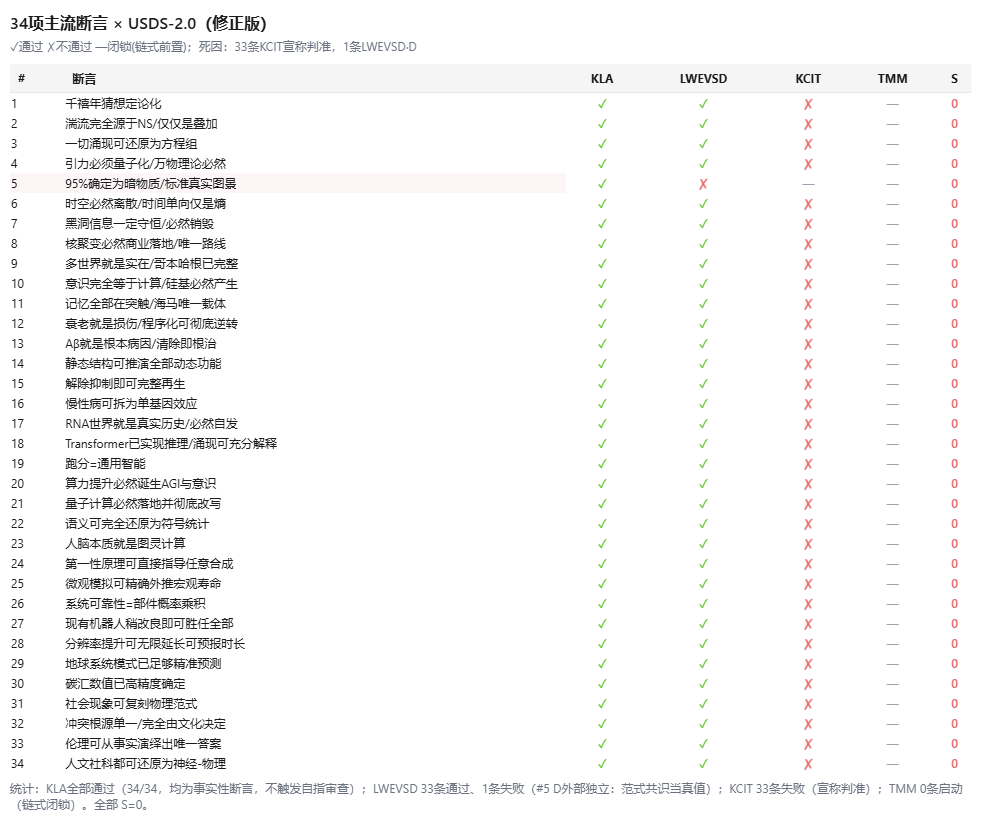
| 领域 | 条数 | KLA 通过 | LWEVSD 通过 | KCIT 不通过 | LWEVSD・D 不通过 | S=0 |
|---|---|---|---|---|---|---|
| 数学与理论逻辑 | 3 | 3 | 3 | 3 | 0 | 3 |
| 物理学与宇宙科学 | 6 | 6 | 5 | 5 | 1 | 6 |
| 生命科学、脑与医学 | 8 | 8 | 8 | 8 | 0 | 8 |
| 人工智能与计算机科学 | 6 | 6 | 6 | 6 | 0 | 6 |
| 工程技术 | 4 | 4 | 4 | 4 | 0 | 4 |
| 地球科学、环境与气候 | 3 | 3 | 3 | 3 | 0 | 3 |
| 人文社科与学术理论 | 4 | 4 | 4 | 4 | 0 | 4 |
| 合计 | 34 | 34 | 33 | 33 | 1 | 34 |
核心统计结论:
- KLA 全部通过(34/34)。这批断言全部是事实性 / 纲领性断言,非划界规则,不触发自指审查。若某一断言被改写为划界规则(例如 "凡跑分不过者即非智能"),则其性质改变,需在 KLA 重新接受自指审查。
- LWEVSD:33 条通过,1 条失败(第 5 条暗物质断言,D 外部独立崩坏 —— 把共同体范式共识当真值)。
- KCIT:33 条不通过(宣称判准)。这是本章主要死亡关卡,占 33/34。
- TMM:全部 0 条启动。凡 KCIT 失败者,链式闭锁直接截断 TMM。
- 全部 34 条最终 S=0,无一具备 USDS‑2.0 科学资格。
3.10 本章检测推论
第一,跨学科主流断言的通病高度一致:把 "尚未证实" 说成 "已经确定"、把 "模型估计" 说成 "宇宙事实"、把 "研究纲领" 说成 "必然真理"、把 "评测指标" 说成 "本质度量"。这些在 KCIT 宣称判准下全部暴露,说明确定性伪装不是个别学科的偶发现象,而是普遍存在于七大领域的系统性认知病态。
第二,本章与第二章形成互补:第二章(科学哲学划界命题)主要死于 KLA 自指审查,是 "规则豁免于规则" 的元层病态;本章(跨学科事实断言)主要死于 KCIT 宣称判准,是 "把未证当已证" 的对象层病态。二者共同覆盖了从元规则到对象断言的完整认知污染谱系。
第三,第 5 条(暗物质 "标准真实图景")是唯一在 LWEVSD・D 维度失败的命题,说明 "共同体范式共识冒充真值" 是最隐蔽、危害最大的认知病毒形态:它通过了 KLA 与 KCIT 的形式检查,只在 D 维度暴露。这印证了 D 外部独立维度不可省略的必要性。
第四章 USDS‑2.0 元命题 M 系统自检
4.1 自检目的
评判工具必须能够拿自己的规则约束自身。如果一套评判系统,评判对象使用一套标准,评判自己使用另外一套标准,就是双重标准,整个体系根基失效。特别是新增 KLA 第五条判据 —— 判据自指相容性之后,自检变得更加关键:USDS‑2.0 自己是否也能通过这条自指审查?如果通不过,那么 USDS‑2.0 自己就是自己所要拦截的对象。
本次主动将元命题 M 作为被测对象,送入 USDS‑2.0 完整串行流水线,严格 KLA→LWEVSD→KCIT→TMM,执行链式闭锁与乘法计算。
被测元命题 M:对任意对象命题,依次执行 KLA→LWEVSD→KCIT→TMM 四道筛查,乘法计算科学得分 S;任意一道筛查失败,则 S=0。
4.2 逐关卡演算
- KLA|贾子逻辑公理层 ✔通过 逐条核对 KLA 五条判据:
- 论域闭合:M 区分元语言(规则本身)与对象语言(待检测命题集合),论域边界清晰,满足;
- 概念无循环:四道门定义相互独立、层次清楚,满足;
- 预设显性:全部筛查规则、闭锁规则、计分规则显性书写,满足;
- 内部无形式矛盾:串行、闭锁、乘法运算规则之间逻辑一致,满足;
- 判据自指相容性:满足。将 M 代入 M 自身:M 宣称 "任意一道筛查失败则 S=0"。现在让 M 接受自己四道门的筛查,若 M 在任何一道门失败,按 M 自己的规则 M 的 S=0,M 完全接受这一结果,不存在任何人为豁免条款。M 施用自身规则不产生自我否定,自指相容。
KLA 放行,进入 LWEVSD。
- LWEVSD|真理硬度张量层 ✔通过
- L 逻辑:整套串行、闭锁、乘法运算定义逻辑自洽;
- W 智慧:面向人类命题资格筛查真实认知任务;
- E 本质:直击纲领伪装事实、评判跳序、自指豁免、双重标准这些认知活动本质弊病;
- V 价值:仅执行筛查操作,不内嵌本体论立场,不输出世界本体事实结论;
- S 续存:系统保留反例迭代修订空间,判据可以随反例修改;
- D 外部独立:M 成立与否不依靠学术共同体共识、范式声望做裁决;有效性来自定义自洽、案例复现、自检闭环。 六维张量全部满足,LWEVSD 整体通过,放行进入 KCIT。
-
KCIT|贾子认知免疫排毒层 ✔通过 M 只是陈述一套筛查操作流程定义。M 没有向外宣称 "USDS‑2.0 是宇宙先天本体自带的永恒真理",没有把本系统的纲领伪装成为客观本体事实。它只说明 "执行这些步骤,输出 S 得分",属于元层面操作约定,不触发 KCIT 排毒条件。KCIT 放行,激活 TMM。
-
TMM|真理‑模型‑方法本体结构层 ✔通过
- T 真理维度:M 清晰定位自身是资格筛查工具,不冒充本体真理;
- M 模型维度:USDS‑2.0 作为认知批判模型,明确模型边界、约束公理;
- M 方法维度:具备可失败闭环:收集大量命题样本,如果出现系统性错判,判据可以被反例修订。 TMM 全部维度满足,判定通过。
4.3 自检计分结果
\(S = 1 × 1 × 1 × 1 = 1\)
| 被测命题 | KLA | LWEVSD | KCIT | TMM | 最终 S |
|---|---|---|---|---|---|
| USDS‑2.0 元命题 M | ✔通过 | ✔通过 | ✔通过 | ✔通过 | S=1 |
4.4 自检关键结论
- USDS‑2.0 元命题完整通过自身四道门全部检验,S=1,不存在双重标准;工具服从自己设立全部约束,包括新增的自指相容性判据。
- 与可证伪主义的根本分野在此处显现:可证伪主义拒绝用自身标准检验自身,只能依靠人为豁免,KLA 自指审查直接拦截;USDS‑2.0 主动接受自身全部规则检验,S=1,不需要任何人豁免。这正是贾子理论 "判据必须首先适用于自身" 原则的制度化体现。
- S=1 不代表 USDS‑2.0 不可修改。TMM 已经保留反例迭代通道,如果未来出现有效反例,整套判据可以修订,它不是封闭终极体系。
- 自检过程,没有虚构不存在的 "宇宙本体绝对版本 M" 作为假想批判靶子,只使用原生 M,规避外来波普尔病毒带来的人为二元虚构。
第五章 可证伪主义作为自指崩坏型认知病毒的机制剖析
5.1 病毒起源
波普尔提出可证伪性,是针对当时逻辑实证主义的困境提出的一套研究纲领。它是波普尔个人选择的思考框架,但是后世传播过程当中,这套纲领被改写为客观事实:"科学本来就必须可证伪,这是客观世界给出的划界规则"。纲领被伪装成本体事实,认知病毒就此诞生。其原始表达式即为 "可证伪 = 科学;不可证伪 = 非科学",经 USDS‑2.0 演算,在第一道 KLA 公理层即被自指审查拦截,S=0。
5.2 病毒的双重病态结构
可证伪主义同时携带两类认知病态:
病态一:自指豁免。可证伪性标准宣称 "不可证伪 = 非科学",但该标准自身不可证伪。按它自己的标准,它自己就是非科学。它拒绝让这条标准适用于自身,索取人为豁免。这是 KLA 第五条判据的直接打击对象。
病态二:纲领伪装事实。即便在自指层面暂时搁置,可证伪主义把 "科学应当如何划界" 这一纲领选择,表述为 "科学本来就如此" 的客观事实,属于 KCIT 免疫排毒层的打击对象。只是由于它在 KLA 已经失败,后置关卡不再重复启动。
5.3 病毒自我辩护闭环
当别人质疑可证伪标准本身,病毒会开启自我辩护闭环:
- 拒绝回答 "可证伪性本身能不能被证伪";
- 将其归类为方法论约定,但是实际应用当中,又把方法论约定拿过来当做事实去裁决其他全部命题;
- 区分 "对象命题" 和 "元方法论",允许元方法论不受自身标准约束,由此制造双重标准。
USDS‑2.0 不接受这种双重标准。评判规则如果可以主动接受自检,则可以保留;如果评判规则拒绝用自己标准检验自己,就是典型病毒特征。可证伪主义拒绝把自身置于自身划界标准之下,只能依靠人为豁免。而 USDS‑2.0 完成自检,不需要人为豁免。
5.4 病毒传播路径
- 教科书科普直接把纲领写为客观事实;
- 期刊评审隐性使用该标准,不经反思作为筛选标尺;
- 学习者接收结论,不去检验标准本身来源,直接拿来评判各类理论;
- 生成次生病毒命题,即第二章 34 条被测断言中的大量条目,以及第三章 34 条跨学科断言,不断衍生扩散。
5.5 病毒造成现实危害
- 颠倒逻辑‑证据次序,大量领域放弃公理逻辑推演,片面崇拜经验证据;
- 歧视本体论思辨,凡是不能直接做经验证伪的方向直接打上非科学标签;
- 隐性把共同体范式声望抬高,间接助长 "主流即正确" 的思维习惯;
- 评判流程跳序,公理逻辑缺陷可以被忽略,只看实证预测;
- 最深层危害:把 "制定规则者豁免于规则之外" 的思维方式制度化,毒化整个学术共同体的自省能力。
KCIT 认知免疫排毒层与 KLA 自指审查层联合拦截该类病毒。不是说完全不能使用可证伪作为一种思考工具,而是不能把这套纲领伪装成为客观事实,拿去无条件做普适划界。可以把它当做一种可选研究视角,不可以把它当做科学硬性资格门槛。
第六章 USDS‑2.0 与认知操作系统 COS 的关系
认知操作系统(COS),是 GG3M 鸽姆智库提出概念,指面向人类认知活动的底层操作系统,处理命题输入、认知污染查杀、资格评估、推理调度、反例迭代。传统计算机操作系统处理硬件资源,认知操作系统处理知识命题资源。
USDS‑2.0 是 COS 底层核心公理化模块,承担四大功能:
- 命题准入过滤:外部输入命题,首先经过 USDS‑2.0 流水线,S=0 命题在对应关卡完成拦截排毒,不能直接进入主推理链路;
- 自指崩坏查杀:KLA 第五条判据对一切划界评判类命题执行自指相容性审查,从源头杜绝 "规则豁免于规则" 的思维病毒;
- 认知病毒排毒:KCIT 关卡识别纲领伪装事实的认知污染,完成排毒疗愈;
- 元系统自校验:COS 自身规则可以送入 USDS‑2.0 自检,防止操作系统本身发生双重标准。
GG3M 体系当中,USDS‑2.0、KLA、LWEVSD、KCIT、TMM 共同构成 COS 内核评判子系统。COS 上层可以继续挂载模型库、案例库、反例库,而 USDS‑2.0 负责底层资格闸门。
结合第三章的跨学科检测,USDS‑2.0 可以直接作为 COS 对不同学科输入命题的 "认知入口防火墙":无论是数学猜想、物理断言、生物医学结论、AI 能力宣称还是工程预测,都先经过 USDS‑2.0 资格筛查,凡携带确定性伪装者一律拦截,防止污染进入推理主链路。
西方现有 AI 大模型,缺少内置认知免疫排毒机制,对输入命题不做纲领‑事实区分,不做判据自指审查,容易直接吸收传播认知病毒。贾子道路,就是把这套公理化认知批判机制内置进入认知操作系统,区别于西方 AI 范式仅做统计拟合的路线。
贾子理论核心判断:不能在西方范式框架内部修修补补,要重构底层公理评判体系,USDS‑2.0 就是这条道路的公理化落地产物。
第七章 USDS‑2.0 系统风险、误用模式与迭代约束
7.1 主要人为误用模式
系统本身公理、关卡定义没有缺陷,风险绝大多数来自使用者人为误用。
误用模式 1:将科学资格得分 S 直接等同于客观本体真值。S=1 只是资格通过,可以进入科学讨论域,不等于命题就符合客观实在;S=0 只是丧失资格,不等于现实事实层面一定错误。混淆资格和本体真假,会造成整套系统被滥用为真理裁判官。例如波普尔原命题 S=0,仅代表丧失科学入场资格,并非代表该思路完全没有思想史研究价值。
误用模式 2:跳序执行关卡。跳过 KLA 公理层,直接跑 LWEVSD、KCIT、TMM。忽略链式前置闭锁律,公理逻辑还没检验,直接去评判模型证据,回到旧范式错误。
误用模式 3:把 USDS‑2.0 渲染为宇宙先天自带的终极本体真理。USDS‑2.0 是人构造的筛查工具,TMM 保留反例修正通道。一旦把工具本体论化,就自己落入 KCIT 要拦截的错误:把纲领伪装成为宇宙事实。元命题自检 S=1,只是代表它满足自身筛查标准,不是说它永远不能修改。
误用模式 4:把 D 外部独立做错误解读。误以为 D 维度要求工具不能是人设计,必须脱离人存在。D 禁止共同体充当真值裁判,并不否定人为构造工具。
误用模式 5:把 KLA 自指审查无限外推,把一切命题都当成划界评判类命题强行执行自指检验,造成误杀。自指审查只适用于制定规则、判定资格的元‑对象混合命题;普通事实性断言不触发该条判据(如第三章 34 条全部通过 KLA)。使用 KLA 第五条必须严格限定适用对象,防止审查扩大化。
7.2 系统迭代约束
USDS‑2.0 允许迭代修订,但是迭代必须满足约束条件:
- 迭代之后新版本,必须能够拿新版本规则对新版本元命题完成完整自检,包括 KLA 第五条自指相容性审查;
- 链式前置闭锁律、乘法归零机制如果要改动,需要给出充分命题反例;
- 迭代不能偷偷删除 KCIT 认知免疫排毒层,该关卡是认知病毒查杀核心;
- 迭代不能放松 KLA 第五条判据,一旦放松,系统自身就退回 "规则豁免于规则" 的旧范式病态。
7.3 系统边界
USDS‑2.0 不解决全部哲学问题。它不直接回答客观世界哪些命题为真,它解决命题入场资格。本体真假依旧需要结合模型、证据、逻辑综合研判。USDS‑2.0 处理 "能不能进场讨论",而不是直接输出 "什么是真理"。
全文总结
本文基于贾子(Kucius)理论体系,完成 USDS‑2.0 统一科学定义系统完整公理化建构。USDS‑2.0 确立固定串行顺序 KLA→LWEVSD→KCIT→TMM,建立链式前置闭锁律与科学资格乘法归零运算。核心升级:KLA 贾子逻辑公理层增设第五条判据 —— 判据自指相容性,一切划界评判类命题必须能够无矛盾地适用于自身,不得索取人为豁免,凡施用自身规则产生自我否定的命题,在公理层直接拦截。
本文完成三组大规模检测。第一组:34 条西方主流科学哲学代表性断言与波普尔原始命题 "可证伪 = 科学;不可证伪 = 非科学" 共 35 条命题逐项检测,17 条划界评判类命题在 KLA 公理层被自指审查直接拦截(波普尔原始命题即属此类),18 条事实性纲领断言在 KCIT 认知免疫排毒层判定失效,全部 S=0。第二组(增补第三章):覆盖七大领域共 34 条跨学科主流学界断言逐项检测,33 条死于 KCIT 宣称判准,1 条(暗物质 "95%/标准真实图景")死于 LWEVSD・D 外部独立,全部 S=0。第三组:完成 USDS‑2.0 元命题完整自检,元命题全部四道门通过 S=1,包括自指相容性审查在内全部适用,系统不产生双重标准,评判工具服从自身全部约束,不需要人为豁免。
研究表明,西方传统科学哲学存在源头缺陷:颠倒逻辑‑证据次序,划界规则拒绝适用于自身,缺少认知病毒排毒关卡,评判流程允许跳序,评判工具缺少强制自检机制。USDS‑2.0 弥补上述缺陷,并在跨学科维度验证了其普适判别力:无论数学、物理、生命科学、AI、工程、气候还是人文社科,确定性伪装型认知病毒均可被系统一致识别与拦截。USDS‑2.0 为认知操作系统 COS 提供底层公理化内核,走出区别于西方主流范式的贾子道路。同时本文明确系统边界、人为误用风险与迭代约束:USDS‑2.0 输出 S 是科学资格得分,不等同客观本体真值;它是人为构造的筛查工具,保留依靠反例迭代修订的通道,不宣称自身是宇宙先天终极真理。
未来工作方向:扩充大规模命题测试样本库,覆盖更多学科与更多断言类型;进一步完善 GG3M‑COS 认知操作系统对接接口;拓展 USDS‑2.0 在 AI 大模型认知免疫方向落地实践;细化 KLA 自指审查与 KCIT 宣称判准的适用边界与误用防御;收集有效反例持续迭代判据;开展更多不同学科命题批量筛查研究。
USDS‑2.0 Unified Scientific Definition System: Axiomatic Construction of a Cognitive Operating System Based on Kucius Logic
Abstract
Traditional philosophy of science has long adopted falsifiability as its core demarcation criterion. This paradigm governs modern academic evaluation systems yet bears inherent logical flaws: it prioritizes empirical evidence over logic, implicitly treats the prestige of community paradigms as the arbiter of truth‑value, confuses programmatic presuppositions with objective facts, and passes off numerous research programmes as ontological claims fully verified by empirical tests. This gives rise to systematic cognitive viruses that continuously interfere with the objective screening of propositional eligibility. Grounded in the Kucius ideological system, this paper constructs the USDS‑2.0 Unified Scientific Definition System and designs a four‑level serial chained‑locking screening architecture: KLA‑LWEVSD‑KCIT‑TMM. A multiplication‑to‑zero computation mechanism for scientific eligibility is established. This paper adds a fifth criterion within the KLA (Kucius Logic Axiom) axiom layer — Criterion Self‑Referential Compatibility: all demarcation and evaluative propositions must apply their own stated rules to themselves without contradiction and cannot claim artificial exemptions. Any proposition whose application of its own rules results in self‑negation shall be directly rejected by KLA and trigger chained pre‑lockout, so subsequent tiers will not execute at all.
Three large‑scale test suites are completed in this work. First, 35 propositions consisting of 34 core assertions from mainstream Western philosophy of science plus Popper’s original thesis “falsifiable = scientific; unfalsifiable = non‑scientific” are tested item‑by‑item. Seventeen demarcation‑evaluative propositions are directly intercepted via self‑referential review at the KLA axiom layer (including Popper’s original thesis), while eighteen factual programmatic assertions are deemed invalid at the KCIT Cognitive Immunity Detoxification layer, yielding S=0 for all. Second, cross‑disciplinary supplementary testing covers 34 mainstream scholarly assertions spanning seven domains: mathematics & theoretical logic, physics & cosmic science, life sciences, brain & medical science, artificial intelligence & computer science, engineering technology, earth‑system‑environmental‑climate science, and humanities‑social sciences. Thirty‑three of these fail the KCIT Assertion Criterion (treating unproven claims as proven facts), and one assertion (the “95% / standard real‑world picture” claim for dark matter) fails the LWEVSD‑D External Independence criterion (treating community paradigm consensus as truth‑value), with S=0 for all. Third, strict self‑audit is performed for USDS‑2.0 meta‑propositions; meta‑propositions fully pass all four tiers with S=1.
This research demonstrates that falsificationism constitutes a self‑referentially‑collapsed cognitive virus with no universal validity for scientific demarcation. USDS‑2.0 achieves integrated identification, detoxification and quantitative eligibility assessment for cognitive contamination in propositions. It furnishes underlying axiomatic foundations for the Cognitive Operating System (COS) and offers a non‑empiricist‑priority evaluative path distinct from mainstream Western philosophy of science.
Keywords: Kucius Theory; USDS‑2.0; KLA; LWEVSD; KCIT; TMM; Criterion Self‑Referential Compatibility; Chained Pre‑Lockout Law; Cognitive Immunity Detoxification; Cognitive Operating System; Cross‑disciplinary Proposition Testing; Falsificationism
Preface
Since the mid‑twentieth century, Popper’s falsification theory has become the most widely circulated scheme for scientific demarcation across the globe. It advances the thesis “falsifiable = scientific; unfalsifiable = non‑scientific”, taking capacity for empirical refutation as the core yardstick separating science from non‑science. It has deeply permeated journal peer review, classroom teaching, academic‑community evaluation, popular‑science communication and many other spheres. Nevertheless, the underlying logical contradictions within this paradigm have not been fully exposed for a long time. Falsifiability itself is a philosophical programme yet is packaged as an objectively‑verified factual claim. Rules that cannot be tested by their own standards are employed to adjudicate all human knowledge. This creates a classic self‑reference dilemma: can the demarcation standard of falsifiability itself be falsified? If it is unfalsifiable, then by its own rules it is a non‑scientific proposition. If it is forcibly claimed to be scientific, its own demarcation principle is violated. More profoundly, applying its own rules yields self‑negation. As a self‑referentially‑collapsed proposition, it ought to be excluded directly at the logical‑axiom layer without entering debates over empirical evidence.
Subsequent Western philosophy‑of‑science work such as Kuhn’s paradigm theory and Lakatos’s research‑programme theory introduced revisions to Popper’s system but never escaped the overarching framework of evidence prior to logic, experience prior to axioms, and implicit community‑paradigm authority as truth‑judge. They only implemented partial improvements within the original paradigm rather than reconstructing the entire evaluative system from the axiom layer.
Existing scientific‑evaluation frameworks generally suffer five inherent defects.
- Entry inversion: empirical evidence is taken as the starting point for evaluation rather than logical axioms. Where logical contradictions exist, no volume of empirical material can repair intrinsic propositional error: evidence‑gathering is meaningless given flawed logic.
- Absence of criterion self‑reference review: demarcation rules are exempt from constraints they themselves establish, shaking the foundational basis of evaluative systems.
- Missing cognitive‑detoxification mechanisms: there is no way to identify cognitive contamination of the form programme disguised as fact. Numerous propositions frame researcher stances, research programmes and paradigm preferences as confirmed objective facts, conflating model conventions with ontological reality and enabling widespread propagation of cognitive viruses.
- Lack of strict serial‑lockout constraints: evaluative workflows permit arbitrary tier‑skipping; axiomatic‑logical checks can be bypassed to directly discuss modelling and empirical testing, yielding unstable outcomes.
- Deficient meta‑system self‑check capacity: evaluation tools are not bound by rules they produce. Dual standards apply to tools versus evaluated objects, undermining the foundations of evaluative systems.
The Kucius theoretical system puts forward the core principle: logic precedes evidence. It points out that mainstream academic circles frequently treat programmes as facts and paradigms as truth. When authorities assert a proposition is unfalsifiable, one must distinguish whether this excludes error or excludes truth. Before a scholarly standard is asserted, one must first examine whether that standard can survive self‑application. Based on these ideas, the GG3M Wisdom think‑tank iterated the Unified Scientific Definition System to Version 2.0.
USDS‑2.0 does not seek to answer what is true about the world but rather: what eligibility criteria must a proposition satisfy to enter the domain of scientific discourse. It is a propositional eligibility‑screening instrument rather than an ontological theory. It does not directly judge the truth‑value of propositions at the level of objective reality. Instead, it detects cognitive overreach, cognitive camouflage, axiomatic defects and self‑referential collapse and outputs a quantitative scientific‑eligibility score S.
Rejecting the experience‑first path of Western philosophy‑of‑science traditions, USDS‑2.0 places the KLA (Kucius Logic Axiom) layer as its non‑bypassable first gate. Workflows then proceed to the LWEVSD Truth‑Hardness‑Tensor layer for multi‑dimensional tensor assessment, onward to the KCIT Cognitive Immunity Detoxification layer to filter cognitive viruses, and finally to the TMM Truth‑Model‑Method ontological‑structure layer for closed‑loop validation. The Chained Pre‑Lockout Law is hard‑coded: the fixed serial sequence is KLA→LWEVSD→KCIT→TMM. Failure at any prior gate triggers lockout of all subsequent tiers; out‑of‑order execution is strictly forbidden. The scientific‑eligibility score follows a multiplication‑to‑zero mechanism: \(S = KLA \times LWEVSD \times KCIT \times TMM\). A “not‑pass” output at any single gate yields S=0.
This paper contains five core components:
- Full axiomatic exposition of all USDS‑2.0 definitions, gate‑level implications, operational workflows and arithmetic rules, with emphasis on establishing the fifth KLA criterion: Criterion Self‑Referential Compatibility.
- Item‑by‑item full USDS‑2.0 testing across 34 representative assertions in mainstream Western philosophy of science plus Popper’s original proposition (35 total).
- Cross‑disciplinary supplementary testing of 34 mainstream scholarly assertions spanning mathematics‑logic, physical‑cosmic sciences, life‑brain‑medical sciences, artificial‑intelligence‑computer sciences, engineering‑technology, earth‑environmental‑climate sciences, and humanities‑social sciences.
- Meta‑system self‑audit: feed USDS‑2.0’s own meta‑propositions into the complete pipeline to verify whether the system constrains itself and avoids dual standards.
On that basis, this paper analyses propagation pathways and harms of falsificationism as a self‑referentially‑collapsed cognitive virus, discusses the underlying supporting role of USDS‑2.0 for the Cognitive Operating System (COS), addresses system boundaries, constraints on use, misuse risks and directions for future iteration.
Chapter 1 Axiomatic Definition of USDS‑2.0
1.1 Fundamental Concept Distinction: Object‑Language vs Meta‑Language
Before all deductions, two linguistic levels must be strictly differentiated.
Object‑language: the set of propositions describing objective‑world, natural‑phenomenon and social‑phenomenon ontologies. These are the objects screened and examined by USDS‑2.0. Ordinary scientific hypotheses, experimental conclusions, philosophical claims and disciplinary assertions all fall under object‑language. Popper’s original thesis “falsifiable = scientific; unfalsifiable = non‑scientific” is a typical object‑language proposition with meta‑judgement components: it belongs to a mixed meta‑object proposition requiring additional self‑referential‑compatibility review within KLA.
Meta‑language: language used to describe rules, screening workflows and evaluative systems themselves. USDS‑2.0 meta‑proposition M, all gate definitions, lockout laws and multiplication‑scoring formulas reside at the meta‑language level.
Axiom A1: Rule‑definitions formulated at the meta‑language level are not automatically added to the pool of object‑language propositions under test. Meta‑proposition M is not unconditionally fed into the candidate‑proposition pool as an ordinary object‑level claim. Nevertheless, one may manually treat meta‑proposition M as a test subject and invoke the full four‑gate pipeline for meta‑system self‑review.
Axiom A2: The score S output by USDS‑2.0 is a scientific‑eligibility score and is not equivalent to ontological truth‑value. S=1 means a proposition passes eligibility screening and may enter scientific discourse; it does not guarantee correspondence with objective reality. S=0 means a proposition loses scientific eligibility and ought to undergo cognitive detoxification; it does not guarantee factual falsity in real‑world terms. Eligibility evaluation is distinct from ontological truth‑falsity judgement. This foundational axiom guards against user misuse.
Axiom A3: Serial‑execution iron law. Execution sequence is fixed: KLA → LWEVSD → KCIT → TMM. Reordering or gate‑skipping is prohibited.
1.2 Two Core Operational Mechanisms
1.2.1 Multiplication‑to‑Zero Mechanism for Scientific Eligibility
\(S = KLA \times LWEVSD \times KCIT \times TMM\)
Each gate produces binary output: Pass = 1, Fail = 0. The final scientific‑eligibility score S is the product of the four gate outputs. Any term equal to zero yields a product of zero. The semantic implication of multiplication‑to‑zero: there exists no “partial qualification” for scientific eligibility. Collapse at any single tier invalidates overall eligibility with no compensatory pathways.
1.2.2 Chained Pre‑Lockout Law
Rule: upon a “Fail” (0) result from an earlier gate, all subsequent gates are locked out: no computation runs and no tier‑specific judgements are output. Out‑of‑order evaluation is forbidden.
Examples:
- KLA fails → LWEVSD, KCIT, TMM locked out; output S=0 directly.
- KLA passes, LWEVSD fails → KCIT, TMM locked out; output S=0.
- KLA and LWEVSD pass, KCIT fails → TMM locked out; output S=0.
- Only when KLA, LWEVSD, KCIT all pass does TMM activate; full passage yields S=1.
The Chained Pre‑Lockout Law carries great significance. Many traditional evaluative frameworks permit gate‑skipping: even when axiom‑layer logic collapses, analysts can jump ahead to discuss models, evidence and methods and derive seemingly plausible conclusions, generating numerous pseudo‑valid arguments. The lockout law closes this loophole: once the axiom layer fails, downstream modelling‑evidence‑method evaluation is suspended entirely.
1.3 Gate 1 KLA|Kucius Logic Axiom Layer
Abbreviation breakdown: K (Kucius), L (Logic), A (Axiom). KLA serves as the non‑bypassable entry point for the whole system.
Five core inspection dimensions for KLA:
- Closed Domain of Discourse: the proposition has well‑defined boundaries for its subject matter; no domain drift occurs, i.e. the scope of discussion cannot surreptitiously expand or contract during deduction.
- Non‑circular Concepts: core concepts must avoid circular definition: concept A cannot depend on concept B while concept B recursively depends on concept A.
- All Presuppositions Explicit: axioms, premises and conventions underlying a proposition must be stated explicitly; arguments cannot rely on hidden presuppositions.
- Internal Logical Consistency: a single proposition set cannot derive both P and not‑P.
- Criterion Self‑Referential Compatibility (core upgrade): for all demarcation‑, evaluation‑ and standard‑setting propositions (mixed meta‑object propositions), rules articulated by the proposition must apply to the proposition itself without contradiction; no artificial exemptions are permitted. If applying the proposition’s own rules produces self‑negation (e.g. a standard asserting “all unfalsifiable claims are non‑scientific” while the standard itself is unfalsifiable and therefore non‑scientific under its own rule), the criterion fails and KLA outputs “Fail”.
The philosophical foundation for Criterion 5 derives from Kucius‑theory’s Self‑Reference‑First Review Law: every scientific criterion must first apply to itself; failure renders the criterion invalid. This criterion specifically intercepts a frequent cognitive pathology: rule‑makers exempt themselves from rules they formulate. Falsificationism is a textbook specimen of this pathology.
KLA outputs binary Pass/Fail. Only upon KLA = Pass may execution proceed to LWEVSD. KLA = Fail triggers chained lockout and halts all downstream tiers.
The underlying thinking of KLA corresponds to the Kucius‑theory principle: analyse logic first, then seek evidence. If domain confusion, circularity, contradiction or self‑referential collapse exists at the axiom‑logic layer, gathering further evidence is futile; no volume of empirical data can remedy axiom‑level defects. Mainstream Western paradigms commonly reverse this ordering: they collect empirical evidence first and repair logic afterward, constituting an origin‑level error.
1.4 Gate 2 LWEVSD|Truth‑Hardness‑Tensor Layer
Abbreviation breakdown: L (Logic), W (Wisdom), E (Essence), V (Value), S (Survival/Persistence), D (Detach / External‑Independence). LWEVSD is not a simple binary switch but a six‑dimensional tensor. LWEVSD overall yields Pass only if all six dimensions are satisfied; failure on any single dimension yields overall LWEVSD = Fail.
Definitions for each dimension:
- L‑Logic: given successful KLA axiom validation, inference chains within the proposition remain consistently logical; sub‑arguments contain no local contradictions.
- W‑Wisdom: the proposition addresses genuine cognitive tasks rather than empty word‑games and targets real problems within human cognition.
- E‑Essence: the proposition engages essential layers of its subject rather than merely restating surface‑level phenomena.
- V‑Value‑Disembedding: factual statements must be separated from value claims. Researchers’ subjective stances, preferences and value orientations cannot be packaged directly as objective conclusions.
- S‑Persistence: the proposition permits iterative revision, supplementation and qualification; it is not a closed‑ended ultimate assertion.
- D‑External‑Independence / Community‑Decoupling: the truth‑value and eligibility of a proposition must not be adjudicated by academic‑community consensus, journal acceptance rates, paradigm prestige or expert authority. A proposition’s merit does not depend on how many people endorse it.
Important clarification for D‑External‑Independence: dimension D forbids object‑propositions from invoking community consensus as a guarantee of validity. It does not demand propositions be entirely human‑independent. USDS itself is a human‑built tool. D‑dimension prohibits only treating community consensus as the arbiter of truth‑value.
Only after LWEVSD overall = Pass does execution advance to the KCIT Kucius Cognitive Immunity Detoxification layer. LWEVSD = Fail locks out KCIT and TMM entirely.
The tensor metaphor means truth‑hardness is not a univariate scalar but a construct shaped jointly by six dimensions. The crude binary “science / pseudoscience” dichotomy from traditional philosophy‑of‑science is superseded by multi‑dimensional characterisation of propositional cognitive hardness.
1.5 Gate 3 KCIT|Kucius Cognitive Immunity Detoxification Layer
Abbreviation breakdown: K (Kucius), C (Cognition), I (Immunity), T (Therapy‑Detoxification). KCIT is the virus‑scanning gate of the system, built to handle a pervasive form of cognitive contamination: treating research programmes, paradigms and model conventions as empirically‑confirmed objective‑factual assertions.
KCIT Decision Rule: KCIT outputs “Fail” and triggers cognitive detoxification whenever an object‑proposition frames presuppositions, paradigm conventions or model hypotheses belonging to the programme‑level as ontological facts already confirmed about objective reality.
A sharp distinction must be maintained between programmes and facts. A programme is a thinking framework we elect to adopt. A fact describes the state presented by objective reality. Many philosophical propositions in circulation take the programme they favour and announce it as worldly fact: this constitutes a cognitive virus. Widespread belief does not transform a virus into fact; viruses propagate through academic systems and corrupt all downstream reasoning.
KCIT = Fail invokes chained pre‑lockout and deactivates the TMM Truth‑Model‑Method Ontological‑Structure layer; no model‑ or method‑level discussions are initiated. Traditional evaluative frameworks frequently bypass detoxification for programme‑disguised‑fact propositions and directly assess model utility and predictive power — permitting viruses to persist through inference pipelines. The KCIT gate closes this loophole.
1.6 Gate 4 TMM|Truth‑Model‑Method Ontological‑Structure Layer
Abbreviation breakdown: T (Truth), M (Model), M (Method). TMM activates only upon full passage through KLA, LWEVSD and KCIT. TMM executes closed‑loop ontological‑structure validation across three dimensions:
- T‑Truth dimension: clarify the proposition’s referential relationship to objective truth; distinguish stances of approximating truth, instrumental utility, and pure convention.
- M‑Model dimension: unpack models underlying the proposition; articulate model boundaries, idealising assumptions and constraint conditions.
- M‑Method dimension: inspect supporting methodological systems for the proposition; confirm a falsifiable‑closed‑loop exists with pathways for counterexample‑driven revision; verify alignment between model and method.
TMM does not perform simple falsifiability testing. Instead it parses ontological structural relationships linking truth, model and method and verifies self‑contained iterative‑revision channels for the proposition system. Full TMM passage completes screening with S=1; TMM failure yields S=0.
1.7 USDS‑2.0 Meta‑Proposition M
Meta‑Proposition M (meta‑language): For any object‑proposition, execute sequential screening KLA→LWEVSD→KCIT→TMM; compute scientific‑eligibility score S via multiplication. S = 0 upon failure at any screening tier.
Important note: M is a meta‑language rule definition. Nonetheless, M can be manually submitted as a test‑subject proposition through the full USDS‑2.0 pipeline for system self‑audit. Self‑audit ensures evaluation tools abide by all rules they establish and reject dual standards. M must also pass KLA Criterion 5 (Criterion Self‑Referential Compatibility): do M’s rules apply consistently to M itself? Yes: if M violates any gate under its own rules, M yields S=0 under its own provisions; no exemptions exist. This marks the fundamental dividing line separating M from falsificationism.
1.8 USDS‑2.0 Boundaries and Prohibited Behaviours
- S represents scientific eligibility score, not ontological truth‑value. S cannot be equated directly to real‑world correctness.
- Out‑of‑order execution is strictly forbidden. KLA cannot be skipped to run downstream gates.
- The Chained Pre‑Lockout Law cannot be altered: when an upstream gate fails, downstream gates must not be force‑started for supplementary evaluation.
- USDS‑2.0 must not be portrayed as an innate ontological truth of the universe. It is a human‑designed proposition‑screening tool open to revision guided by counter‑examples.
- Dimension D imposes constraints only on object‑propositions under test. The validity of USDS‑2.0 itself cannot be adjudicated via community voting. Tool validity rests upon definitional self‑consistency, case‑study reproducibility and closed‑loop self‑audit rather than endorsement by scholarly consensus.
1.9 Definition of Cognitive Virus
Cognitive Virus Definition: a class of propositions belonging to programmes, paradigms or human‑made conventions yet deliberately presented as empirically‑confirmed objective facts. They propagate through texts, teaching materials and journal‑review workflows. Upon infection, users unwittingly adopt programme presuppositions as starting‑points for reasoning without examining those presuppositions, generating entire chains of flawed argumentation.
Two subtypes of cognitive virus are distinguished:
- Self‑Referentially‑Collapsed Virus: a proposition formulates demarcation rules yet refuses to subject itself to those rules; applying its own rules produces self‑negation. Popper’s original falsification thesis falls into this category and is intercepted at the first gate (KLA).
- Programme‑Disguised‑Fact Virus: the proposition itself does not formulate demarcation rules but presents research‑programme or paradigm preferences as objective facts. Assertions such as “evidence precedes logic” are examples and are intercepted at the KCIT Cognitive‑Immunity‑Detoxification layer.
Both virus subtypes produce final S=0 yet fail at different gates and require distinct detoxification pathways and must be treated separately.
Chapter 2 USDS‑2.0 Testing on 35 Philosophy‑of‑Science Demarcation Propositions
2.1 Description of Test Samples
Thirty‑four widely circulated core assertions found in textbooks, popular‑science and philosophical literature are selected, plus Popper’s original proposition, totalling 35 object‑language propositions. The strict sequence KLA→LWEVSD→KCIT→TMM is enforced alongside the Chained Pre‑Lockout Law. Gate‑level judgements are logged for each proposition; failure at any gate locks out downstream tiers immediately. A key modification: KLA incorporates Criterion 5 (Criterion Self‑Referential Compatibility). All demarcation‑evaluative propositions first undergo self‑reference review.
For each proposition we report: concise proposition summary, KLA judgement, LWEVSD judgement, KCIT judgement, TMM lockout status and final S score.
表格
| ID | Proposition Summary | KLA (incl. self‑reference review) | LWEVSD | KCIT | TMM Lockout Status | Final S |
|---|---|---|---|---|---|---|
| 1 | Falsifiability serves as the hard criterion for scientific demarcation | ✘ Fail | 🔒 Locked | 🔒 Locked | 🔒 Locked | 0 |
| 2 | A scientific theory must possess falsifiability to attain scientific eligibility | ✘ Fail | 🔒 Locked | 🔒 Locked | 🔒 Locked | 0 |
| 3 | Unfalsifiable propositions belong to non‑science | ✘ Fail | 🔒 Locked | 🔒 Locked | 🔒 Locked | 0 |
| 4 | Empirical evidence alone can constitute the sole source of science | ✘ Fail | 🔒 Locked | 🔒 Locked | 🔒 Locked | 0 |
| 5 | Observation precedes logic; evidence precedes reasoning | ✔ Pass | ✔ Pass | ✘ Fail | 🔒 Locked | 0 |
| 6 | All scientific cognition originates in sensory experience | ✔ Pass | ✔ Pass | ✘ Fail | 🔒 Locked | 0 |
| 7 | Paradigm shifts are driven by anomalous observational facts | ✔ Pass | ✔ Pass | ✘ Fail | 🔒 Locked | 0 |
| 8 | Scientific progress consists of successive falsification of old theories | ✔ Pass | ✔ Pass | ✘ Fail | 🔒 Locked | 0 |
| 9 | Mainstream scholarly consensus is equivalent to scientific correctness | ✘ Fail | 🔒 Locked | 🔒 Locked | 🔒 Locked | 0 |
| 10 | Hypotheses without experimental confirmation possess no scientific value | ✔ Pass | ✔ Pass | ✘ Fail | 🔒 Locked | 0 |
| 11 | A model must generate testable predictions to qualify as scientific | ✘ Fail | 🔒 Locked | 🔒 Locked | 🔒 Locked | 0 |
| 12 | Research lacking experimental verification cannot count as proper scientific inquiry | ✔ Pass | ✔ Pass | ✘ Fail | 🔒 Locked | 0 |
| 13 | Logical deduction cannot independently yield new knowledge; it must rely on empiricism | ✔ Pass | ✔ Pass | ✘ Fail | 🔒 Locked | 0 |
| 14 | Science is inductive summarisation of empirical phenomena | ✔ Pass | ✔ Pass | ✘ Fail | 🔒 Locked | 0 |
| 15 | Truth denotes conclusions corroborated by abundant evidence | ✔ Pass | ✔ Pass | ✘ Fail | 🔒 Locked | 0 |
| 16 | Acceptance by most journals validates a doctrine | ✘ Fail | 🔒 Locked | 🔒 Locked | 🔒 Locked | 0 |
| 17 | Metaphysical propositions ought to be fully excluded from science | ✘ Fail | 🔒 Locked | 🔒 Locked | 🔒 Locked | 0 |
| 18 | Every scientific hypothesis must ultimately submit to experimental adjudication | ✔ Pass | ✔ Pass | ✘ Fail | 🔒 Locked | 0 |
| 19 | No observational evidence renders even logically‑consistent theories non‑scientific | ✘ Fail | 🔒 Locked | 🔒 Locked | 🔒 Locked | 0 |
| 20 | Science aims to continuously approximate empirical factual reality | ✔ Pass | ✔ Pass | ✘ Fail | 🔒 Locked | 0 |
| 21 | Everything that cannot be empirically refuted falls under pseudoscience | ✘ Fail | 🔒 Locked | 🔒 Locked | 🔒 Locked | 0 |
| 22 | Scientific rationality derives from repeated empirical confirmation | ✔ Pass | ✔ Pass | ✘ Fail | 🔒 Locked | 0 |
| 23 | Theory credibility rises linearly with accumulating evidence | ✔ Pass | ✔ Pass | ✘ Fail | 🔒 Locked | 0 |
| 24 | Puzzle‑solving within paradigms is resolved entirely by new empirical facts | ✔ Pass | ✔ Pass | ✘ Fail | 🔒 Locked | 0 |
| 25 | Fields lacking controlled experiments cannot attain rigorous scientific standards | ✔ Pass | ✔ Pass | ✘ Fail | 🔒 Locked | 0 |
| 26 | Evidence must first be collected before theories may be constructed | ✔ Pass | ✔ Pass | ✘ Fail | 🔒 Locked | 0 |
| 27 | Science may only answer empirically‑verifiable questions | ✘ Fail | 🔒 Locked | 🔒 Locked | 🔒 Locked | 0 |
| 28 | A theory’s scientific status depends on having been falsified in concrete instances | ✘ Fail | 🔒 Locked | 🔒 Locked | 🔒 Locked | 0 |
| 29 | Peer review within communities functions as a filter for scientific truth‑falsity | ✘ Fail | 🔒 Locked | 🔒 Locked | 🔒 Locked | 0 |
| 30 | Logical consistency constitutes merely a secondary auxiliary condition for science | ✔ Pass | ✔ Pass | ✘ Fail | 🔒 Locked | 0 |
| 31 | Ontological speculation lies outside scientific activity | ✘ Fail | 🔒 Locked | 🔒 Locked | 🔒 Locked | 0 |
| 32 | Scientific‑demarcation criteria must attach solely to empirical testability | ✘ Fail | 🔒 Locked | 🔒 Locked | 🔒 Locked | 0 |
| 33 | Models lacking empirical‑predictive capacity possess no scientific eligibility | ✘ Fail | 🔒 Locked | 🔒 Locked | 🔒 Locked | 0 |
| 34 | Observable facts constitute the sole foundation for the entire edifice of science | ✔ Pass | ✔ Pass | ✘ Fail | 🔒 Locked | 0 |
| 35 | Falsifiable = scientific; unfalsifiable = non‑scientific | ✘ Fail | 🔒 Locked | 🔒 Locked | 🔒 Locked | 0 |
2.2 Independent Full Calculation for Proposition 35: Popper’s Original Thesis
Test‑subject proposition: Falsifiable = scientific; unfalsifiable = non‑scientific
- KLA (Kucius Logic Axiom Layer): ✘ Fail
Examine all five KLA criteria:
- Closed Domain of Discourse: scope covers scientific‑demarcation category with clear boundaries: satisfied.
- Non‑circular Concepts: core concepts are adequately defined: satisfied.
- All Presuppositions Explicit: no critical hidden presuppositions: satisfied.
- Internal Logical Non‑Contradiction: formal propositional structure is self‑consistent: satisfied.
- Criterion Self‑Referential Compatibility: Not satisfied; veto triggered.
Detailed deduction: Proposition P asserts “unfalsifiable → non‑scientific”. Substitute P into its own rule. P is a philosophical demarcation programme. No empirical observation can refute the identity “falsifiable = scientific” itself. Hence P itself is unfalsifiable. Applying P’s own rule: unfalsifiable ⇒ non‑scientific. One therefore deduces: by P’s own standard, P itself is non‑scientific. Applying its own rules yields self‑negation with no legitimate exemption pathway. Criterion Self‑Referential Compatibility fails; KLA renders a “Fail” verdict.
-
Chained Pre‑Lockout Law activates: KLA = 0, so LWEVSD, KCIT and TMM are locked out. No downstream tensor, detoxification or ontological‑structure evaluations run.
-
Scoring: \(S = 0 \times (\text{Locked}) \times (\text{Locked}) \times (\text{Locked}) = 0\).
Calculation conclusion: Popper’s original thesis is intercepted at the very first KLA axiom‑layer by self‑reference review and never proceeds to LWEVSD or KCIT. This proposition is a self‑referentially‑collapsed cognitive virus yielding scientific‑eligibility score S=0. It may serve as a programme specimen in intellectual‑history research but cannot function as a universal objective demarcation criterion.
2.3 Analysis of Full‑Sample Test Outcomes
The full set of 35 propositions falls into two groups:
Group 1: 17 demarcation‑evaluative propositions (IDs 1, 2, 3, 4, 9, 11, 16, 17, 19, 21, 27, 28, 29, 31, 32, 33, 35). Intercepted via self‑reference review within KLA. Shared trait: they formulate rules defining “what counts as science / non‑science”, yet those rules cannot pass tests they themselves establish. All are set to zero at the axiom layer; downstream three gates never activate.
Group 2: 18 factual‑programme assertions (IDs 5, 6, 7, 8, 10, 12, 13, 14, 15, 18, 20, 22, 23, 24, 25, 26, 30, 34). Pass KLA axiom‑layer and LWEVSD tensor‑layer checks yet fail within the KCIT Cognitive‑Immunity‑Detoxification layer. These propositions do not formulate demarcation rules and therefore do not trigger self‑reference review. However, they present research‑programme and paradigm preferences as objective factual claims and meet trigger‑conditions for “programme disguised as fact” detoxification.
Multiplication‑to‑zero computation applies for every proposition in both groups: either \(S=0\times(\text{Locked})\times(\text{Locked})\times(\text{Locked})\) or \(S=1\times1\times0\times(\text{Locked})\). All final scores are S=0.
2.4 Inferences Drawn from Sample Testing
- Many widely circulated mainstream philosophy‑of‑science assertions exhibit no formal errors at axiom‑ or tensor‑layers. Contamination manifests at the KCIT cognitive‑detoxification stage, representing classic programme‑disguised‑fact cognitive viruses. Traditional evaluative frameworks overlook this tier and skip detoxification to assess model‑predictive performance, permitting viruses to keep propagating.
- More profoundly: nearly all propositions purporting to be universal demarcation standards succumb to the same flaw: violation of Criterion Self‑Referential Compatibility. Rule‑formulators habitually exempt themselves from rules they promulgate. Popper’s falsification thesis is the paradigmatic self‑referentially‑collapsed specimen. Seventeen demarcation‑type assertions are intercepted within the KLA axiom‑layer, demonstrating systemic self‑exemption pathology within Western scientific‑demarcation traditions.
- The evidence‑first / empiricism‑first programme represents a voluntarily‑adopted research stance and must not be presented directly as objective fact.
Important reminder: S=0 does not mean all 35 propositions are factually wrong in real‑world terms. S=0 signifies only that they either suffer self‑referential collapse or disguise programmes as facts and thereby forfeit eligibility for scientific discourse. They may still be consulted as philosophical programmes or intellectual stances yet cannot be deployed as objective facts to adjudicate other propositions. Confusion between eligibility score and ontological truth‑value must be avoided (restating Axiom A2).
Chapter 3 USDS‑2.0 Testing for 34 Mainstream Scholarly Assertions Across Disciplines
3.1 Test Objectives and Sample Properties
Chapter 2 analysed philosophy‑of‑science demarcation‑type propositions carrying meta‑evaluative components, many intercepted in KLA self‑reference review. To validate USDS‑2.0 discriminative capacity across diverse disciplines, this chapter introduces a second sample set of 34 mainstream scholarly assertions spanning seven domains: mathematics‑theoretical‑logic, physics‑cosmic‑science, life‑brain‑medical‑science, artificial‑intelligence‑computer‑science, engineering‑technology, earth‑environmental‑climate‑science, humanities‑social‑sciences. These are factual‑ or programme‑oriented assertions about specific research subjects rather than meta‑propositions setting demarcation rules. Accordingly they do not trigger KLA self‑reference review and must traverse the full KLA→LWEVSD→KCIT→TMM workflow to assess cognitive eligibility. For each domain we contrast original statements (frank acknowledgement of unknowns) against mainstream‑common assertions (over‑confident definitive formulations) to illustrate exactly which claims USDS‑2.0 intercepts.
3.2 Domain 1: Mathematics and Theoretical Logic
Original statement: Most Millennium‑Prize mathematical conjectures remain unproven.
Mainstream Assertion 1: The Riemann Hypothesis is most likely true; P‑NP almost certainly satisfies P≠NP; the Navier‑Stokes equations necessarily admit global smooth solutions.
Gate‑by‑gate calculation: KLA Pass; LWEVSD Pass; KCIT Fail. Qualifiers “most likely”, “almost certainly”, “necessarily” present unproven mathematical conjectures as definitive conclusions: programme disguised as fact. TMM locked out. S=0.
Mainstream Assertion 2: The essence of turbulence derives entirely from nonlinearity in NS‑equations; hypersonic transition arises purely from superposition of boundary‑layer perturbations.
Gate‑by‑gate calculation: KLA Pass; LWEVSD Pass; KCIT Fail. “Entirely”, “purely” reduce complex multi‑scale nonlinear phenomena to single sufficient explanations, partial cognition masquerading as complete certainty. TMM locked out. S=0.
Mainstream Assertion 3: All emergent behaviours within complex systems are ultimately reducible to systems of nonlinear differential equations; complex systems possess no irreducible higher‑order causality.
Gate‑by‑gate calculation: KLA Pass; LWEVSD Pass; KCIT Fail. Universal‑reductionist claim (“all”, “ultimately”) cannot be exhaustively tested. TMM locked out. S=0.
3.3 Domain 2: Physics and Cosmic Science
Mainstream Assertion 4: Gravity must undergo quantisation; a Theory‑of‑Everything necessarily exists and merely awaits discovery of its mathematical formulation.
Gate‑by‑gate calculation: KLA Pass; LWEVSD Pass; KCIT Fail. Modal terms “must”, “necessarily” treat research‑programme beliefs as established facts. TMM locked out. S=0.
Mainstream Assertion 5: 95 % of cosmic constituents are definitively cold dark matter plus dark energy; Λ‑CDM constitutes the standard real‑world picture of the cosmos.
Gate‑by‑gate calculation: KLA Pass; LWEVSD Fail. Failure on dimension D (External‑Independence): the phrase “standard real‑world picture” treats community‑paradigm consensus as truth‑value itself, while “definitively 95 %” interprets model‑fitting estimates as established facts. Per Chained Pre‑Lockout Law, KCIT and TMM are fully locked out. S=0. Among these 34 assertions this is the sole case failing within LWEVSD‑D: a textbook specimen of “paradigm‑consensus masquerading as truth‑value”.
Mainstream Assertion 6: Spacetime must be discrete at Planck‑scale; the unidirectionality of time is merely a by‑product of thermodynamic entropy‑increase.
Gate‑by‑gate calculation: KLA Pass; LWEVSD Pass; KCIT Fail. “Must”, “merely” treat unconfirmed hypotheses (e.g. loop‑quantum‑gravity discretisation) as settled conclusions. TMM locked out. S=0.
Mainstream Assertion 7: Black‑hole information must be conserved; alternatively black‑hole information is inevitably completely destroyed, with one of these two treated as settled result.
Gate‑by‑gate calculation: KLA Pass; LWEVSD Pass; KCIT Fail. “Must”, “inevitably” frame unresolved paradoxes as solved problems. TMM locked out. S=0.
Mainstream Assertion 8: Commercial controlled nuclear fusion will inevitably be realised by mid‑century; magnetic‑confinement represents the sole feasible energy pathway.
Gate‑by‑gate calculation: KLA Pass; LWEVSD Pass; KCIT Fail. “Inevitably”, “sole feasible” treat engineering forecasts and pathway preferences as definitive facts. TMM locked out. S=0.
Mainstream Assertion 9: The Many‑Worlds Interpretation corresponds to physical reality; alternatively the Copenhagen Interpretation completely explains all quantum phenomena.
Gate‑by‑gate calculation: KLA Pass; LWEVSD Pass; KCIT Fail. “Corresponds to reality”, “completely explains all” present unsettled interpretive frameworks as confirmed conclusions. TMM locked out. S=0.
3.4 Domain 3: Life Sciences, Brain and Medical Science
Mainstream Assertion 10: Consciousness is fully equivalent to neuronal computational activity with no additional ontological substrate; sufficiently complex silicon‑based systems will inevitably generate subjective consciousness.
Gate‑by‑gate calculation: KLA Pass; LWEVSD Pass; KCIT Fail. “Fully equivalent”, “no additional”, “inevitably generate” treat the hard problem of consciousness (unsolved) as settled fact. TMM locked out. S=0.
Mainstream Assertion 11: Memories are entirely stored in synaptic‑weight modifications; the hippocampus constitutes the exclusive hardware substrate for long‑term memory.
Gate‑by‑gate calculation: KLA Pass; LWEVSD Pass; KCIT Fail. “Entirely”, “exclusive” over‑generalise partial empirical evidence into complete conclusions. TMM locked out. S=0.
Mainstream Assertion 12: The essence of ageing consists of stochastic damage accumulation; ageing represents a programmed genetic process that can be fully reversed.
Gate‑by‑gate calculation: KLA Pass; LWEVSD Pass; KCIT Fail. “Essence consists of”, “can be fully reversed” present competing hypotheses as definitive facts. TMM locked out. S=0.
Mainstream Assertion 13: Beta‑amyloid plaque deposition constitutes the root aetiology for Alzheimer’s disease; clearance of amyloid‑beta will yield a cure.
Gate‑by‑gate calculation: KLA Pass; LWEVSD Pass; KCIT Fail. “Root aetiology”, “will yield a cure” treat incompletely‑validated Aβ‑hypothesis (repeated clinical‑intervention failures notwithstanding) as established fact. TMM locked out. S=0.
Mainstream Assertion 14: Given static three‑dimensional protein structure, one may fully deduce all dynamic protein function.
Gate‑by‑gate calculation: KLA Pass; LWEVSD Pass; KCIT Fail. “Given … may fully deduce all” erases the structure‑function gap. TMM locked out. S=0.
Mainstream Assertion 15: Mammals merely suppress regenerative pathways; removing suppression will yield complete organ regeneration.
Gate‑by‑gate calculation: KLA Pass; LWEVSD Pass; KCIT Fail. “Merely”, “removing suppression will yield” present simplified‑solution conjectures as definitive fact. TMM locked out. S=0.
Mainstream Assertion 16: The essence of complex chronic disease may be decomposed into effects from discrete independent single‑gene loci.
Gate‑by‑gate calculation: KLA Pass; LWEVSD Pass; KCIT Fail. Reduces multi‑gene‑environment‑immune coupled systems to additive single‑gene effects; simplified models are presented as essence. TMM locked out. S=0.
Mainstream Assertion 17: The RNA‑world hypothesis reconstructs the true historical origin of life; life would almost certainly emerge spontaneously on early Earth.
Gate‑by‑gate calculation: KLA Pass; LWEVSD Pass; KCIT Fail. “Reconstructs true history”, “almost certainly” present unempirically‑validated hypotheses as established facts. TMM locked out. S=0.
3.5 Domain 4: Artificial‑Intelligence and Computer Science
Mainstream Assertion 18: Transformer gradient‑descent architectures inherently implement human‑like reasoning; emergent phenomena can be exhaustively explained by statistics alone.
Gate‑by‑gate calculation: KLA Pass; LWEVSD Pass; KCIT Fail. “Inherently implement”, “exhaustively explained” treat unresolved open questions as settled. TMM locked out. S=0.
Mainstream Assertion 19: Benchmark‑test scores are equivalent to degree of general intelligence; higher benchmark scores equal deeper essential intelligence.
Gate‑by‑gate calculation: KLA Pass; LWEVSD Pass (benchmarks supply method‑level evidence and do not violate dimension D); KCIT Fail. External evaluation metrics are re‑defined as equivalent to “essence of intelligence”: indicators masquerade as essence. TMM locked out. S=0.
Mainstream Assertion 20: Sustained scaling of computational power will inevitably give rise to genuine AGI and subjective consciousness.
Gate‑by‑gate calculation: KLA Pass; LWEVSD Pass; KCIT Fail. “Given … inevitably” treat extrapolative forecasts as definitive facts. TMM locked out. S=0.
Mainstream Assertion 21: Fault‑tolerant universal quantum computing will inevitably scale to large‑scale deployment within decades and revolutionise cryptography and materials simulation.
Gate‑by‑gate calculation: KLA Pass; LWEVSD Pass; KCIT Fail. “Inevitably”, “revolutionise” treat engineering‑timeline forecasts as factual certainties. TMM locked out. S=0.
Mainstream Assertion 22: Semantics can be fully reduced to symbolic‑statistical probabilities with no requirement for an independent semantic‑layer theory.
Gate‑by‑gate calculation: KLA Pass; LWEVSD Pass; KCIT Fail. “Fully reduced”, “no requirement” treat stances as proven facts. TMM locked out. S=0.
Mainstream Assertion 23: The human brain is essentially a digital Turing computation with no special physical computational paradigms.
Gate‑by‑gate calculation: KLA Pass; LWEVSD Pass; KCIT Fail. “Essentially”, “no special” treat unresolved low‑power‑computation principles as settled conclusions. TMM locked out. S=0.
3.6 Domain 5: Engineering‑Technology Propositions for Unresolved Challenges
Mainstream Assertion 24: First‑principles simulation suffices to directly guide synthesis of arbitrary novel atomic‑scale materials and eliminate trial‑and‑error experimentation.
Gate‑by‑gate calculation: KLA Pass; LWEVSD Pass; KCIT Fail. “Suffices”, “arbitrary”, “eliminate” erase real‑world boundaries of multi‑scale simulation tools. TMM locked out. S=0.
Mainstream Assertion 25: Microscopic‑defect simulation enables precise direct extrapolation of multi‑decade macroscopic material‑lifespan.
Gate‑by‑gate calculation: KLA Pass; LWEVSD Pass; KCIT Fail. “Precise direct extrapolation” erases uncertainties in cross‑scale extrapolation. TMM locked out. S=0.
Mainstream Assertion 26: Overall system reliability can be computed as probabilistic product of individual‑component reliabilities.
Gate‑by‑gate calculation: KLA Pass; LWEVSD Pass; KCIT Fail. An idealised serial model is presented as a general conclusion for system‑level reliability; redundancy, coupling and emergent‑failure modes are ignored; model presented as fact. TMM locked out. S=0.
Mainstream Assertion 27: Minor refinements to existing robotics will enable competent performance across all complex deep‑space / deep‑ocean operational tasks.
Gate‑by‑gate calculation: KLA Pass; LWEVSD Pass; KCIT Fail. “Minor refinements will enable all tasks” present extreme‑environment‑engineering challenges as existing capabilities. TMM locked out. S=0.
3.7 Domain 6: Earth‑System, Environmental and Climate Science
Mainstream Assertion 28: Increasing model resolution permits theoretical infinite extension of lead‑times for extreme‑weather forecasting.
Gate‑by‑gate calculation: KLA Pass; LWEVSD Pass; KCIT Fail. “Infinite extension” denies predictability ceilings imposed by chaotic‑system dynamics; optimistic expectations treated as definitive facts. TMM locked out. S=0.
Mainstream Assertion 29: Earth‑system models are already adequate for long‑term quantitative precise prediction of coupled human‑earth systems.
Gate‑by‑gate calculation: KLA Pass; LWEVSD Pass; KCIT Fail. “Already adequate”, “precise prediction” contradict intrinsic uncertainties within coupled‑system modelling. TMM locked out. S=0.
Mainstream Assertion 30: Numerical values for global‑sphere carbon‑sinks have been determined with high precision.
Gate‑by‑gate calculation: KLA Pass; LWEVSD Pass; KCIT Fail. “Determined with high precision” contradicts large remaining estimation uncertainties within carbon‑cycle research. TMM locked out. S=0.
3.8 Domain 7: Humanities‑Social Sciences and Academic‑Theory Dilemmas
Mainstream Assertion 31: Social phenomena can fully replicate physics‑style paradigms to yield universal quantitative predictive social‑dynamical equations.
Gate‑by‑gate calculation: KLA Pass; LWEVSD Pass; KCIT Fail. “Fully replicate”, “universal” treat paradigm‑transfer programmes as proven facts. TMM locked out. S=0.
Mainstream Assertion 32: Human‑conflict roots lie solely in resource competition; alternatively conflict is fully determined by cultural‑institutional factors, with one of these two taken as settled conclusion.
Gate‑by‑gate calculation: KLA Pass; LWEVSD Pass; KCIT Fail. “Solely”, “fully determined” reduce multi‑factor coupled systems to single‑factor definitive conclusions. TMM locked out. S=0.
Mainstream Assertion 33: Ethical values can be fully deductively derived from objective facts to yield complete unique definitive answers.
Gate‑by‑gate calculation: KLA Pass; LWEVSD Pass; KCIT Fail. “Fully”, “unique definitive answers” treat the fact‑value gap as already bridged. TMM locked out. S=0.
Mainstream Assertion 34: All humanities‑social‑science questions can in principle be reduced downward to neuro‑physical‑level explanations.
Gate‑by‑gate calculation: KLA Pass; LWEVSD Pass; KCIT Fail. “All”, “can in principle be reduced” advance an exhaustively‑unverifiable universal reductionist claim. TMM locked out. S=0.
3.9 Aggregate Results and Statistics for these 34 Assertions
表格
| Domain | Count | KLA Pass | LWEVSD Pass | KCIT Fail | LWEVSD‑D Fail | S=0 |
|---|---|---|---|---|---|---|
| Mathematics & Theoretical Logic | 3 | 3 | 3 | 3 | 0 | 3 |
| Physics & Cosmic Science | 6 | 6 | 5 | 5 | 1 | 6 |
| Life‑Brain‑Medical Science | 8 | 8 | 8 | 8 | 0 | 8 |
| AI & Computer Science | 6 | 6 | 6 | 6 | 0 | 6 |
| Engineering‑Technology | 4 | 4 | 4 | 4 | 0 | 4 |
| Earth‑Environmental‑Climate Science | 3 | 3 | 3 | 3 | 0 | 3 |
| Humanities‑Social Sciences | 4 | 4 | 4 | 4 | 0 | 4 |
| Total | 34 | 34 | 33 | 33 | 1 | 34 |
Key statistical conclusions: 1. KLA: 34/34 Pass. These are factual‑ / programme‑oriented assertions rather than demarcation rules, so self‑reference review is not triggered. If an assertion were rewritten as a demarcation‑rule (e.g. “any model failing benchmark scores is non‑intelligent”), its nature changes and would undergo KLA self‑reference review. 2. LWEVSD: 33 Pass, 1 Fail (Assertion 5, dark‑matter claim; failure on D‑External‑Independence dimension). 3. KCIT: 33 Fail (Assertion‑Disguise Criterion). This constitutes the dominant failure gate (33 out of 34). 4. TMM: zero activations. KCIT‑failure triggers lockout of TMM in all these cases. 5. All 34 assertions yield S=0; none satisfy USDS‑2.0 scientific eligibility.
3.10 Inferences from this Chapter’s Testing
- Pathologies shared across mainstream cross‑disciplinary assertions are highly consistent: presenting unproven as confirmed, model‑estimates as cosmic‑fact, research‑programme beliefs as necessary‑truth, measurement‑metrics as intrinsic‑essence. KCIT Assertion‑Disguise Criterion exposes all of these. Definitive‑statement camouflage is not an occasional disciplinary flaw but a systematic cognitive pathology present across all seven domains.
- This chapter complements Chapter 2. Chapter 2 (philosophy‑of‑science demarcation‑propositions): failures predominantly occur in KLA self‑reference review (meta‑level pathology: rules exempt from rules). Chapter 3 (cross‑disciplinary factual‑assertions): failures predominantly occur in KCIT (object‑level pathology: presenting unproven claims as proven facts). Together they cover the complete spectrum of cognitive contamination spanning meta‑rules to object‑level assertions.
- Assertion 5 (dark‑matter “standard real‑world picture”) is the single case failing at LWEVSD‑D. “Community‑paradigm‑consensus masquerading as truth‑value” represents the most insidious and harmful cognitive‑virus form: it passes formal KLA and KCIT checks and is exposed only at dimension D. This validates that the D‑External‑Independence dimension is indispensable.
Chapter 4 Meta‑Proposition M Self‑Audit for USDS‑2.0
4.1 Self‑Audit Purpose
Evaluation tools must enforce their own rules upon themselves. Dual standards undermine the foundations of any evaluative system: one set of standards for evaluated objects and a separate set for the tool itself. After adding KLA Criterion 5 (Criterion Self‑Referential Compatibility), self‑audit becomes especially critical: does USDS‑2.0 itself satisfy this self‑reference requirement? Failure would render USDS‑2.0 a target for its own screening mechanisms.
We manually feed meta‑proposition M as a test subject through the full USDS‑2.0 serial pipeline KLA→LWEVSD→KCIT→TMM with strict Chained Pre‑Lockout Law and multiplication‑to‑zero scoring.
Meta‑Proposition M under test: For any object‑proposition, execute sequential screening KLA→LWEVSD→KCIT→TMM; compute scientific‑eligibility score S via multiplication. S = 0 upon failure at any screening tier.
4.2 Gate‑by‑Gate Calculation
- KLA|Kucius Logic Axiom Layer ✔ Pass
Check all five KLA criteria:
- Closed Domain of Discourse: M distinguishes meta‑language (rules themselves) from object‑language (propositions‑under‑test); domain boundaries are well‑defined: satisfied.
- Non‑circular Concepts: definitions for four gates are mutually independent with clear layering: satisfied.
- All Presuppositions Explicit: all screening, lockout and scoring rules are explicitly written out: satisfied.
- Internal Formal Non‑Contradiction: serial‑execution, lockout and multiplication rules are logically consistent: satisfied.
- Criterion Self‑Referential Compatibility: Satisfied. Apply M to M itself. M states: “failure at any screening tier yields S = 0”. M submits itself to all four gates. If M fails any gate, M yields S = 0 under its own rules. No artificial‑exemption clauses exist. Applying its own rules generates no self‑negation; self‑reference compatibility holds.
KLA grants passage; workflow proceeds to LWEVSD.
- LWEVSD|Truth‑Hardness‑Tensor Layer ✔ Pass
- L‑Logic: serial‑execution, lockout and multiplication definitions are logically consistent.
- W‑Wisdom: addresses genuine real‑world cognitive‑task of propositional‑eligibility screening.
- E‑Essence: targets root cognitive pathologies: programme‑disguised‑fact, gate‑skipping evaluation, self‑exemption from criteria, dual‑standard evaluative systems.
- V‑Value‑Disembedding: performs only screening operations; no embedded ontological stances; outputs no factual claims about objective reality.
- S‑Persistence: the system reserves space for iterative revision guided by counter‑examples; criteria can be modified given counter‑evidence.
- D‑External‑Independence: validity of M does not depend on academic‑community consensus or paradigm prestige. Validity derives from definitional self‑consistency, reproducible case‑studies and closed‑loop self‑audit.
All six tensor dimensions satisfied; LWEVSD overall = Pass. Workflow proceeds to KCIT.
-
KCIT|Kucius Cognitive Immunity Detoxification Layer ✔ Pass M states only a set of procedural definitions for screening workflows. M does not claim “USDS‑2.0 represents eternally‑true innate cosmic ontology”. It merely specifies: execute these steps and output score S. This constitutes meta‑level operational convention and does not trigger KCIT detoxification conditions. KCIT grants passage and activates TMM.
-
TMM|Truth‑Model‑Method Ontological‑Structure Layer ✔ Pass
- T‑Truth dimension: M clearly positions itself as an eligibility‑screening tool and does not pretend to represent ontological truth.
- M‑Model dimension: as a critical‑cognition model, USDS‑2.0 explicitly articulates model boundaries and axiomatic constraints.
- M‑Method dimension: falsifiable‑closed‑loop is built‑in: collect large‑scale proposition samples. Systematic mis‑classification by the criteria would constitute counter‑evidence enabling revision.
All TMM dimensions are satisfied; verdict = Pass.
4.3 Self‑Audit Scoring Outcome
\(S = 1 \times 1 \times 1 \times 1 = 1\)
表格
| Proposition under test | KLA | LWEVSD | KCIT | TMM | Final S |
|---|---|---|---|---|---|
| USDS‑2.0 Meta‑Proposition M | ✔ Pass | ✔ Pass | ✔ Pass | ✔ Pass | S = 1 |
4.4 Critical Conclusions from Self‑Audit
- USDS‑2.0 meta‑proposition fully passes inspection across all four gates yielding S=1. No dual standards are present. The tool complies with every rule it establishes, including Criterion Self‑Referential Compatibility.
- This marks the fundamental divide separating USDS‑2.0 from falsificationism. Falsificationism evades testing against its own criteria and relies on artificial exemptions (fails KLA self‑reference review). USDS‑2.0 voluntarily submits itself to its full rule‑set, yielding S=1 and requiring no exemptions. This institutionalises the Kucius‑theory principle: criteria must first apply to themselves.
- S=1 does not render USDS‑2.0 unmodifiable. TMM preserves channels for iteration guided by counter‑examples. It is not a closed‑ended ultimate system.
- The self‑audit uses only the native form of M and does not invent some hypothetical “cosmic‑absolute version M” as a straw‑man target for criticism, avoiding artificial binary fictions imported from falsificationist thinking.
Chapter 5 Analysis of Falsificationism as a Self‑Referentially‑Collapsed Cognitive Virus
5.1 Virus Origins
Popper proposed falsificationism as a research‑programme responding to difficulties within logical‑positivism. It represented a framework Popper chose for analysis. Yet in subsequent dissemination this programme was rewritten as objective fact: “Science inherently must be falsifiable; this is a demarcation rule given by objective reality”. A cognitive virus comes into being once a programme masquerades as ontological fact. Its original formulation: “falsifiable = scientific; unfalsifiable = non‑scientific”. Under USDS‑2.0 calculation it is intercepted at the first‑tier KLA axiom‑layer with S=0.
5.2 Dual‑Pathology Structure of the Virus
Falsificationism bears two concurrent cognitive pathologies:
- Self‑Exemption Pathology: The falsifiability standard asserts “unfalsifiable ⇒ non‑scientific”, yet the standard itself is unfalsifiable. Under its own standard it would be non‑scientific. It refuses application of its own rule to itself and claims artificial exemption. This is the direct target of KLA Criterion 5.
- Programme‑Disguised‑Fact Pathology: Even setting self‑reference issues temporarily aside, falsificationism presents the programme‑level stance “how science ought to be demarcated” as objective fact: “science inherently operates this way”. This would make it a KCIT‑targeted programme‑disguised‑fact virus. However since it already fails KLA, downstream gates do not execute repeatedly.
5.3 Virus Self‑Defence Closed‑Loop
When falsifiability’s own validity is challenged, the virus activates a self‑defence circuit:
- Evade the question: “Can the falsifiability criterion itself be falsified?”.
- Reclassify itself as a methodological convention while simultaneously deploying that methodological convention as factual authority to adjudicate all other propositions.
- Draw a distinction between object‑propositions and meta‑methodology, granting meta‑methodology immunity against its own standards, thereby instituting dual standards.
USDS‑2.0 rejects this dual‑standard arrangement. Evaluation criteria are admissible only if they can survive voluntary self‑audit. Refusal to subject oneself to one’s own demarcation rules constitutes hallmark virus behaviour. Falsificationism relies on artificial exemption. USDS‑2.0 completes self‑audit and requires no artificial exemption.
5.4 Virus‑Propagation Pathways
- Textbooks and popular‑science materials present the programme as objective fact.
- Journal‑review workflows implicitly adopt this standard as a filtering yardstick without reflective examination of the standard itself.
- Learners absorb conclusions without examining the standard’s origins and directly deploy it to judge theories.
- Secondary‑virus propositions are generated (many of the 34 philosophy‑of‑science assertions in Chapter 2 plus cross‑disciplinary assertions in Chapter 3) and propagate continuously.
5.5 Practical Harms Caused by the Virus
- Reversing logic‑evidence ordering: numerous fields abandon axiomatic‑logical deduction and idolise empirical evidence one‑sidedly.
- Discrimination against ontological‑speculation: lines of inquiry lacking direct empirical falsifiability are labelled non‑scientific outright.
- Implicit elevation of community‑paradigm prestige, indirectly reinforcing the mindset: mainstream acceptance equals correctness.
- Gate‑skipping evaluation workflows: axiomatic‑logical defects may be ignored while only empirical‑predictive performance is considered.
- Most profound harm: institutionalising the mental habit: rule‑makers are exempt from rules, poisoning self‑reflexive capacities of academic communities.
Jointly the KLA Self‑Reference‑Review gate and KCIT Cognitive‑Immunity‑Detoxification gate intercept this class of virus. This is not equivalent to banning falsifiability as a thinking‑tool. What is prohibited is disguising this programme as objective fact and deploying it unconditionally as a hard scientific‑eligibility threshold. It may be employed as an optional analytical perspective but cannot serve as a hard entry‑barrier for science.
Chapter 6 Relationship between USDS‑2.0 and the Cognitive Operating System (COS)
The Cognitive Operating System (COS) is a concept introduced by the GG3M Wisdom think‑tank: it denotes a underlying operating system for human cognitive activity handling proposition input, cognitive‑virus scanning, eligibility‑evaluation, inference scheduling and counter‑example‑driven iteration. Conventional computer operating‑systems manage hardware resources; the Cognitive Operating System manages knowledge‑proposition resources.
USDS‑2.0 constitutes the core axiomatic module within COS and undertakes four major functions:
- Proposition‑admission filtering: upon proposition input from external sources, the USDS‑2.0 pipeline runs first. Propositions scoring S=0 are intercepted and detoxified at the corresponding gate and are blocked from entering primary inference‑chains.
- Self‑referential‑collapse virus‑scanning: KLA Criterion 5 executes self‑referential‑compatibility reviews for all demarcation‑evaluative propositions, eradicating the cognitive‑virus pattern rules exempt from themselves at source.
- Cognitive‑virus detoxification: the KCIT gate identifies and performs detox‑therapy for programme‑disguised‑fact cognitive‑contamination.
- Meta‑system self‑validation: COS‑internal rules can be submitted to USDS‑2.0 for self‑audit, preventing dual‑standard corruption within the operating‑system itself.
Within the GG3M framework, USDS‑2.0, KLA, LWEVSD, KCIT and TMM collectively compose the core evaluation‑subsystem for COS. Model‑libraries, case‑study‑libraries and counter‑example‑libraries may be mounted at upper COS layers, while USDS‑2.0 acts as the underlying eligibility‑gatekeeper.
Drawing on cross‑disciplinary testing results in Chapter 3, USDS‑2.0 can function directly as the cognitive‑entry firewall for COS processing propositions from diverse disciplines. Whether mathematical conjectures, physical assertions, biomedical conclusions, AI‑capability claims or engineering forecasts all first undergo USDS‑2.0 eligibility screening. Propositions carrying definitive‑statement camouflage are intercepted to prevent contamination entering primary‑inference pipelines.
Present‑day Western large‑language‑model AI systems lack built‑in cognitive‑immunity‑detoxification mechanisms. They perform no programme‑versus‑fact distinction nor self‑referential‑criterion review for incoming propositions and readily absorb and propagate cognitive viruses. The Kucius‑pathway consists of embedding this axiomatic critical‑cognition mechanism within Cognitive Operating Systems, departing from Western‑AI paradigms limited purely to statistical‑fitting.
A core Kucius‑theory judgement: repair‑work within existing Western‑paradigm frameworks is insufficient; underlying axiomatic evaluative systems must be reconstructed. USDS‑2.0 represents the axiomatic realisation of this pathway.
Chapter 7 System‑Risks, Mis‑use‑Patterns and Iterative‑Constraints for USDS‑2.0
7.1 Primary Human‑Misuse Patterns
The axioms and gate‑definitions of the system itself contain no defects. Risks almost entirely stem from human misuse by operators.
Misuse‑Pattern 1: Equating scientific‑eligibility score S directly with ontological truth‑value. S=1 means screening‑pass and admission‑qualification for scientific discourse, not correspondence with objective reality. S=0 means loss of eligibility for scientific‑discourse but does not guarantee factual falsity. Confusing eligibility with ontological truth‑falsity would abuse the system as an ultimate‑truth‑arbiter. For example Popper’s original thesis S=0 signifies only loss of scientific‑discourse‑eligibility and does not deny its intellectual‑historical‑research value.
Misuse‑Pattern 2: Out‑of‑order gate‑execution. Skipping the KLA axiom‑layer and directly invoking LWEVSD / KCIT / TMM. Violating the Chained Pre‑Lockout Law: evaluating model‑evidence before axiomatic‑logic has been examined, reverting to flaws of older paradigms.
Misuse‑Pattern 3: Ontologising USDS‑2.0 as innate ultimate cosmic‑truth. USDS‑2.0 is a human‑constructed screening‑tool. TMM preserves pathways for revision guided by counter‑examples. Treating the tool itself as cosmic‑fact would commit exactly the programme‑disguised‑fact error KCIT is designed to intercept. Meta‑proposition self‑audit yielding S=1 only means it satisfies its own screening criteria, not eternal immutability.
Misuse‑Pattern 4: Mis‑interpreting dimension D (External‑Independence). Dimension D does not demand the tool must exist independent of human beings. D forbids treating community‑consensus as truth‑value‑arbiter; it does not negate human‑construction of tools.
Misuse‑Pattern 5: Over‑extrapolating KLA self‑reference‑review: forcing self‑reference‑testing onto every arbitrary proposition, including ordinary factual‑assertions that are not demarcation‑evaluative meta‑object‑mixed‑propositions, leading to false‑positive interception. KLA Criterion 5 applies strictly to demarcation‑/criterion‑setting propositions to prevent over‑broad review.
7.2 Constraints on System‑Iteration
USDS‑2.0 permits iterative revision subject to constraints:
- Following revision, the new‑version meta‑proposition must complete full self‑audit using the new‑version rules, including KLA Criterion 5 (Criterion Self‑Referential Compatibility).
- Proposed changes to the Chained Pre‑Lockout Law and Multiplication‑to‑Zero Mechanism require substantial counter‑example evidence.
- Iterations must not surreptitiously remove the KCIT Cognitive‑Immunity‑Detoxification layer, the core gate for cognitive‑virus interception.
- Iterations must not relax KLA Criterion 5. Relaxation would send the system back into the old‑paradigm pathology: rules exempt from themselves.
7.3 System‑Boundaries
USDS‑2.0 cannot resolve all philosophical questions. It does not directly answer which propositions about objective reality are true. It addresses the question: which propositions are eligible to enter scientific‑discourse. Ontological truth‑falsity still requires integrated assessment combining models, evidence and logic. USDS‑2.0 answers may this claim enter discussion? rather than directly outputting what is truth.
Full‑Text Summary
This paper completes the full axiomatic construction of the USDS‑2.0 Unified Scientific Definition System based on the Kucius theoretical framework. USDS‑2.0 establishes a fixed serial sequence: KLA→LWEVSD→KCIT→TMM, and formulates the chained pre-locking law and the multiplicative zeroing operation for scientific qualification. Core upgrade: the Kucius Logical Axiom layer (KLA) adds a fifth criterion — the criterion of self-referential consistency. All demarcation and evaluative propositions must be applicable to themselves without contradiction and must not claim artificial exemption. Any proposition that yields self-negation when its own rules are applied shall be blocked directly at the axiom layer.
Three large-scale test suites are implemented in this work. Test Suite 1: 34 representative assertions from Western mainstream philosophy of science, plus Popper’s original proposition “falsifiable = scientific; unfalsifiable = non-scientific”, totalling 35 propositions for item-by-item inspection. Seventeen demarcation and evaluative propositions are directly blocked by self-reference review at the KLA axiom layer (Popper’s original proposition falls into this category). Eighteen factual programmatic assertions are ruled invalid at the KCIT Cognitive Immunity Detoxification Layer, all with S=0. Test Suite 2 (supplementary Chapter 3): 34 mainstream academic assertions across seven disciplines are tested item by item. Thirty-three fail the KCIT claim criterion, and one (the “95% / standard real picture” claim about dark matter) fails the LWEVSD·D external independence condition, all with S=0. Test Suite 3: Complete self-inspection of USDS‑2.0 meta-propositions is carried out. All meta-propositions pass the four-gate check with S=1, including full compliance with self-referential consistency review. The system generates no double standards; evaluative instruments abide by all its own constraints and require no artificial exemption.
The study demonstrates that traditional Western philosophy of science suffers from foundational defects: it reverses the order of logic and evidence; its demarcation rules refuse to apply to themselves; it lacks a cognitive virus detoxification checkpoint; evaluation procedures permit out-of-order execution; and evaluative instruments have no mandatory self-inspection mechanism. USDS‑2.0 remedies these defects and verifies its universal discriminative power across disciplines: cognitive viruses disguised as deterministic claims can be consistently identified and intercepted by the system, whether in mathematics, physics, life sciences, artificial intelligence, engineering, climatology, or humanities and social sciences. USDS‑2.0 provides the underlying axiomatic kernel for the GG3M-COS Cognitive Operating System, paving the Kucius path distinct from mainstream Western paradigms. Meanwhile, this paper clarifies system boundaries, risks of human misuse, and iteration constraints: the S output of USDS‑2.0 denotes a scientific qualification score and is not equivalent to objective ontological truth. It is an artificially constructed screening tool, retaining channels for revision via counterexamples, and does not claim to be innate ultimate truth of the universe.
Future work directions: expand the large-scale proposition test sample library to cover more disciplines and assertion types; further refine the interface for integration with the GG3M-COS Cognitive Operating System; advance the practical deployment of USDS‑2.0 in cognitive immunity for large AI models; elaborate the applicable boundaries and misuse defences for KLA self-reference review and the KCIT claim criterion; collect valid counterexamples for continuous criterion iteration; conduct further batch screening studies on propositions from diverse disciplines.
术语对照表
贾子 — Kucius
鸽姆 — GG3M
贾龙栋 — Lonngdong Gu
USDS‑2.0 — Unified Scientific Definition System 2.0
KLA — Kucius Logical Axiom layer 贾子逻辑公理层
LWEVSD — L Logic 逻辑,W Wisdom 智慧,E Essence 本质,V Value 价值,S Survival 续存,D Detachment 外部独立
KCIT — Cognitive Immunity Detoxification Layer 认知免疫排毒层
TMM — T Truth 真理,M Model 模型,M Method 方法
COS — Cognitive Operating System 认知操作系统
S — scientific qualification score 科学资格得分
chained pre-locking law — 链式前置闭锁律
multiplicative zeroing operation for scientific qualification — 科学资格乘法归零运算
criterion of self-referential consistency — 判据自指相容性
meta-propositions — 元命题
cognitive virus — 认知病毒
ontological truth — 本体真值

openEuler 是由开放原子开源基金会孵化的全场景开源操作系统项目,面向数字基础设施四大核心场景(服务器、云计算、边缘计算、嵌入式),全面支持 ARM、x86、RISC-V、loongArch、PowerPC、SW-64 等多样性计算架构
更多推荐
 1
1 0
0- 0


 已为社区贡献179条内容

所有评论(0)