计网期中考试2025回忆
HNU CS 计网期中,仅供学习,如有侵权,联系作者删除
第一部分-简答题(10*4)
T1
考点:UDP校验和,多路复用多路分解,socket
- 写出UDP的特征3
- UDP校验和要把什么内容加在一起3
- 说明多路复用和分解复用的原理,说明源套接字和,目的套接字在其中的用途4
T2
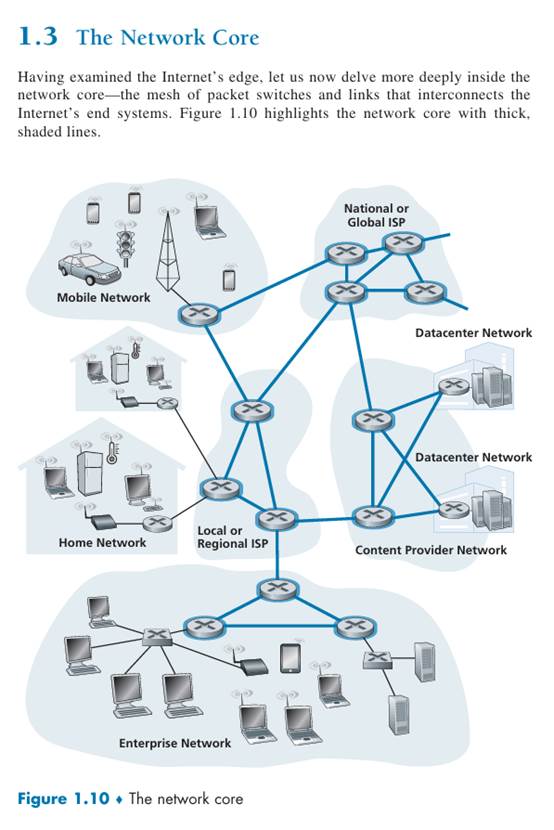
考点:网络边缘,网络核心,TCP/IP协议栈
情景一:云服务器厂商确保全国客户连接稳定快速,不会因为一个服务器的瘫痪而全部瘫痪
情景二:公司内打印机,笔记本,台式机组网,使其访问更快
- 情景一二分别对应的是网络边缘还是网络核心?阐述理由3
- 网络核心网络边缘在TCP/IP协议栈的位置3
- 指出网络边缘和网络核心的核心设计原则,列举说明4
(e.g., desktop PCs, Macs, and Linux boxes), servers (e.g., Web and e-mail servers),
and mobile devices (e.g., laptops, smartphones, and tablets). Furthermore, an
increasing number of non-traditional “things” are being attached to the Internet as
end systems (see the Case History feature).
T3
考点:排队时延,流量强度,路由器缓存
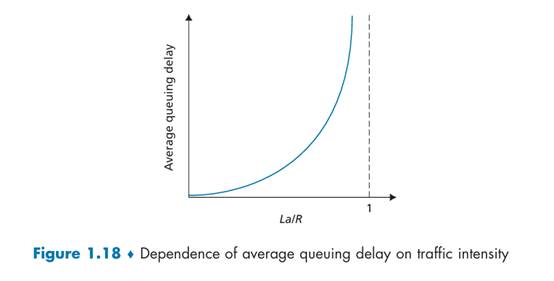
R=7*10^5bps L=2800bit
- 排队时延和流量强度的关系3
- 算d_queue,假设a=53pkt。给了公式d_queue=IL/R (1- I)(好像是但是遗忘。。。带进去算就行了)3
- 实际的流量强度和排队时延的关系4
类似于
P14. Consider the queuing delay in a router buffer. Let I denote traffic intensity;
that is, I = La/R. Suppose that the queuing delay takes the form IL/R (1- I)
for I < 1.
a. Provide a formula for the total delay, that is, the queuing delay plus the
transmission delay.
b. Plot the total delay as a function of L /R
拓展:
P16. Consider a router buffer preceding an outbound link. In this problem, you
will use Little’s formula, a famous formula from queuing theory. Let N
denote the average number of packets in the buffer plus the packet being
transmitted. Let a denote the rate of packets arriving at the link. Let d denote
the average total delay (i.e., the queuing delay plus the transmission delay)
experienced by a packet. Little’s formula is N = a * d. Suppose that on
average, the buffer contains 100 packets, and the average packet queuing
delay is 20 msec. The link’s transmission rate is 100 packets/sec. Using
Little’s formula, what is the average packet arrival rate, assuming there is
no packet loss?
T4
考点:web缓存,HTTP 304 not modified,TCP三次握手,RTT计算,传输时延计算,web安全,cookie
考虑C-S架构,C现在向S请求70个对象
- 对象30%在自己的缓存内,给了dtrans ,RTT,计算总传输时间
- 因为有网络缓存,如何确保自己上网的安全性
第二部分 综合设计题(20*3)
T5
考点:TCP协议 TCP序列号ACK号 TCP三次握手 TCP流量控制 快速重传 S-ACK 超时重传 累计确认 TCP拥塞控制 ECN
考虑C-S结构。初始序列号C:1000 、S:2000
- UDP和TCP的差异?为什么TCP是面向连接的可靠传输协议?3
- TCP三次握手的过程,写序列号5
- 滑动窗口由哪两个参数决定?接收方滑动窗口大小为0,发送方怎么办?(min{rwnd,cwnd})4
- MSS=500b 报文总共大小=1000b ,第一个报文段丢了,剩下的到了,描述TCP传输的过程4
- 某电商平台双十一期间,太多人下单导致网络拥塞,如何控制吞吐量?举例说明4
T6
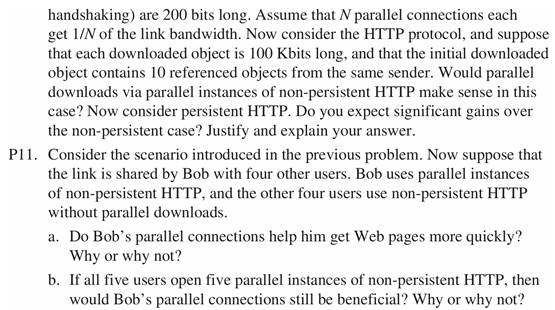
考点:DNS,RTT计算,三次握手,持续/非持续HTTP,并行连接
类似于:
CNTDA第八版第二章课后习题
P7. Suppose within your Web browser you click on a link to obtain a Web page.
The IP address for the associated URL is not cached in your local host, so
a DNS lookup is necessary to obtain the IP address. Suppose that n DNS
servers are visited before your host receives the IP address from DNS; the
successive visits incur an RTT of RTT1, . . . , RTTn. Further suppose that the
Web page associated with the link contains exactly one object, consisting of
a small amount of HTML text. Let RTT0 denote the RTT between the local
host and the server containing the object. Assuming zero transmission time
of the object, how much time elapses from when the client clicks on the link
until the client receives the object?
P8. Referring to Problem P7, suppose the HTML file references eight very small
objects on the same server. Neglecting transmission times, how much time
elapses with
a. Non-persistent HTTP with no parallel TCP connections?
b. Non-persistent HTTP with the browser configured for 6 parallel
connections?
c. Persistent HTTP?
考虑C-S架构 ,C里面点击一个链接,此链接的IP不在本地cache内,不在本地DNS服务器内,访问了2个权威服务器才找到。
不过是3个DNS服务器 1本地rtt0=2 2权威DNSrtt1=33 rtt2=35 访问站点的rtthtp=31
(单位都是ms)
得到链接后,先请求1对象,接下来请求对象中的5个引用对象,对象大小很小,忽略dtrans
- 点击链接到得到IP地址的时间4
- 点击链接到得到所有对象的时间(非持续串行)4
- 同2(非持续并行)4
- 同2(持续并行)4
- 非持续串行、非持续并行、持续串行、持续并行哪个最好4
补充:

T7
考点:TCP拥塞控制,cwnd,ssthresh,TCP Reno,TCP Tahoe,慢启动,拥塞避免,快速恢复,冗余ACK
类似于这道题
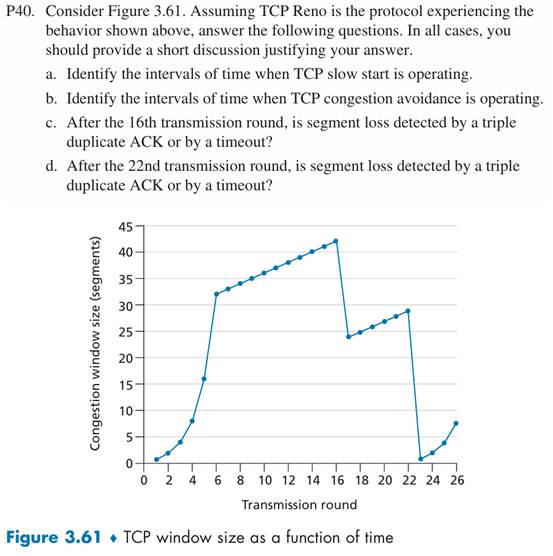
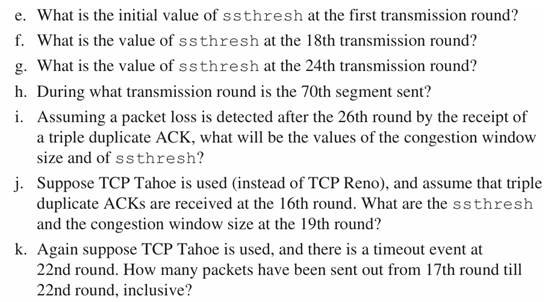
考试题目问法类似于a-g
也是5个小题(5*4),难度略低于此题,题目也有一张图,但是很难画出来,这里不给了

openEuler 是由开放原子开源基金会孵化的全场景开源操作系统项目,面向数字基础设施四大核心场景(服务器、云计算、边缘计算、嵌入式),全面支持 ARM、x86、RISC-V、loongArch、PowerPC、SW-64 等多样性计算架构
更多推荐
 9
9 0
0- 0


 已为社区贡献2条内容

所有评论(0)