/* init cache data */
	ret = regmap_cache_init(rd);
	if (ret < 0) {
		pr_info(" cache data init fail\n");
		goto err_cacheinit;
	}

	INIT_DELAYED_WORK(&rd->work, work_func);

	for (i = 0; i <= 3; i++)
		rd->block_write[i] =block_map[i];

	data = rd->props.regmap_mode & CACHE_MODE_MASK;
	if (data == CACHE_WR_THROUGH) {
		rd->regmap_ops.regmap_block_write = &cache_block_write;
		rd->regmap_ops.regmap_block_read = &scache_block_read;
	} else if (data == SY_CACHE_WR_BACK) {
		rd->regmap_ops.regmap_block_write = &asyn_cache_block_write;
		rd->regmap_ops.regmap_block_read = &cache_block_read;
	} else if (data == SY_CACHE_DISABLE) {
		rd->regmap_ops.regmap_block_write = &chip_block_write;
		rd->regmap_ops.regmap_block_read = &chip_block_read;
	}

////////////////////////////////////////////////////////////////////////////////////////////////////////////////////////////////////////////////////

delayed_work的工作比较简单:
1:初始化:
INIT_DELAYED_WORK(_work, _func);
2:启动:
schedule_delayed_work(struct delayed_work *dwork,
unsigned long delay);

以某TP驱动为例,示意图如下:
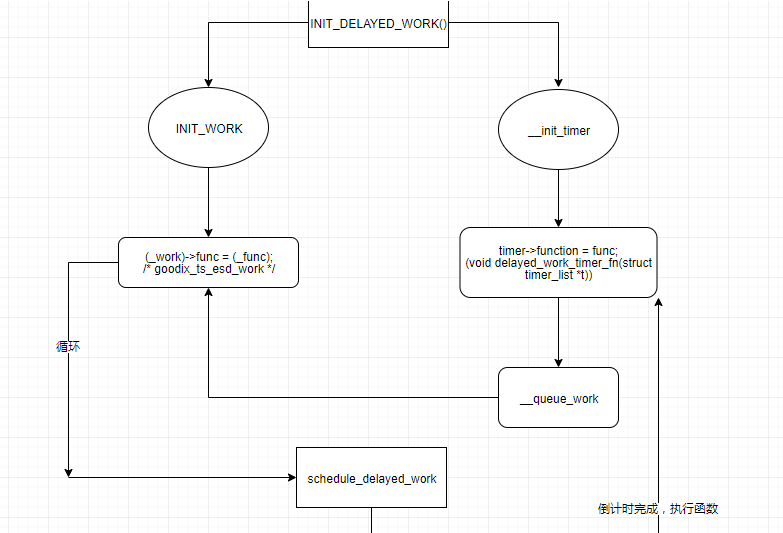


直接上代码:
1:关键结构体:

1
2
3
4
5
6
7
8
9
10
11
12
13
14
15
16
17
18
19
20
21
22
23
24
25
26
27
28
29
30
31
32
33
34
35
36
37
38
39
40
41
42
43
44
45
46
47
48
49
50
51
52
53
54
55
56
57
58
59
60
61
62
63
64
65
66
67
68
69
70
71
72
73
74
75
76
77
78
79
80
81
82

/*
 * The externally visible workqueue.  It relays the issued work items to
 * the appropriate worker_pool through its pool_workqueues.
 */
struct workqueue_struct {
    struct list_head    pwqs;       /* WR: all pwqs of this wq */
    struct list_head    list;       /* PR: list of all workqueues */

    struct mutex        mutex;      /* protects this wq */
    int         work_color; /* WQ: current work color */
    int         flush_color;    /* WQ: current flush color */
    atomic_t        nr_pwqs_to_flush; /* flush in progress */
    struct wq_flusher   *first_flusher; /* WQ: first flusher */
    struct list_head    flusher_queue;  /* WQ: flush waiters */
    struct list_head    flusher_overflow; /* WQ: flush overflow list */

    struct list_head    maydays;    /* MD: pwqs requesting rescue */
    struct worker       *rescuer;   /* I: rescue worker */

    int         nr_drainers;    /* WQ: drain in progress */
    int         saved_max_active; /* WQ: saved pwq max_active */

    struct workqueue_attrs  *unbound_attrs; /* PW: only for unbound wqs */
    struct pool_workqueue   *dfl_pwq;   /* PW: only for unbound wqs */

#ifdef CONFIG_SYSFS
    struct wq_device    *wq_dev;    /* I: for sysfs interface */
#endif
#ifdef CONFIG_LOCKDEP
    struct lockdep_map  lockdep_map;
#endif
    char            name[WQ_NAME_LEN]; /* I: workqueue name */

    /*
     * Destruction of workqueue_struct is sched-RCU protected to allow
     * walking the workqueues list without grabbing wq_pool_mutex.
     * This is used to dump all workqueues from sysrq.
     */
    struct rcu_head     rcu;

    /* hot fields used during command issue, aligned to cacheline */
    unsigned int        flags ____cacheline_aligned; /* WQ: WQ_* flags */
    struct pool_workqueue __percpu *cpu_pwqs; /* I: per-cpu pwqs */
    struct pool_workqueue __rcu *numa_pwq_tbl[]; /* PWR: unbound pwqs indexed by node */
};

typedef void (*work_func_t)(struct work_struct *work);

struct work_struct {
/*  atomic_long_t data; */
    unsigned long data;

    struct list_head entry;
    work_func_t func;
#ifdef CONFIG_LOCKDEP  /* no define in 4-19 */
    struct lockdep_map lockdep_map;
#endif
};

struct timer_list {
    /*
     * All fields that change during normal runtime grouped to the
     * same cacheline
     */
    struct hlist_node   entry;
    unsigned long       expires;
    void            (*function)(struct timer_list *);
    u32         flags;

#ifdef CONFIG_LOCKDEP
    struct lockdep_map  lockdep_map;
#endif
};

struct delayed_work {
    struct work_struct work;
    struct timer_list timer;

    /* target workqueue and CPU ->timer uses to queue ->work */
    struct workqueue_struct *wq;
    int cpu;
};

2: init DELAYED_WORK

1
2
3
4
5
6
7
8
9
10
11
12
13
14
15
16
17
18
19
20
21
22
23
24
25
26
27
28
29
30
31
32
33
34
35
36
37
38
39
40
41
42
43
44
45
46
47
48
49
50
51
52
53
54
55
56
57
58
59
60
61
62
63
64
65
66
67
68

#define __INIT_WORK(_work, _func, _onstack)             \
    do {                                \
        __init_work((_work), _onstack);  /* debug 相关 */         \
        (_work)->data = (atomic_long_t) WORK_DATA_INIT();   /* 6~36 bit 为1*/\
        INIT_LIST_HEAD(&(_work)->entry);    /* 初始化 list_head */       \
        (_work)->func = (_func);    /* goodix_ts_esd_work */            \
    } while (0)

#define INIT_WORK(_work, _func)                     \
    __INIT_WORK((_work), (_func), 0)
   
static void do_init_timer(struct timer_list *timer,
              void (*func)(struct timer_list *),
              unsigned int flags,
              const char *name, struct lock_class_key *key)
{
    timer->entry.pprev = NULL;
    timer->function = func;
    timer->flags = flags | raw_smp_processor_id();
    lockdep_init_map(&timer->lockdep_map, name, key, 0);
}

/**
 * init_timer_key - initialize a timer
 * @timer: the timer to be initialized
 * @func: timer callback function
 * @flags: timer flags
 * @name: name of the timer
 * @key: lockdep class key of the fake lock used for tracking timer
 *       sync lock dependencies
 *
 * init_timer_key() must be done to a timer prior calling *any* of the
 * other timer functions.
 */
void init_timer_key(struct timer_list *timer,
            void (*func)(struct timer_list *), unsigned int flags,
            const char *name, struct lock_class_key *key)
{
    debug_init(timer);
    do_init_timer(timer, func, flags, name, key);
}
   
#define __init_timer(_timer, _fn, _flags)               \
    init_timer_key((_timer), (_fn), (_flags), NULL, NULL)
   
#define from_timer(var, callback_timer, timer_fieldname) \
    container_of(callback_timer, typeof(*var), timer_fieldname)
   
void delayed_work_timer_fn(struct timer_list *t)
{
    struct delayed_work *dwork = from_timer(dwork, t, timer);

    /* should have been called from irqsafe timer with irq already off */
    __queue_work(dwork->cpu, dwork->wq, &dwork->work);
}

#define __INIT_DELAYED_WORK(_work, _func, _tflags)          \
    do {                                \
        INIT_WORK(&(_work)->work, (_func));         \
        __init_timer(&(_work)->timer,               \
                 delayed_work_timer_fn,         \
                 (_tflags) | TIMER_IRQSAFE);        \
    } while (0)

#define INIT_DELAYED_WORK(_work, _func)                 \
    __INIT_DELAYED_WORK(_work, _func, 0)

INIT_DELAYED_WORK(&ts_esd->esd_work, goodix_ts_esd_work);

3:start

1
2
3
4
5
6
7
8
9
10
11
12
13
14
15
16
17
18
19
20
21
22
23
24
25
26
27
28
29
30
31
32
33
34
35
36
37
38
39
40
41
42
43
44
45
46
47
48
49
50
51
52
53
54
55
56
57
58
59
60
61
62
63
64
65
66
67
68
69
70
71
72
73
74
75
76
77
78
79
80
81
82
83
84
85
86
87
88
89
90
91
92
93
94
95
96
97
98
99
100
101
102
103
104
105
106
107
108
109
110
111
112
113
114
115
116
117
118
119
120
121
122
123
124
125
126
127
128
129
130
131
132
133
134
135
136
137
138
139
140

/**
 * mod_timer - modify a timer's timeout
 * @timer: the timer to be modified
 * @expires: new timeout in jiffies
 *
 * mod_timer() is a more efficient way to update the expire field of an
 * active timer (if the timer is inactive it will be activated)
 *
 * mod_timer(timer, expires) is equivalent to:
 *
 *     del_timer(timer); timer->expires = expires; add_timer(timer);
 *
 * Note that if there are multiple unserialized concurrent users of the
 * same timer, then mod_timer() is the only safe way to modify the timeout,
 * since add_timer() cannot modify an already running timer.
 *
 * The function returns whether it has modified a pending timer or not.
 * (ie. mod_timer() of an inactive timer returns 0, mod_timer() of an
 * active timer returns 1.)
 */
int mod_timer(struct timer_list *timer, unsigned long expires)
{
    return __mod_timer(timer, expires, 0);
}
EXPORT_SYMBOL(mod_timer);

/**
 * add_timer - start a timer
 * @timer: the timer to be added
 *
 * The kernel will do a ->function(@timer) callback from the
 * timer interrupt at the ->expires point in the future. The
 * current time is 'jiffies'.
 *
 * The timer's ->expires, ->function fields must be set prior calling this
 * function.
 *
 * Timers with an ->expires field in the past will be executed in the next
 * timer tick.
 */
void add_timer(struct timer_list *timer)
{
    BUG_ON(timer_pending(timer));
    mod_timer(timer, timer->expires);
}
EXPORT_SYMBOL(add_timer);

static void __queue_delayed_work(int cpu, struct workqueue_struct *wq,
                struct delayed_work *dwork, unsigned long delay)
{
    struct timer_list *timer = &dwork->timer;
    struct work_struct *work = &dwork->work;

    WARN_ON_ONCE(!wq);
    WARN_ON_ONCE(timer->function != delayed_work_timer_fn);
    WARN_ON_ONCE(timer_pending(timer));
    WARN_ON_ONCE(!list_empty(&work->entry));

    /*
     * If @delay is 0, queue @dwork->work immediately.  This is for
     * both optimization and correctness.  The earliest @timer can
     * expire is on the closest next tick and delayed_work users depend
     * on that there's no such delay when @delay is 0.
     */
    if (!delay) {
        __queue_work(cpu, wq, &dwork->work);
        return;
    }

    dwork->wq = wq;
    dwork->cpu = cpu;
    timer->expires = jiffies + delay;

    if (unlikely(cpu != WORK_CPU_UNBOUND))
        add_timer_on(timer, cpu);
    else
        add_timer(timer);
}

/**
 * queue_delayed_work_on - queue work on specific CPU after delay
 * @cpu: CPU number to execute work on
 * @wq: workqueue to use
 * @dwork: work to queue
 * @delay: number of jiffies to wait before queueing
 *
 * Return: %false if @work was already on a queue, %true otherwise.  If
 * @delay is zero and @dwork is idle, it will be scheduled for immediate
 * execution.
 */
bool queue_delayed_work_on(int cpu, struct workqueue_struct *wq,
               struct delayed_work *dwork, unsigned long delay)
{
    struct work_struct *work = &dwork->work;
    bool ret = false;
    unsigned long flags;

    /* read the comment in __queue_work() */
    local_irq_save(flags);

    if (!test_and_set_bit(WORK_STRUCT_PENDING_BIT, work_data_bits(work))) {
        __queue_delayed_work(cpu, wq, dwork, delay);
        ret = true;
    }

    local_irq_restore(flags);
    return ret;
}
EXPORT_SYMBOL(queue_delayed_work_on);

/**
 * queue_delayed_work - queue work on a workqueue after delay
 * @wq: workqueue to use
 * @dwork: delayable work to queue
 * @delay: number of jiffies to wait before queueing
 *
 * Equivalent to queue_delayed_work_on() but tries to use the local CPU.
 */
static inline bool queue_delayed_work(struct workqueue_struct *wq,
                      struct delayed_work *dwork,
                      unsigned long delay)
{
    return queue_delayed_work_on(WORK_CPU_UNBOUND, wq, dwork, delay);
}

/**
 * schedule_delayed_work - put work task in global workqueue after delay
 * @dwork: job to be done
 * @delay: number of jiffies to wait or 0 for immediate execution
 *
 * After waiting for a given time this puts a job in the kernel-global
 * workqueue.
 */
static inline bool schedule_delayed_work(struct delayed_work *dwork,
                     unsigned long delay)
{
    return queue_delayed_work(system_wq, dwork, delay);
}

schedule_delayed_work(&ts_esd->esd_work, GOODIX_ESD_CHECK_INTERVAL * HZ);


Logo

openEuler 是由开放原子开源基金会孵化的全场景开源操作系统项目,面向数字基础设施四大核心场景(服务器、云计算、边缘计算、嵌入式),全面支持 ARM、x86、RISC-V、loongArch、PowerPC、SW-64 等多样性计算架构

更多推荐